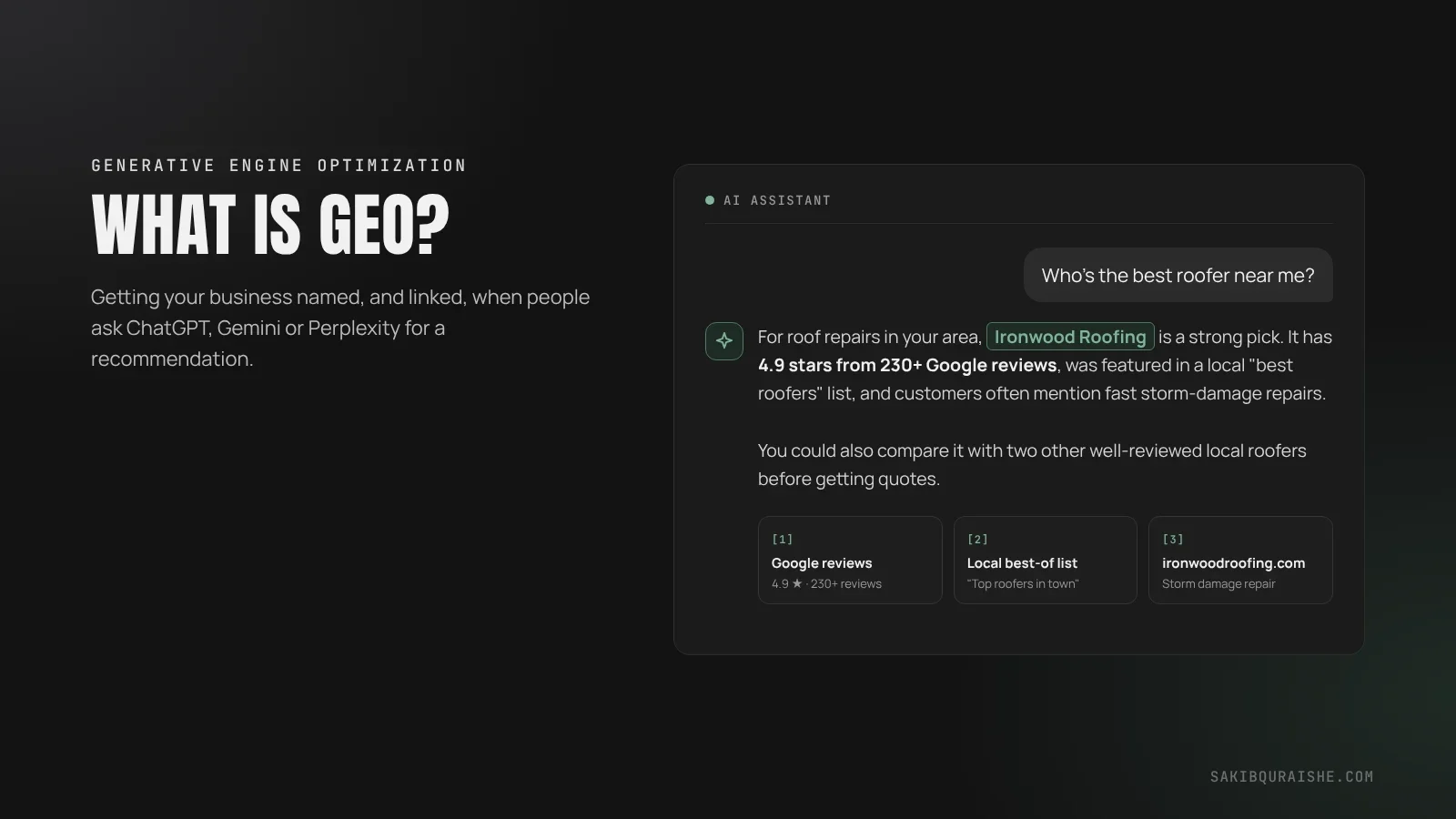
GEO, or generative engine optimization, is the work of making your business easy for AI tools like ChatGPT, Gemini, Perplexity and Google's AI Overviews to understand, trust and recommend. It builds on SEO: clear pages that answer real questions, consistent business information across the web, genuine reviews, and mentions on sites AI tools already trust.
- GEO is about being named and cited inside AI answers, not just ranked in a list of links.
- AI tools favour businesses they can clearly identify and that many trusted sources agree on.
- For local businesses, your Google Business Profile, reviews and consistent listings carry a lot of weight.
- Write pages that answer questions directly, and get mentioned on directories, review sites and local press.
- AI answers change almost every time, so track how often you appear, not your "position".
More customers now ask an AI assistant who to hire before they ever open Google Maps. I work on AI search visibility alongside local SEO for my clients, and the businesses that show up in those answers tend to be the ones that were already doing the basics well, just more consistently.
What is GEO (generative engine optimization)?
GEO (generative engine optimization) is the practice of improving how often and how accurately AI-powered search tools mention, cite and recommend your business in their answers. A "generative engine" is any tool that writes an answer instead of showing a list of links: ChatGPT, Gemini, Perplexity, Claude, Microsoft Copilot and Google's AI Overviews and AI Mode. You'll also hear AEO (answer engine optimization) and AI SEO; they describe the same goal.
How is GEO different from SEO?
GEO is different from SEO in what you're competing for. SEO earns a position in a list of results; GEO earns a place inside an answer. The foundations overlap heavily:
| SEO | GEO | |
|---|---|---|
| Goal | Rank high in a list of links | Be named or cited in the AI's answer |
| What's judged | Whole pages | Individual passages that answer a question |
| Authority signals | Mostly backlinks | Links plus unlinked mentions and reviews across the web |
| Success metric | Rankings, clicks | How often you're mentioned or cited |
| Shared basics | Crawlable site, quality content, trust signals | Same |
GEO doesn't replace SEO. AI tools that search the web live usually pull from pages that already perform well in search, so strong SEO is still the starting point.
For how local SEO itself differs from regular SEO, see local SEO vs regular SEO.
How do ChatGPT, Gemini and Perplexity choose which businesses to recommend?
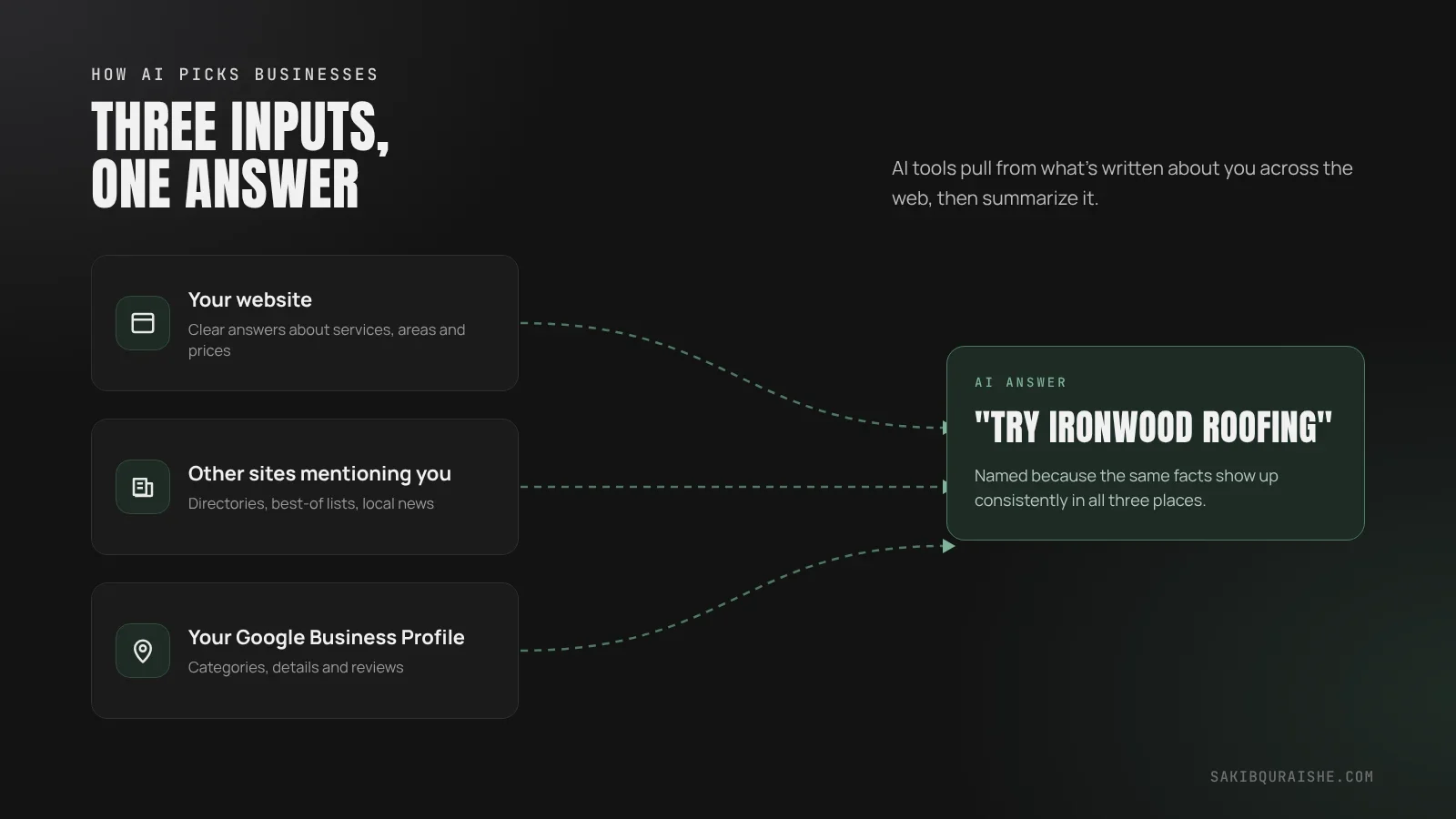
ChatGPT, Gemini and Perplexity choose which businesses to recommend by pulling information from the web and from what they learned in training, then favouring sources that are clear, consistent and backed up by other trusted sites. Three things matter most:
- Clarity. Can the AI tell exactly what you do, where and for whom?
- Consensus. Do many independent sources (directories, reviews, press, lists) say the same things about you?
- Extractability. Does your site contain short, direct answers the AI can quote?
Research backs the content side. The original GEO research paper by Aggarwal and colleagues found that optimizing content this way can increase visibility in generative engine answers by up to 40%, with results varying by topic. On the local side, Whitespark added AI visibility scoring to its 2026 Local Search Ranking Factors, and three of the top five AI visibility factors were citation factors: consistent listings on directories and data sources.
Each tool leans on different sources. Gemini and Google's AI features use Google's index and Business Profile data. ChatGPT search and Copilot are widely reported to draw partly on Bing's index. Perplexity runs its own search and shows numbered citations.
Why do local businesses have an advantage in AI search?
Local businesses have an advantage in AI search because AI tools already have rich, structured data about them: Google Business Profile details, reviews, categories, hours and listings on directories. Google's Ask Maps feature, for example, builds answers from your profile, your reviews and your website, as BrightLocal explains. That means the work you do on local SEO feeds directly into AI answers.
The most useful local actions:
- Complete your Google Business Profile, especially categories and services. See my Google Business Profile checklist.
- Earn steady, detailed reviews that mention the job and the town. See how to get more Google reviews.
- Keep your name, address and phone identical everywhere. See why NAP consistency still matters.
- Get reviews on the review sites that matter in your industry, not just Google.
That advantage comes from strong local SEO. See what is local SEO and how it works.
How do you make your website easy for AI to read and quote?
You make your website easy for AI to read and quote by writing pages that answer questions directly and by making sure AI crawlers can access them:
- Answer first. Start each page and section with a clear, complete answer in two or three sentences, then add detail.
- Use question headings that match how people ask, such as "How much does roof repair cost in Phoenix?"
- Make every section stand alone. AI tools lift passages out of context, so avoid openings like "As mentioned above".
- Use tables and lists for comparisons, prices and steps.
- Say clearly who you are, what you do and where, on your homepage, service pages and About page.
- Publish your prices or price factors. If you don't, AI tools may quote a competitor who does.
- Add structured data (LocalBusiness, Service, FAQPage) that matches what's on the page. See schema markup for AI search.
- Let AI crawlers in. Check that your robots.txt, firewall or hosting doesn't block crawlers such as OAI-SearchBot, PerplexityBot or GPTBot, and that your main content loads without needing JavaScript.
- Connect Bing Webmaster Tools, since Bing's index feeds some AI tools.
For structured data and crawl fixes, see my Technical SEO service.
How do you get other websites to mention your business?
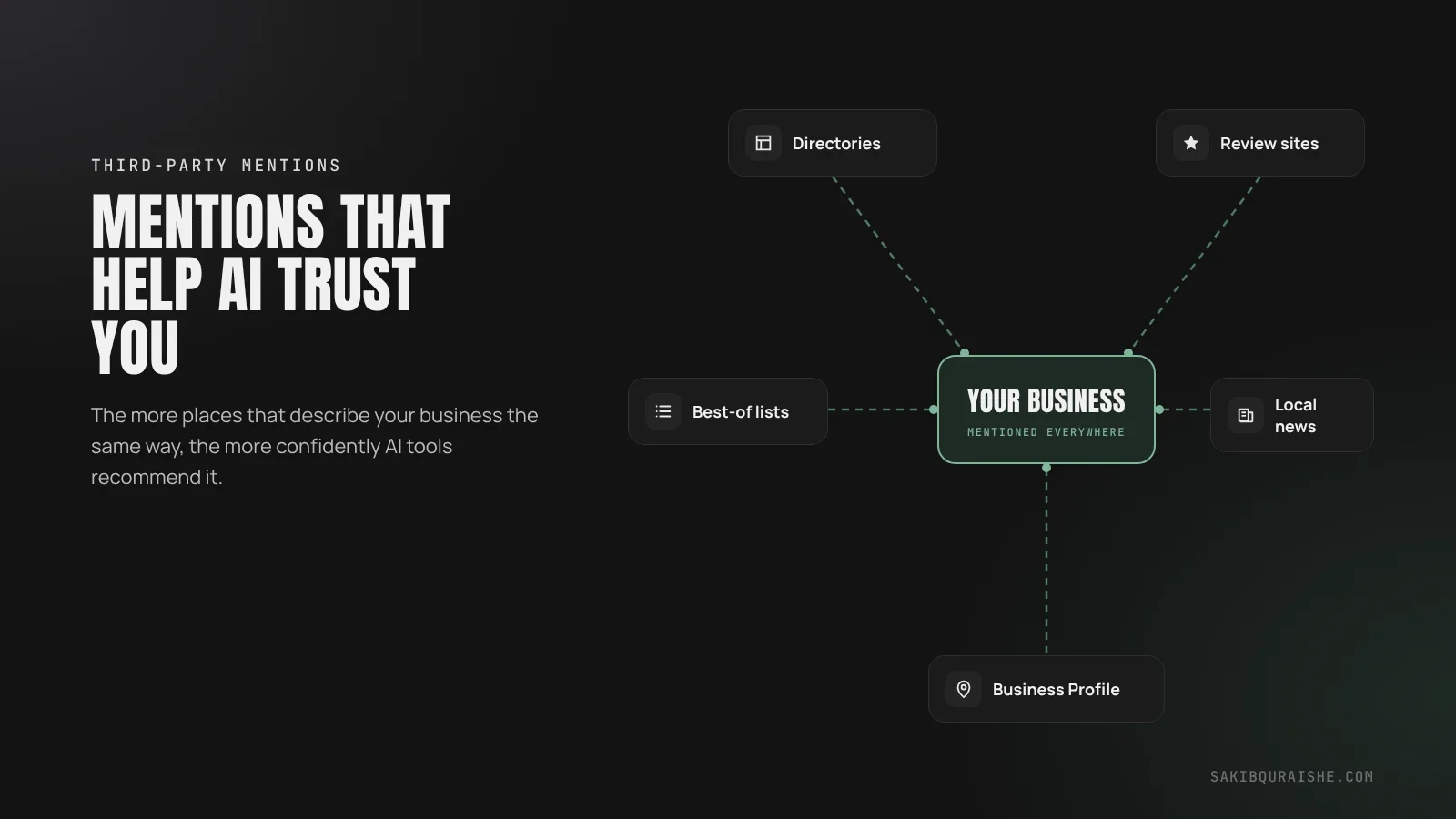
You get other websites to mention your business by showing up where AI tools look for confirmation that you're credible. Whitespark's Darren Shaw recommends:
- Getting listed on every prominent directory in your industry, with every field filled in.
- Asking to be included on expert-curated "best of" lists for your city or niche.
- Getting reviews on the review platforms that matter in your industry.
- Adding a testimonials or reviews page to your site, linked in the main menu.
- Earning local mentions through community involvement, local news and partner businesses.
If your website says you're the best roofer in town and nothing else online agrees, an AI tool has one source. If ten independent sites say it, it becomes something the AI will repeat.
Earning local mentions, citations and links is the focus of my Local Link Building service.
How do you keep your business information consistent everywhere?
You keep your business information consistent everywhere by using one exact business name, address, phone, description and list of services on your website, Google Business Profile, Bing Places, Apple Business Connect, social profiles and directories. AI tools need to be sure all those mentions refer to the same business. Mixed names, old addresses or different service lists make that harder. More in entity-based local SEO.
How do you check if ChatGPT recommends your business?
You check if ChatGPT recommends your business by asking it, and other AI tools, the questions your customers would ask, on a regular schedule. One check means very little, because AI answers vary a lot. A SparkToro study of nearly 3,000 runs of the same prompts found less than a 1 in 100 chance of getting the same list of brands twice. What was more stable was how often a brand appeared at all.
A simple monthly routine:
- Write 15–30 real customer questions, such as "best emergency plumber in Tampa" or "who repairs metal roofs near Scottsdale".
- Ask each one in ChatGPT, Gemini (or Google's AI Mode) and Perplexity, in a fresh chat each time.
- Run each question two or three times and note whether you appeared, how you were described and which sites were cited.
- Track how often you appear, such as "7 of 15 runs", not your position in the list.
- Keep the same questions every month so you can see the trend.
- Note the sites the AI cites. The ones that keep appearing are where you should be listed or mentioned.
Also ask new customers how they found you, with "ChatGPT or another AI tool" as an option. Many AI-influenced visits show up in analytics as direct traffic. More in how to track AI visibility.
How long does GEO take to work?
GEO usually takes a few weeks for technical fixes to be picked up and three to six months for consistent AI mentions to build. AI mentions are less predictable than rankings, so measure them monthly and judge the trend. On one of my roofing campaigns, search impressions grew from near zero to 2.09K over three months, driven by question-style and service searches, built on the same entity and schema work AI tools read. See the roofing case study.
What GEO mistakes should you avoid?
The GEO mistakes to avoid are the ones that make you less trustworthy, not more:
- Publishing lots of thin AI-written pages. Fewer, clearer pages that answer real questions work better.
- Blocking AI crawlers by accident through a security setting or plugin.
- Inconsistent business details across your site and listings.
- Fake or incentivized reviews. They break Google's rules and undermine trust.
- Believing anyone who guarantees ChatGPT placement. No one controls AI answers directly.
- Ignoring Google Business Profile. For local businesses, it's one of the strongest signals AI tools use.
FAQ
Is GEO the same as AEO?
GEO and AEO describe the same goal: getting your business included in AI-generated answers. AEO (answer engine optimization) is the term HubSpot and some others use; GEO is more common in research. More in AEO vs GEO vs SEO.
Does GEO replace SEO?
GEO doesn't replace SEO. AI tools lean on the same signals as Google, such as clear pages, structured data, reviews and authority, so good SEO is the foundation.
Can anyone guarantee my business will appear in ChatGPT?
No one can guarantee your business will appear in ChatGPT, because no one controls AI answers. Good GEO makes you easier to understand and trust, which raises how often you appear.
Does an llms.txt file help with GEO?
An llms.txt file may help a little and costs almost nothing to add, but it isn't an official standard and major AI tools haven't committed to using it.
Do I need a different strategy for each AI tool?
You don't need a completely different strategy for each AI tool. The same foundations work everywhere; the main differences are which index each tool searches, which is why Google Business Profile and Bing Webmaster Tools both matter.
Does GEO work for service-area businesses?
GEO works well for service-area businesses, as long as your Google Business Profile, service pages and listings clearly state the areas you serve.
Want to know what AI says about your business?
I'll test your business across ChatGPT, Gemini and Google's AI results, then show you what to fix first. See my AEO / GEO service, request a free local map audit, or read how this fits with my Local SEO service. For the broader picture, read my complete guide to AI search optimization for local businesses and how to show up in Google AI Overviews.
Sources
- Aggarwal et al.: GEO: Generative Engine Optimization (arXiv 2311.09735)
- Search Engine Land: SparkToro study on AI recommendation lists
- Whitespark: 2026 Local Search Ranking Factors
- BrightLocal: Google Business Profile Q&A and Ask Maps
- Your roofing case study and AEO / GEO service page (2.09K impressions in three months; weeks for fixes, 3–6 months for mentions)
- Also read: Serenique Tech, Passionfruit, Imagentia, Equinet Academy, Semly, Comexland, Solutech, AuraStudio.