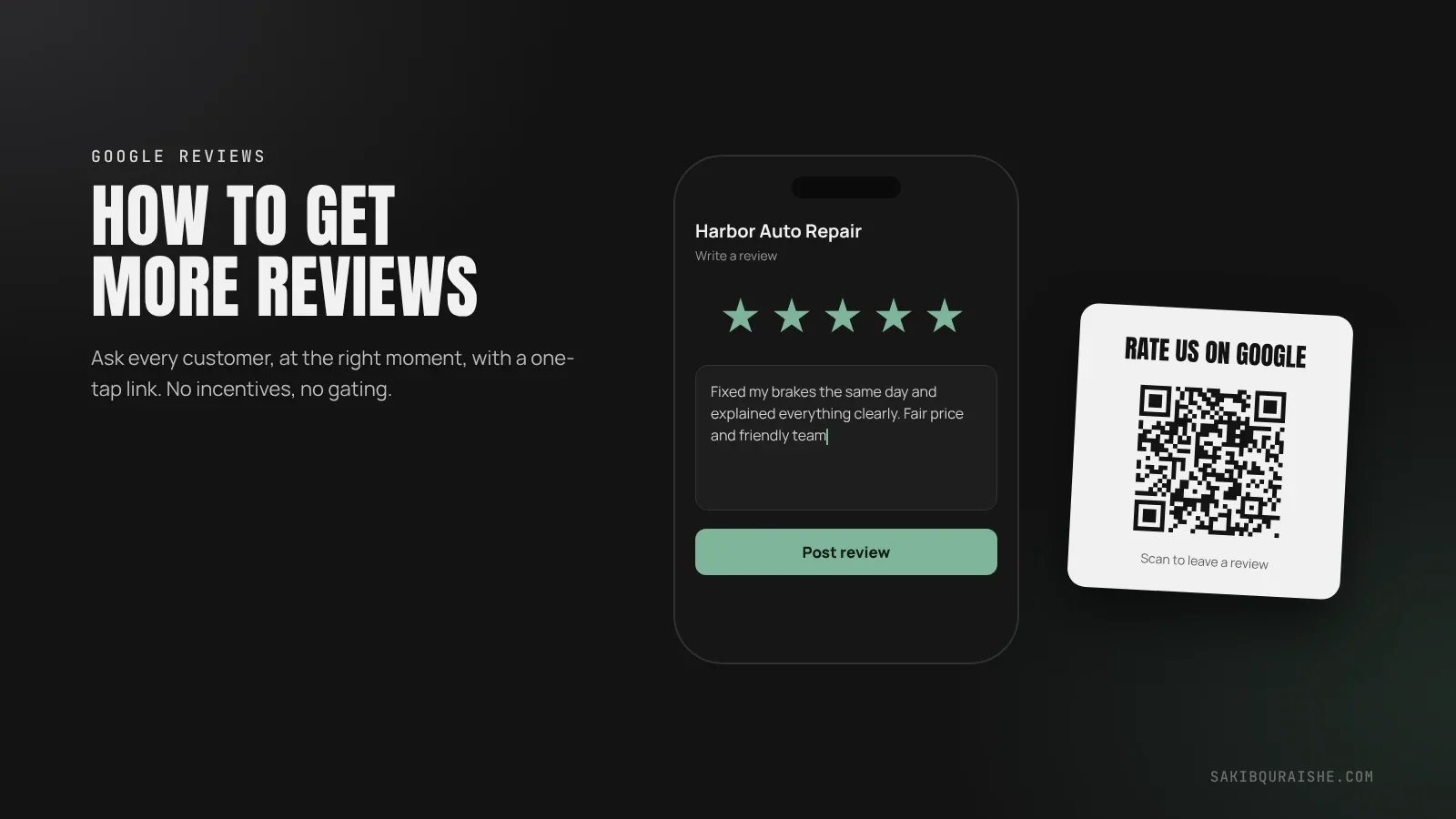
You get more Google reviews by asking every customer, at the same moment, with a one-tap review link, and by making it a routine rather than a one-off campaign. Google allows you to ask. What it bans is offering anything in return, asking only happy customers, or writing reviews yourself. A steady flow of genuine reviews also helps your Maps rankings.
- 97% of US consumers read reviews for local businesses, and 74% only consider reviews from the last three months.
- Ask every customer the same way, right after the job, with your direct review link.
- Never offer discounts or gifts for reviews, and never filter out unhappy customers.
- Steady reviews every month beat a burst followed by silence, for customers and for rankings.
- Reply to every review; 89% of consumers expect it.
Most businesses don't have a review problem; they have an asking problem. They do good work and simply never ask in a consistent way. The system below fixes that without risking your profile.
Why do Google reviews matter so much?
Google reviews matter so much because they affect both who chooses you and where you rank. BrightLocal's 2026 Local Consumer Review Survey of 1,002 US adults found that 97% read reviews for local businesses, 47% won't use a business with fewer than 20 reviews, and 31% will only use one rated 4.5 stars or higher.
For rankings, reviews are one of the strongest signals you control. In Whitespark's 2026 Local Search Ranking Factors survey, four review factors made the top 15 for local pack rankings: a high star rating (#6), the number of reviews with text (#9), how recent they are (#11) and a steady flow over time (#14).
Reviews are one of the core parts of local SEO. See what is local SEO and how it works.
More review data in local SEO statistics for 2026.
What does Google allow when asking for reviews?
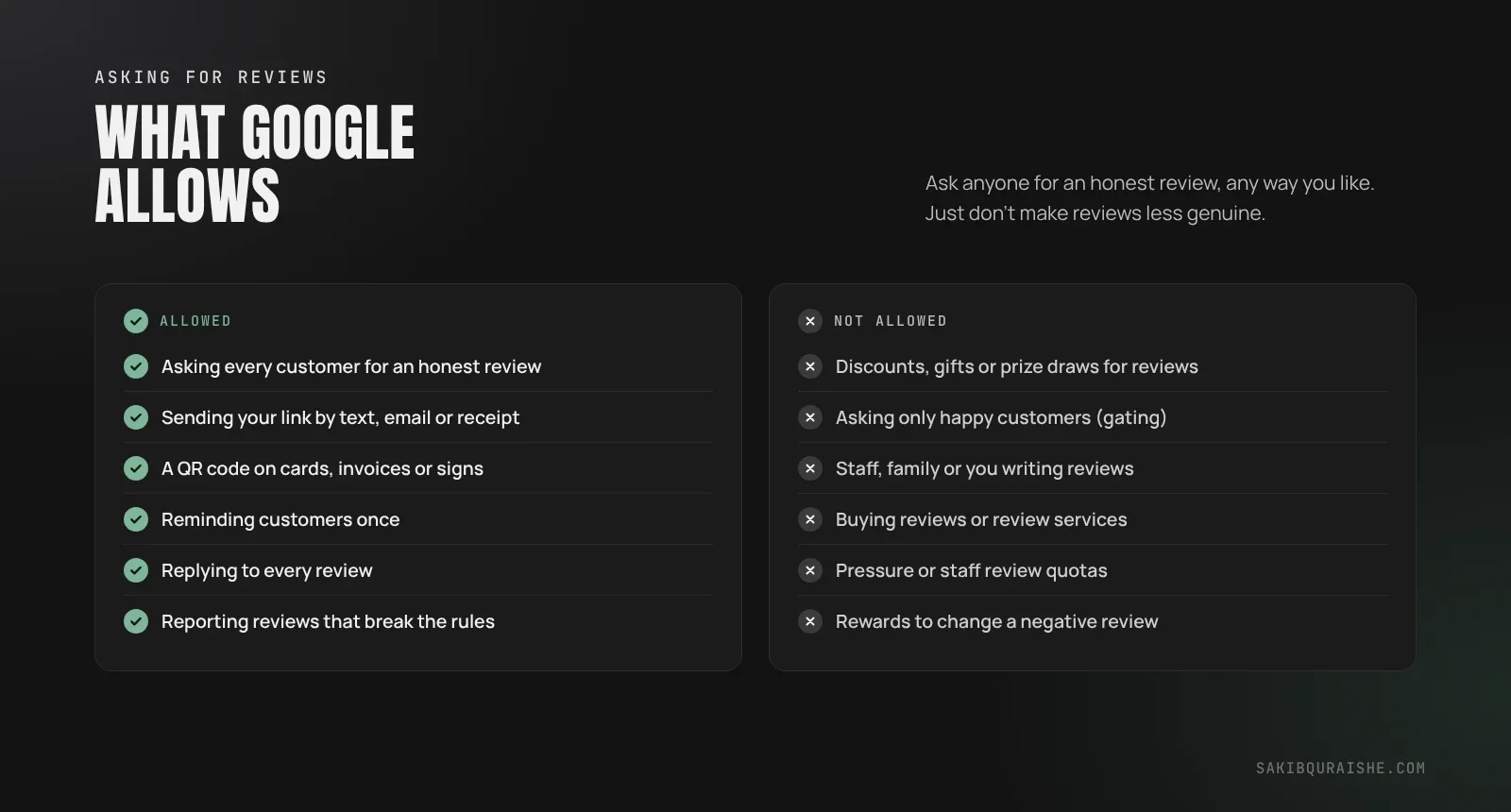
Google allows you to ask any customer for an honest review, by any channel. What it doesn't allow is anything that makes reviews less genuine:
| Allowed | Not allowed |
|---|---|
| Asking every customer for an honest review | Offering discounts, gifts, prize draws or credit for a review |
| Sending your review link by text, email or receipt | Asking only happy customers (review gating) |
| Printing a QR code on cards, invoices or signs | Staff, family or you writing reviews |
| Reminding customers once | Buying reviews or using review services |
| Replying to every review | Pressuring customers or setting staff review quotas |
| Reporting reviews that break Google's rules | Asking customers to change or remove a negative review for a reward |
In the US, the FTC's rule on fake reviews also bans fake and undisclosed insider reviews, so the risk goes beyond losing your Google reviews.
How do you get your Google review link and QR code?
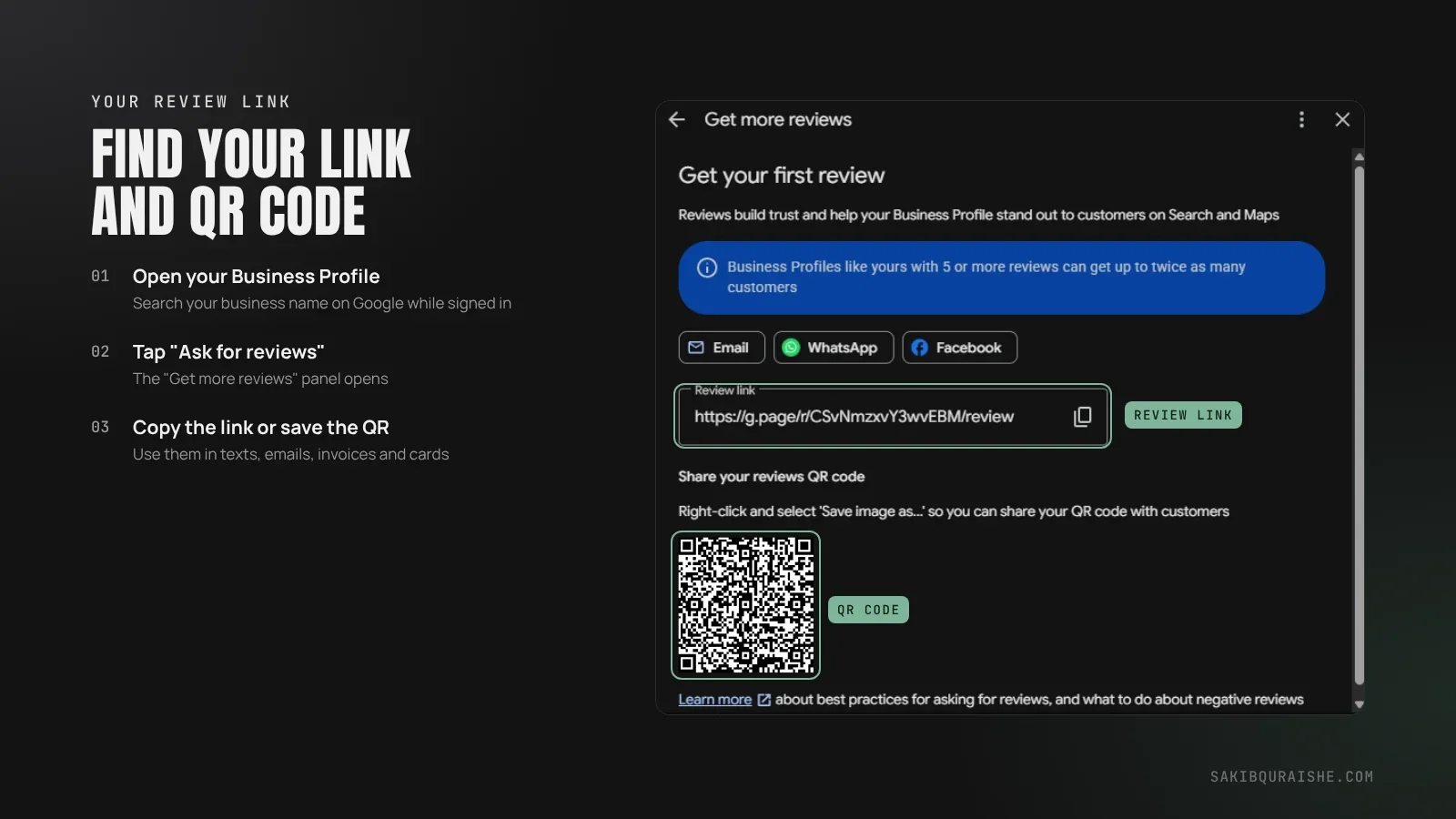
You get your Google review link and QR code from your Business Profile. Search your business name on Google while signed in, open your profile tools, and choose "Ask for reviews" (sometimes shown as "Get more reviews"). You can copy the link or download a QR code. Google's help page on getting reviews explains the steps and notes that customers need a Google account to post, though it doesn't have to be Gmail.
Put the link everywhere a customer already looks: texts, emails, invoices, receipts, your email signature and the thank-you page on your website. Put the QR code on business cards, counter signs and job completion sheets.
When is the best time to ask for a review?
The best time to ask for a review is right after the customer has seen the value of your work, while it's fresh. The exact moment depends on your business:
| Business type | Best moment to ask |
|---|---|
| Home services (plumbers, roofers, electricians) | When the job is finished and the customer has seen the result |
| Clinics and dentists | At checkout, or by text the same day |
| Restaurants and cafes | When the bill arrives, or with the receipt |
| Retail | At the counter, or in the order confirmation |
| Professional services | When a matter closes or a milestone is delivered |
If you ask by text or email, send it the same day. Requests sent a week later get far fewer responses because the experience has faded.
What should you say when asking for a review?
You should say something short, personal and honest, with the link included. Ask for an honest review, not a 5-star one. A few scripts you can adapt:
In person: "Thanks for having us. If you were happy with the work, would you mind leaving us an honest Google review? It really helps a small business like ours. I'll text you the link now."
Text message: "Hi [name], thanks for choosing [business] today. If you have a minute, we'd love an honest review on Google: [link]. Thanks, [your name]."
Email: Subject: "How did we do?" Body: "Hi [name], thanks for trusting us with [job]. Would you share your experience on Google? It takes about a minute: [link]. If anything wasn't right, reply here and I'll fix it."
The last line of the email is fine because everyone still gets the Google link. What's not fine is sending only happy customers to Google and unhappy ones to a private form.
How do you build a system that keeps reviews coming?
You build a system that keeps reviews coming by turning the ask into a fixed step in your workflow, so it happens whether you remember or not:
- One link, everywhere. Use your Google review link in every channel.
- One moment. Decide exactly when the ask happens (for example, "when the invoice is sent").
- One owner. Make one person responsible, or automate it through your booking, CRM or invoicing software.
- One reminder. Follow up once, two or three days later, then stop.
- One number to watch. Track new reviews per month, not your total.
A steady flow matters because Google and customers both look at recency. Sterling Sky's research, cited by Semrush, found that a business getting a few new reviews each month can outperform one that collected many reviews long ago and then went quiet.
How do you get more detailed reviews with photos?
You get more detailed reviews by asking customers to mention what you did, not what words to use. "Would you mention the job we did for you?" produces reviews like "fixed our burst pipe in Tampa within an hour", which help other customers and include natural service and location words. Keywords in reviews ranked #36 and reviews with photos ranked #43 in Whitespark's survey, so it's worth asking customers to add a photo of the finished work if they're happy to.
Don't script the review text itself. Reviews that all sound the same look fake to customers and to Google.
Should you reply to every Google review?
You should reply to every Google review, positive and negative. BrightLocal's 2026 consumer survey found 89% of consumers expect owners to respond, 80% are likely to use a business that responds to all its reviews, and 50% are put off by generic, templated replies. Keep replies short, specific and human, and never share private details. More in how to respond to Google reviews.
What should you do about fake or unfair reviews?
You should report fake or unfair reviews that break Google's policies, such as spam, conflicts of interest or offensive content, using the flag option on the review. Google won't remove an honest negative review just because it's negative. In that case, a calm, factual reply is your best tool, because future customers read it too.
How many Google reviews do you need?
You need at least 20 Google reviews to clear the bar many customers set, since 47% won't use a business with fewer, according to BrightLocal's 2026 survey. To compete in the map pack, look at the businesses in the top three for your main search and aim to match their review count over time, with a steadier monthly flow than theirs. For clinics, see my review strategy for clinics.
Do reviews on other sites matter?
Reviews on other sites matter, especially for AI search. Google's Ask Maps feature builds answers from your profile and reviews, and Whitespark's Darren Shaw recommends getting reviews on the review sites that matter in your industry, not just Google, to improve visibility in AI answers. More in GEO explained.
FAQ
Can I offer a discount for a Google review?
You can't offer a discount for a Google review. Google treats any incentive, even for an honest review, as fake and misleading content.
Can my staff ask customers for reviews by name?
Your staff can ask customers for reviews, but avoid asking customers to name a specific employee or setting staff review quotas, which pressure customers and can look manipulative.
Can I remove a bad Google review?
You can't remove a bad Google review yourself. You can report it if it breaks Google's policies; otherwise, reply calmly and professionally.
Do Google reviews help my Maps rankings?
Google reviews help your Maps rankings. Google says review count and score factor into local ranking, and recency and steady flow matter too.
Can customers leave a review without a Gmail account?
Customers can leave a review without a Gmail account. They need a Google account, which can be created with any email address.
How often should I ask for reviews?
You should ask every customer, every time, at the same point in your process. Consistency is what keeps reviews arriving every month.
Want help building your review system?
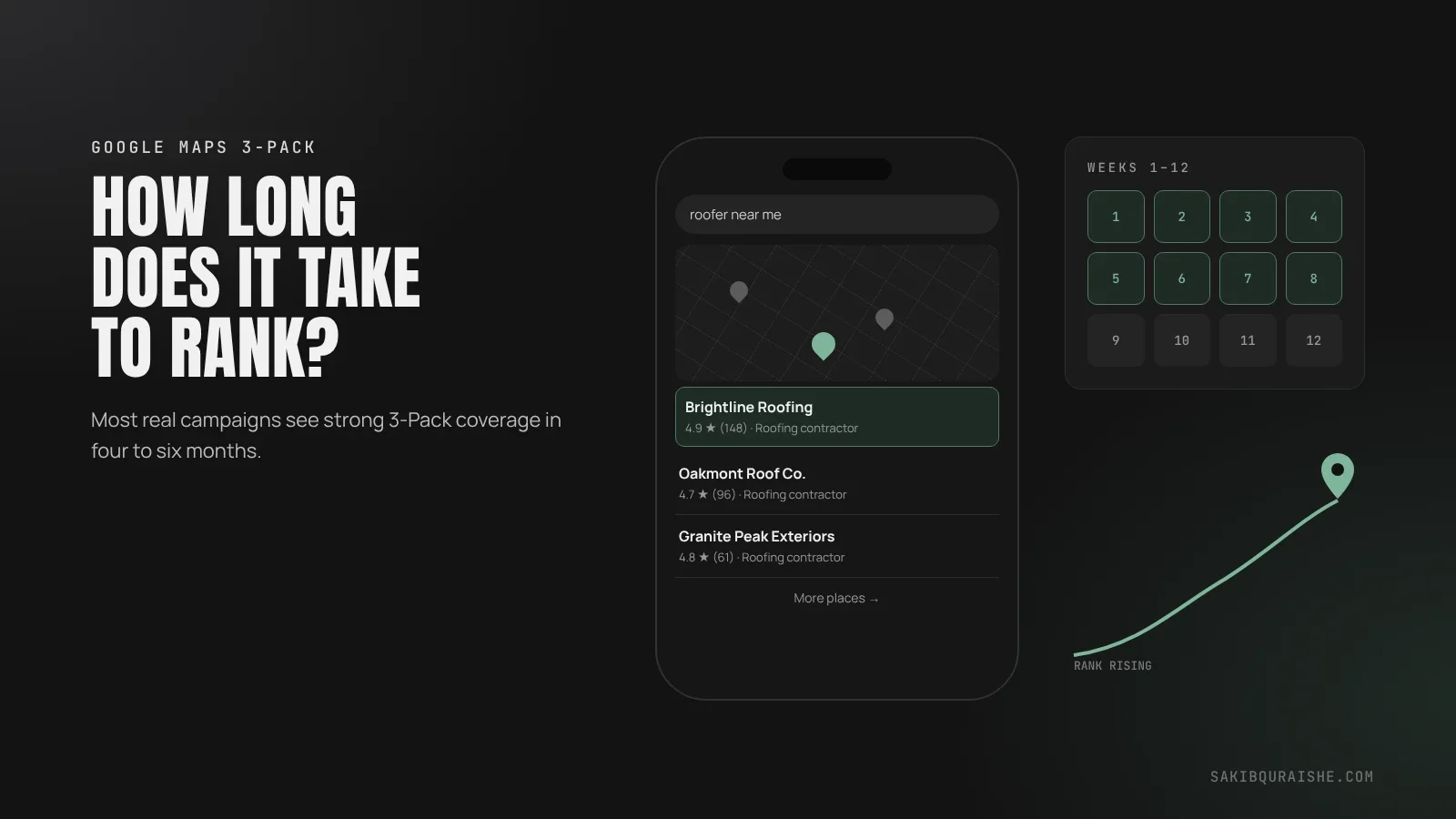
I set up review systems as part of every Local SEO campaign, alongside the rest of the profile work. Request a free local map audit, or see my Local SEO service. For the full profile picture, read my Google Business Profile checklist and how long it takes to rank in the Google Maps 3-Pack.
A review request process and replies to every review are part of my Google Business Profile optimization service.
Sources
- Google: Get reviews on your Business Profile
- BrightLocal: Local Consumer Review Survey 2026
- Whitespark: 2026 Local Search Ranking Factors
- Sterling Sky review velocity research, cited via Semrush (open the Sterling Sky study before publishing)
- Also read: Localsearch, ReplyClerk, Gulf Signal, Semrush, Celtic River, Apzom. Blocked: Uptown Media Services.