You calculate the ROI of local SEO by taking the extra profit local SEO brought in, subtracting what you spent on it, and dividing by what you spent. Then multiply by 100 to get a percentage. The formula is: ROI = (extra profit − local SEO cost) ÷ local SEO cost × 100. To get "extra profit", count only the new calls and leads that came from local search, work out how many became paying jobs, and multiply by the profit you make on each job. This guide walks through it with one example business, start to finish.
- Formula: ROI = (extra profit − cost) ÷ cost × 100.
- You need five numbers: your monthly cost, your extra calls or leads, how many are real leads, how many you win, and your profit per job.
- Count extra leads only, not every call you get, and use profit, not revenue.
- Expect a slow start. In the example below, local SEO loses money for the first few months, pays for itself by month 9, and earns a 50% ROI in year one and 188% in year two.
- Track calls, because most local leads phone you. Use call tracking and your Google Business Profile performance data.
What is the ROI of local SEO?
The ROI (return on investment) of local SEO is how much profit local SEO earns compared with what it costs, shown as a percentage. An ROI of 0% means local SEO paid for itself exactly. An ROI of 100% means it earned back its cost plus the same amount again in profit.
Here's what different results mean in plain money terms, for every $1,000 spent:
| ROI | Extra profit earned | What it means |
|---|---|---|
| −50% | $500 | Lost money: earned back only half the cost |
| 0% | $1,000 | Broke even: earned back the cost, nothing more |
| 50% | $1,500 | Earned back the cost plus $500 |
| 100% | $2,000 | Earned back the cost plus $1,000 |
| 300% | $4,000 | Earned back the cost plus $3,000 |
You'll sometimes see this described as "$4 back for every $1 spent". That's the same 300% result described a different way: $4 of profit came back, which is the $1 you spent plus $3 more. This guide sticks to the ROI percentage so the numbers don't get mixed up.
If you're still deciding whether local SEO is right for you, see what local SEO is and how it works.
What numbers do you need to calculate it?
You need five numbers to calculate local SEO ROI. Each one is simple, and most you already know or can find:
| Number | What it means | Where to find it |
|---|---|---|
| 1. Local SEO cost | Everything you spend on local SEO in a month: agency or freelancer fee, tools, call tracking, and the value of your own time | Invoices and subscriptions |
| 2. Extra calls or leads | The new calls, forms and bookings from local search, above what you got before you started | Call tracking, Google Business Profile performance, analytics |
| 3. Lead rate | The share of those calls that are real job enquiries (not spam, wrong numbers or existing customers) | Listen to calls or check your call log for a month |
| 4. Close rate | The share of real leads that become paying jobs | Your quotes or job booking records |
| 5. Gross profit per job | What you keep from an average job after materials and labor, before overheads like rent | Your accounts or a quick estimate from your accountant |
Two terms worth getting right:
- Extra leads means only the new ones. If you got 20 calls a month from Google before you started, those 20 don't count as local SEO results.
- Gross profit per job is the average job price minus the direct cost of doing the job. A $600 job that costs $300 in parts and labor has a gross profit of $300.
If you're not sure what a local SEO service should cost you, see local SEO pricing.
How do you calculate local SEO ROI step by step?
You calculate local SEO ROI in five steps. Here they are with one example business. These are example numbers, not a promise of results.
Meet Brightline Plumbing (a made-up business):
- Pays $1,200 a month for local SEO, plus $50 for call tracking: $1,250 a month, or $15,000 a year.
- Got 20 calls a month from Google before starting.
- 75% of calls are real job enquiries (lead rate).
- Wins 40% of real enquiries (close rate).
- Average job is $600, with $300 gross profit per job.
Step 1: Add up your total cost
Add everything you spend on local SEO over the period you're measuring. For Brightline, that's $1,250 a month, or $15,000 for the first year. If you or your staff spend time on it (asking for reviews, posting updates), add a fair hourly value for that time too.
Step 2: Count only the extra calls and leads
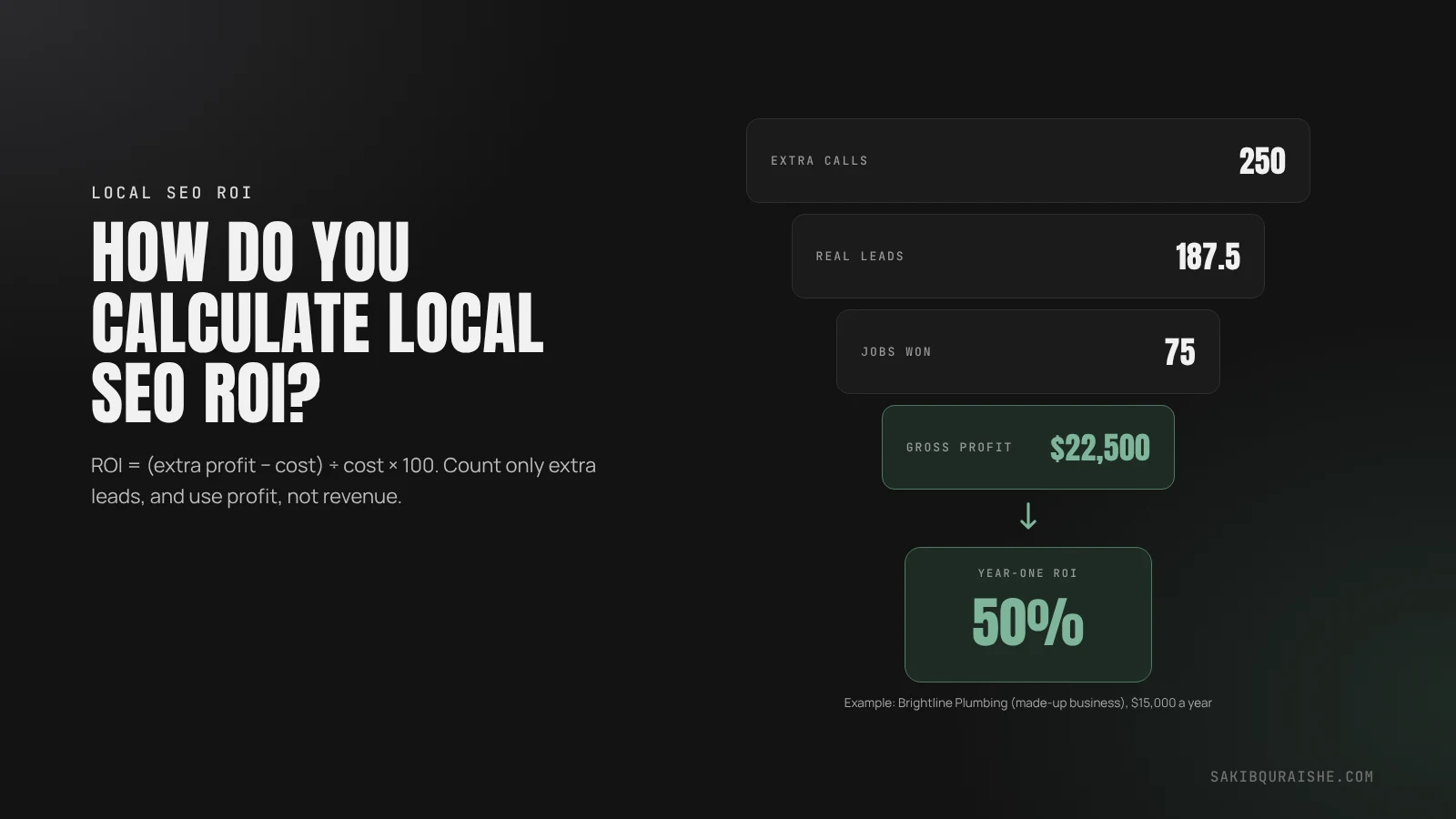
Brightline started at 20 calls a month. In this example, calls grow slowly at first and then climb. Over the first 12 months, Brightline gets 250 extra calls above its starting 20 a month.
Step 3: Turn extra calls into real leads, then into jobs
- Real leads: 250 extra calls × 75% lead rate = 187.5 real leads
- Jobs won: 187.5 leads × 40% close rate = 75 extra jobs
A shortcut: 75% × 40% = 0.3, so every extra call is worth about 0.3 jobs for Brightline.
Step 4: Turn jobs into gross profit
75 extra jobs × $300 gross profit per job = $22,500 extra gross profit in year one.
Step 5: Apply the ROI formula
ROI = (extra profit − cost) ÷ cost × 100
ROI = (22,500 − 15,000) ÷ 15,000 × 100 = 50%
So in year one, local SEO earned back Brightline's $15,000 plus another $7,500.
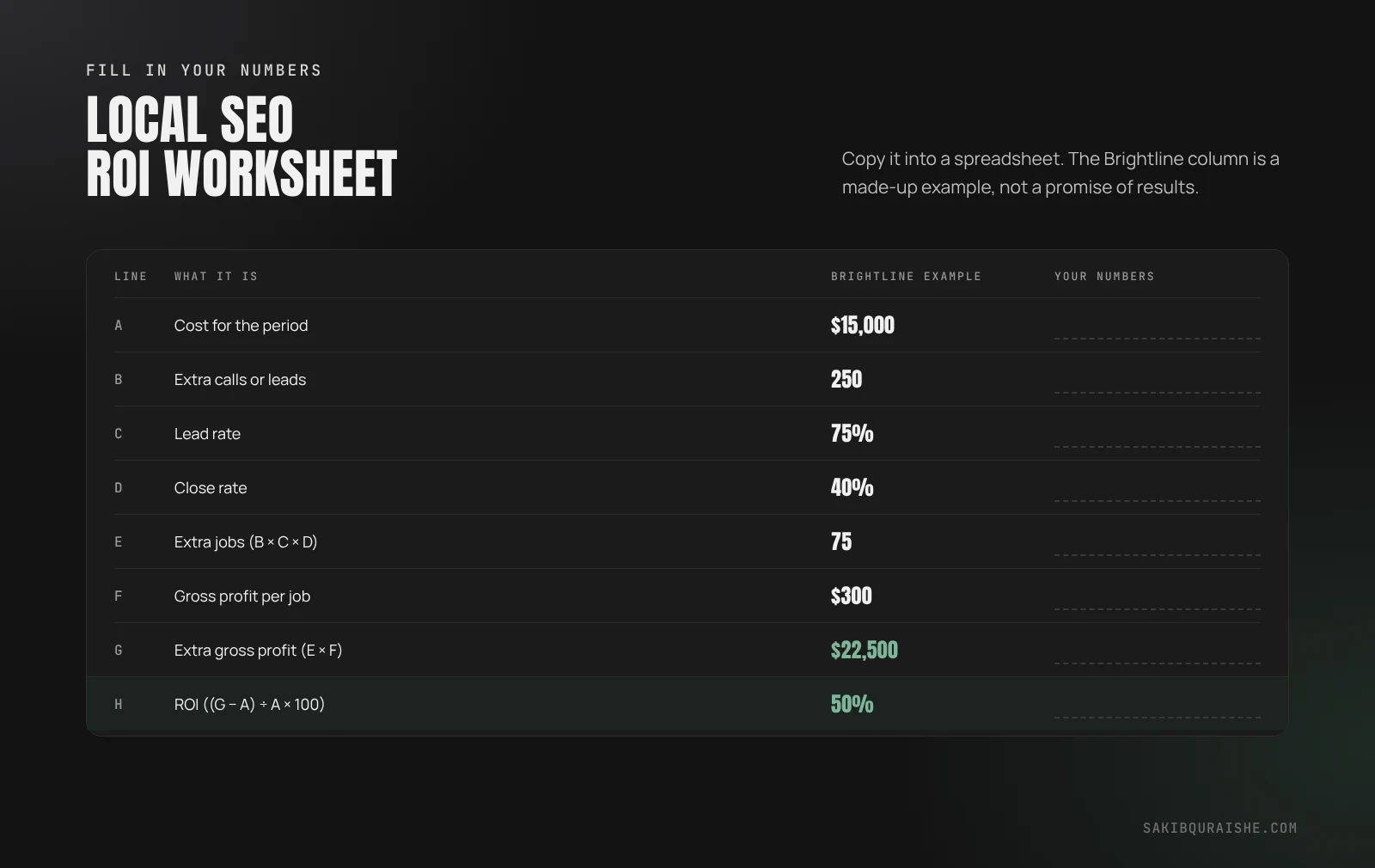
Your worksheet
Copy this table and fill in your own numbers:
| Line | Brightline example | Your numbers |
|---|---|---|
| A. Cost for the period | $15,000 | |
| B. Extra calls or leads | 250 | |
| C. Lead rate | 75% | |
| D. Close rate | 40% | |
| E. Extra jobs (B × C × D) | 75 | |
| F. Gross profit per job | $300 | |
| G. Extra gross profit (E × F) | $22,500 | |
| H. ROI ((G − A) ÷ A × 100) | 50% |
How many extra jobs do you need to break even?
You need enough extra jobs each month to cover your monthly cost. Divide your monthly cost by your gross profit per job:
Break-even jobs a month = monthly cost ÷ gross profit per job
For Brightline: 1,250 ÷ 300 = 4.2, so it needs just over 4 extra jobs a month to cover the cost. At 0.3 jobs per call, that's about 14 extra calls a month (4.2 ÷ 0.3).
This is the quickest way to judge whether local SEO makes sense for you. A roofer who makes $4,000 profit on a job needs one extra job every few months. A café that makes $8 profit per order needs hundreds of extra orders a month.
What is the payback period?
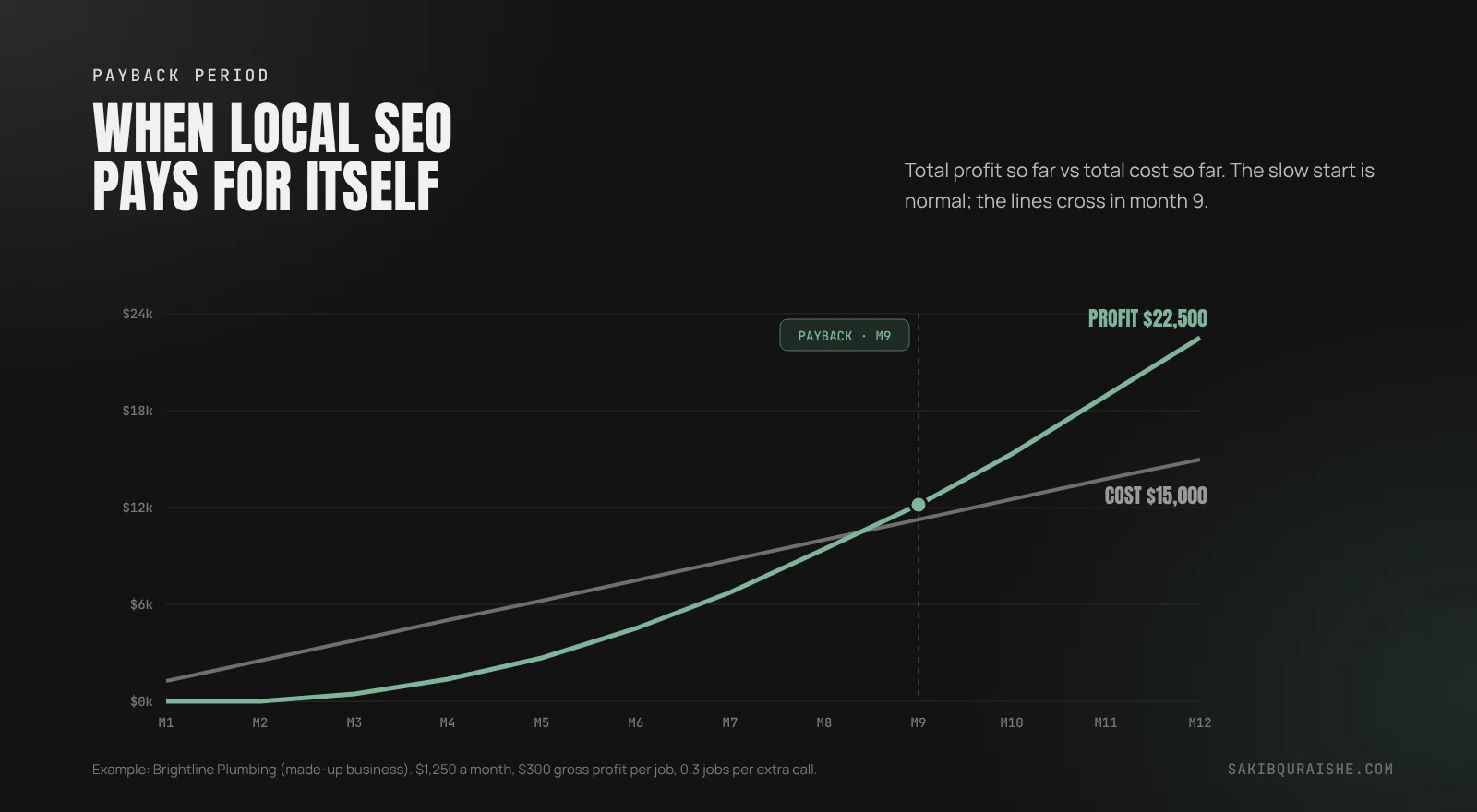
The payback period is how many months it takes for total extra profit to catch up with total cost. Because local SEO starts slowly, it usually loses money for the first few months. Here's Brightline's first year:
| Month | Extra calls | Extra profit that month | Total profit so far | Total cost so far |
|---|---|---|---|---|
| 1 | 0 | $0 | $0 | $1,250 |
| 2 | 0 | $0 | $0 | $2,500 |
| 3 | 5 | $450 | $450 | $3,750 |
| 4 | 10 | $900 | $1,350 | $5,000 |
| 5 | 15 | $1,350 | $2,700 | $6,250 |
| 6 | 20 | $1,800 | $4,500 | $7,500 |
| 7 | 25 | $2,250 | $6,750 | $8,750 |
| 8 | 30 | $2,700 | $9,450 | $10,000 |
| 9 | 30 | $2,700 | $12,150 | $11,250 |
| 10 | 35 | $3,150 | $15,300 | $12,500 |
| 11 | 40 | $3,600 | $18,900 | $13,750 |
| 12 | 40 | $3,600 | $22,500 | $15,000 |
Brightline covers its monthly cost from month 5, and its total profit passes its total cost in month 9. That's its payback period.
Should you use revenue or profit?
You should use profit, because revenue makes ROI look much bigger than it really is. Brightline's 75 extra jobs brought in $45,000 of revenue but only $22,500 of gross profit:
| Calculated with | Year-one figure | ROI |
|---|---|---|
| Revenue | $45,000 | 200% |
| Gross profit | $22,500 | 50% |
Both use the same formula. The revenue version ignores what each job costs you to do, so it can make a loss-making campaign look profitable. Use gross profit for decisions. If someone shows you a revenue-based ROI, ask them to redo it with profit.
When should you use customer lifetime value?
Use customer lifetime value when customers come back. Lifetime value is the total gross profit one customer brings you over the whole time they stay with you.
- Use it for dentists, vets, gyms, salons, accountants and other businesses with repeat visits. A new dental patient might be worth several years of check-ups, not just one visit.
- Be careful for one-off jobs like roofing or emergency repairs, where many customers never come back.
If you use lifetime value, use your real repeat rate, not a hopeful one, and say so when you share the number.
How do you track calls and leads from local SEO?
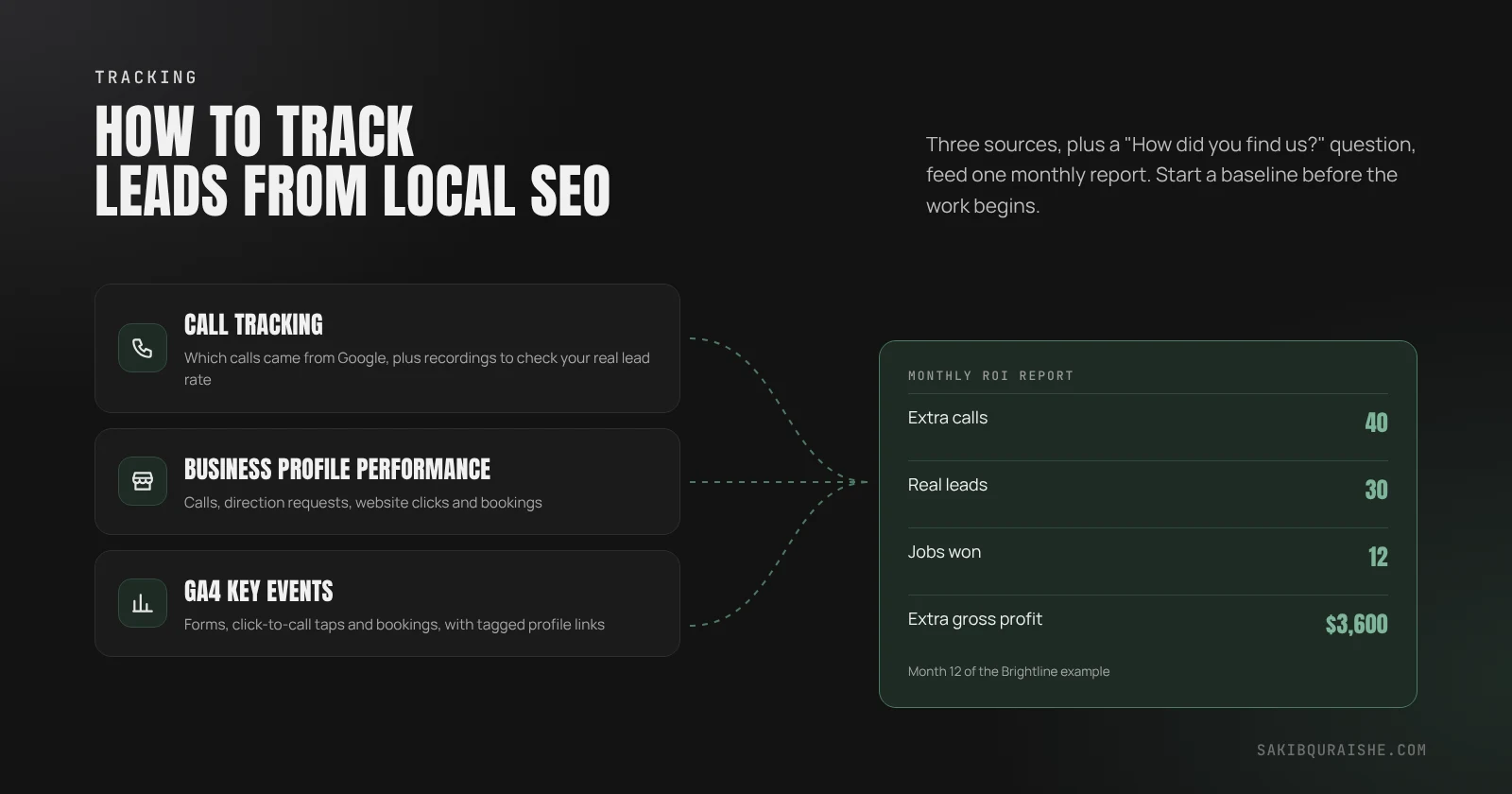
You track calls and leads from local SEO with three tools working together: call tracking, your Google Business Profile performance data and your website analytics.
1. Call tracking
Call tracking gives each source its own phone number, so you can see which calls came from Google. Many local SEOs put the tracking number as the primary number on the Business Profile and keep the main business number as an additional number, so your main number still matches your website and listings. Record calls (where the law allows and callers are told) so you can measure your real lead rate.
2. Google Business Profile performance
Your Business Profile shows calls, direction requests, website clicks and bookings from your profile each month. It's a free, quick check on whether visibility is turning into actions. See how to read your Business Profile performance data.
3. Website analytics
In Google Analytics 4, set form submissions, click-to-call taps and bookings as key events (what GA4 used to call conversions). Add tracking tags to your Business Profile website link so visits from your profile are counted separately from other Google traffic, asSemrush's SEO ROI guide explains for lead-generation sites.
4. Ask every new customer
A simple "How did you find us?" question at booking catches what tools miss, like someone who saw you in the map pack and then drove past your sign.
Tracking also needs a starting point. Record your calls, forms and Business Profile actions for at least one month before local SEO starts, so you have a baseline to measure extra leads against. For more on what to track, see local SEO KPIs and how to measure local SEO results.
What mistakes make local SEO ROI look wrong?
The biggest mistakes are counting all your calls instead of extra ones, using revenue instead of profit, and judging ROI on one good month. Here's how much they change Brightline's result:
| Calculation | What it counts | ROI |
|---|---|---|
| The shortcut | All 60 calls in month 12, revenue, month 12 only | 764% |
| Extra calls only | 40 extra calls in month 12, revenue, month 12 only | 476% |
| Extra calls and profit | 40 extra calls in month 12, profit, month 12 only | 188% |
| The full first year | 250 extra calls, profit, all 12 months | 50% |
Every line uses the same business and the same formula. Only the shortcuts change. The full-year profit figure is the one to make decisions with.
Other common mistakes:
- Forgetting some costs, like tools, call tracking or your own time.
- Ignoring the lead rate. Spam calls and existing customers aren't new leads.
- Judging too early. A negative ROI in month 3 is normal; see the payback table above.
- Giving SEO credit for everything. If you also started running ads or a new van wrap, some new calls came from those.
- Not checking your own math. Two of the top-ranking ROI guides I checked for this post publish worked examples where the final percentage doesn't match their own numbers. Always recalculate.
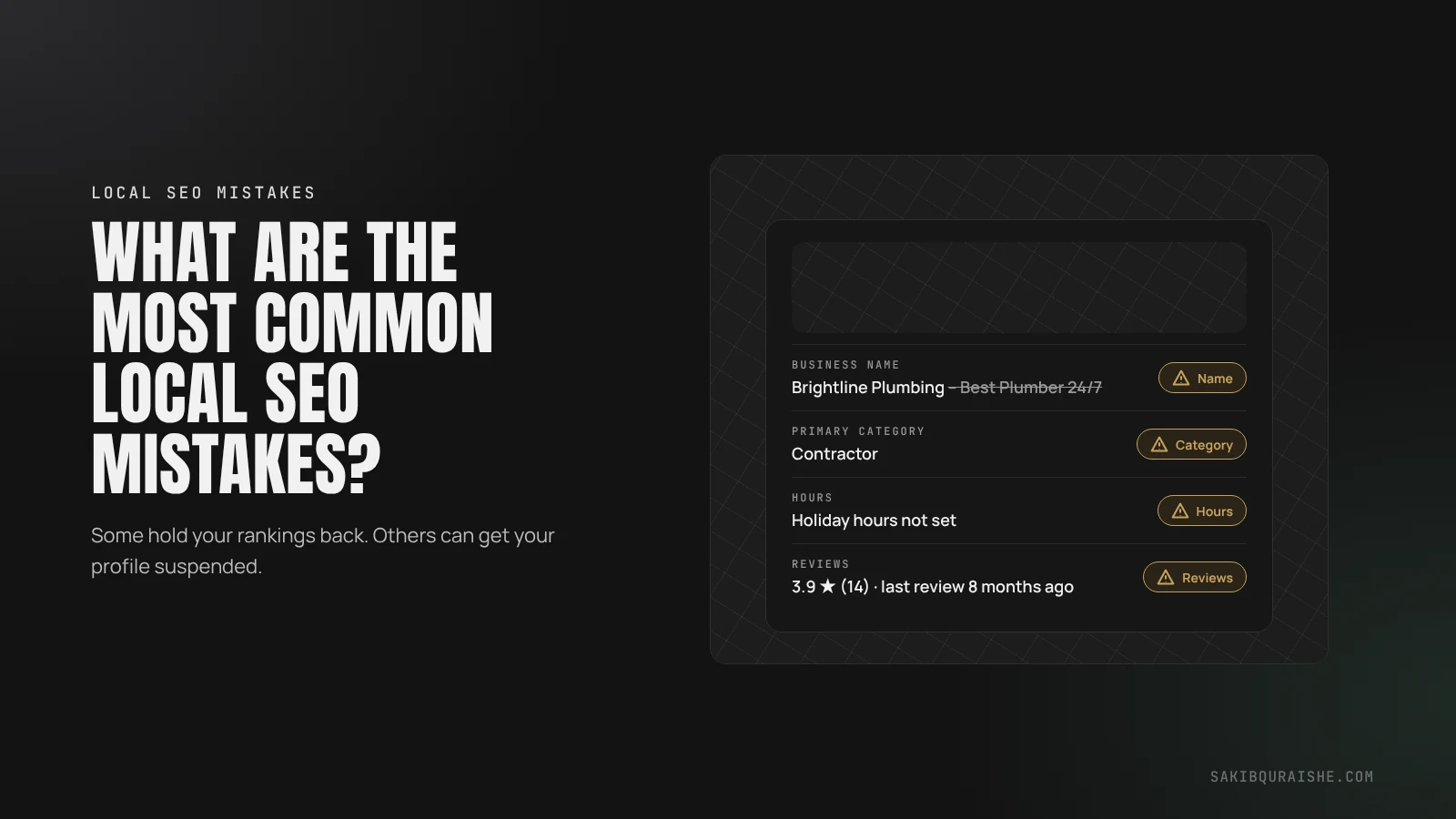
For mistakes in the local SEO work itself, see the most common local SEO mistakes.
How long does local SEO take to pay off?
Local SEO usually takes several months to pay off, because results build gradually. Most local businesses see clear map pack movement in 8 to 12 weeks, and crowded markets can take three to six months (Local SEO service timeline). Google's own guidance on hiring an SEO says it can take "four months to a year" for improvements to take effect, as quoted in Semrush's guide.
Payback usually comes after that, because you need several good months to make up for the slow start. In the Brightline example, payback came in month 9.
Year two is where local SEO tends to pay best. If Brightline keeps its 40 extra calls a month and its cost stays the same:
- Extra calls: 40 × 12 = 480
- Extra jobs: 480 × 0.3 = 144
- Extra gross profit: 144 × $300 = $43,200
- ROI: (43,200 − 15,000) ÷ 15,000 × 100 = 188%
That's why one-off projects and short trials often look worse than they are. See local SEO retainer vs one-time project and a month-by-month local SEO strategy.
As a real example, one electrician I worked with went from 2 calls a month to 28 in six months (case study). Plugged into the worksheet with that business's own lead rate, close rate and profit per job, numbers like these are what turn a slow start into a positive ROI.
Is local SEO cheaper than Google Ads per lead?
Local SEO often costs less per lead than Google Ads once it's established, but ads bring leads from day one.WordStream's 2026 benchmarks (13,474 US campaigns) put the median Google Ads cost per lead at $66.69 across all industries and $90.92 for home services.
You can work out the same number for local SEO: divide your cost by your extra real leads.
| Period | Brightline's extra real leads | Local SEO cost | Cost per real lead |
|---|---|---|---|
| Year one | 187.5 | $15,000 | $80 |
| Year two | 360 | $15,000 | $42 |
| Google Ads, home services (median) | $90.92 |
The two numbers aren't measured in exactly the same way (an ads "lead" is a tracked conversion, while this example counts only real job enquiries), so treat the comparison as a guide. The bigger difference is that ad leads stop when you stop paying, while local SEO rankings usually keep bringing calls for a while. See local SEO vs Google Ads.
What is a good ROI for local SEO?
A good ROI for local SEO is any result above 0% over 12 months, calculated on gross profit, because that means it paid for itself and then some. Beyond that, compare it with your other options, like ads or referral programs, rather than with a headline number.
Be wary of "average ROI" figures you see online, such as "748% average SEO ROI". These usually come from agencies' own client data, aren't specific to local businesses, and often use revenue instead of profit. Your own worksheet, with your own numbers, is far more useful.
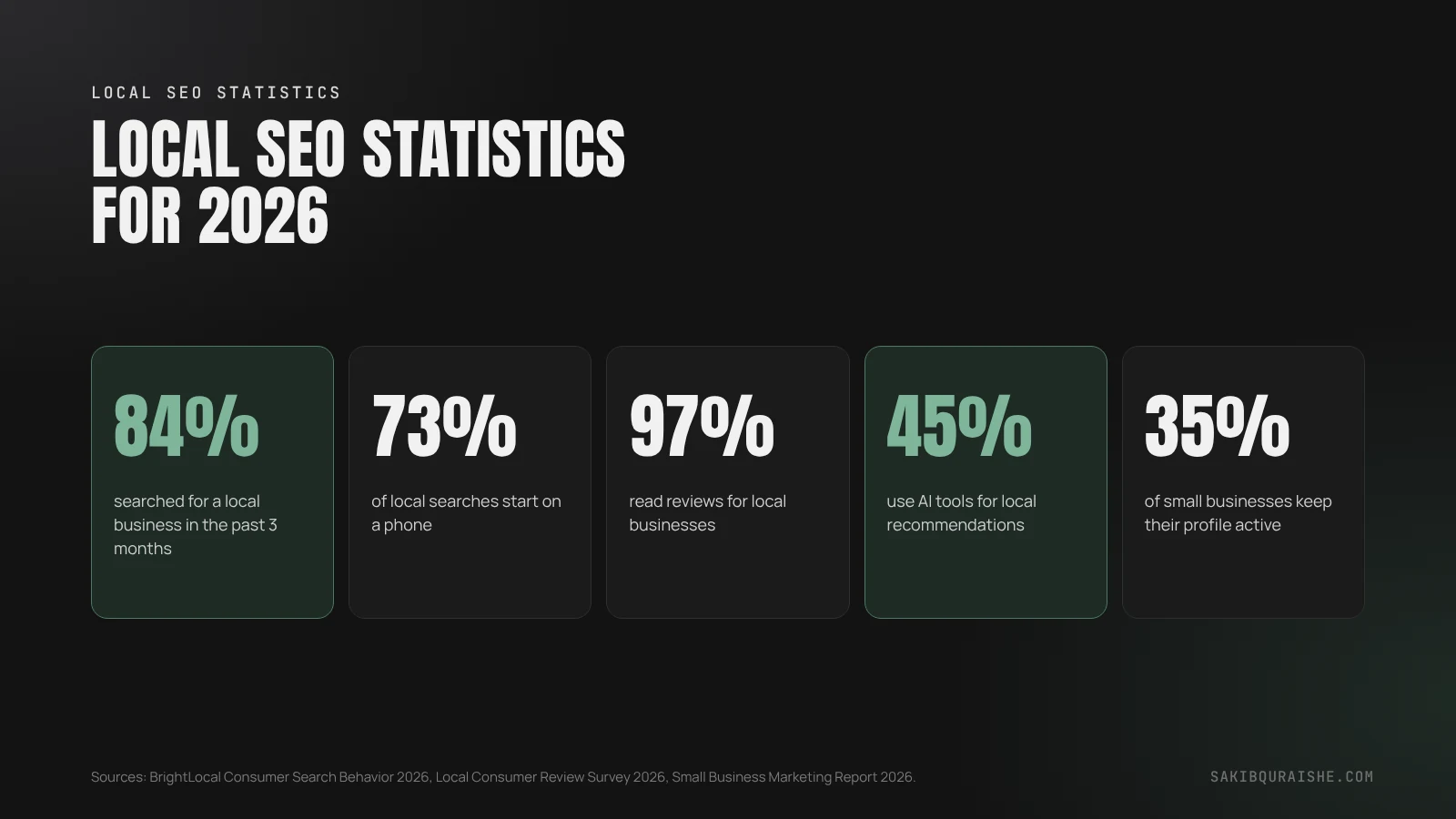
For the wider data on how customers find local businesses, see local SEO statistics for 2026. If you're weighing it up, see is local SEO worth it for a small business.
FAQ
What is the formula for local SEO ROI?
The formula for local SEO ROI is (extra profit − local SEO cost) ÷ local SEO cost × 100. Use gross profit from extra jobs, not total revenue.
How do I know which calls came from local SEO?
You know which calls came from local SEO by using a call tracking number on your Google Business Profile and website, checking your Business Profile performance data, and asking new customers how they found you.
How long does it take for local SEO to pay for itself?
Local SEO usually takes several months to pay for itself. In the example in this guide, it covered its monthly cost from month 5 and fully paid back its total cost in month 9.
Should I use revenue or profit to calculate ROI?
You should use profit. Revenue ignores what each job costs you, so it makes ROI look bigger than it really is.
What if I don't know my close rate?
If you don't know your close rate, track it for one month: count the real enquiries you get and how many become paid jobs. Use that real number instead of an industry average.
Is there a local SEO ROI calculator?
The worksheet in this guide works as a calculator. Copy it into a spreadsheet and fill in your own five numbers.
Want help working out your local SEO ROI?
I'll set up call tracking, measure your starting point, and show you each month how many extra calls, jobs and profit came from local search, using the same worksheet as this guide.Request a free local map audit, or see myLocal SEO service.
Sources
- Semrush
- WordStream/LocaliQ
- Sakib's Local SEO service page, for 8 to 12 weeks and 3 to 6 months
- Electrician case study
- All Brightline Plumbing figures are made up for illustration and recalculated in a spreadsheet