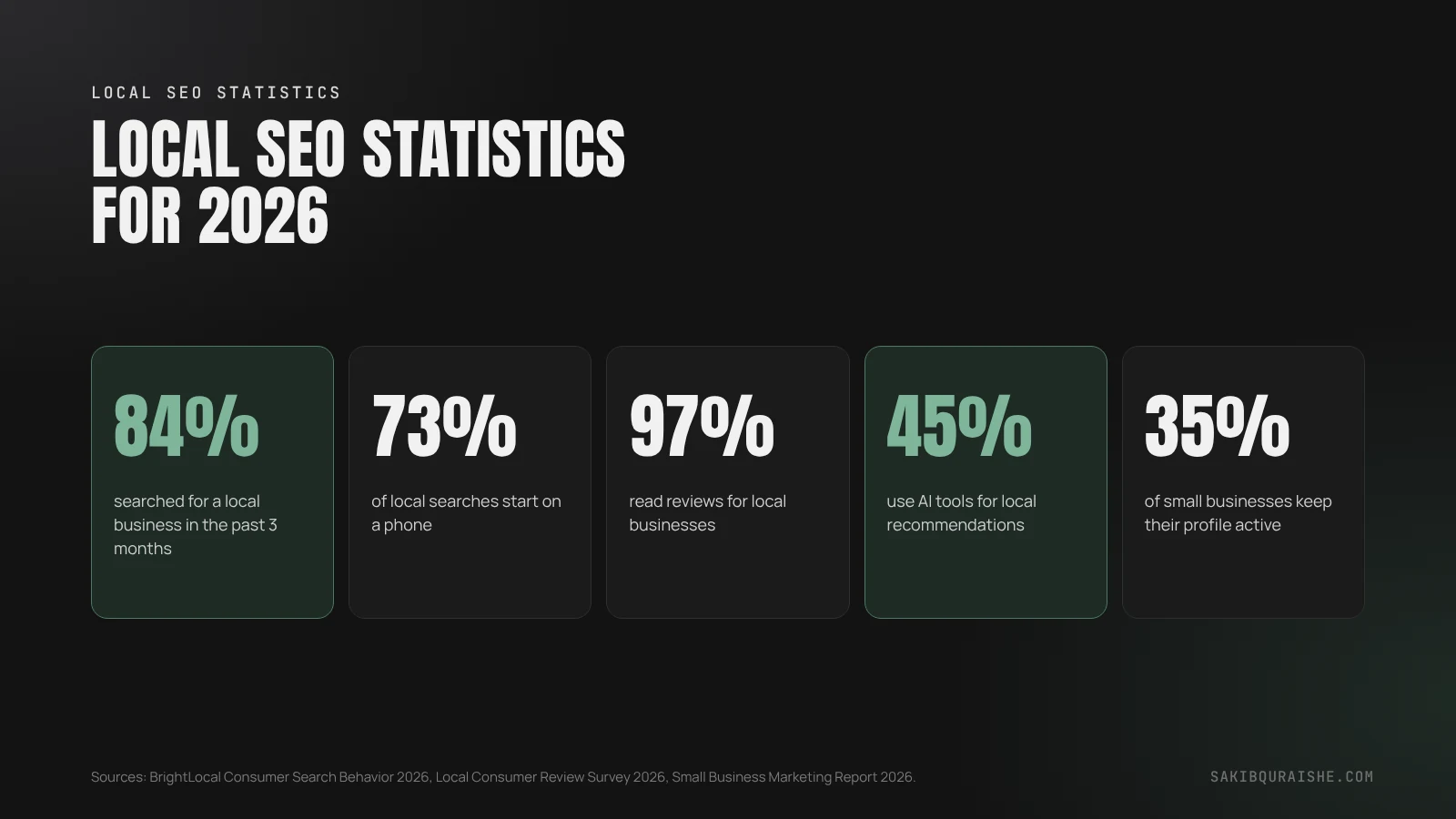
The most important local SEO statistics for 2026 are that 84% of US consumers searched for a local business in the past three months, 73% of those searches started on a phone, 97% of consumers read reviews, and 45% now use AI tools like ChatGPT for local recommendations, up from 6% a year earlier. On the business side, 85% of small businesses have a Google Business Profile, but only 35% keep it active. Every statistic below shows its source, year and sample size, and each section ends with what the numbers mean for you.
- Search: 84% searched for a local business in the past 3 months; 73% started on mobile; 52% started on Google Search.
- Speed: 75% decide which business to use in under 30 minutes, and 72% look at three businesses or fewer.
- Reviews: 97% read reviews; 68% only use businesses rated 4 stars or higher, up from 55%; 47% won't use a business with fewer than 20 reviews.
- Business side: 85% of small businesses have a Google Business Profile, but only 35% keep an active presence on it.
- AI: 45% use AI tools for local recommendations, up from 6%. ChatGPT recommended just 1.2% of 350,000 business locations in one study.
- Old stats to retire: "76% visit within a day" is from 2016, and "46% of searches are local" is a 2018 comment, not a study.
What are the most important local SEO statistics for 2026?
The most important local SEO statistics for 2026 come from large surveys published this year. Here are the ten worth knowing first:
| # | Statistic | Source (year, sample) |
|---|---|---|
| 1 | 84% of consumers searched for a local business in the past three months | BrightLocal Consumer Search Behavior (2026, 1,227 US consumers) |
| 2 | 73% of local searches start on a phone | BrightLocal Consumer Search Behavior (2026) |
| 3 | 52% start their local search on Google Search, and 71% use it at some point | BrightLocal Consumer Search Behavior (2026) |
| 4 | 75% decide which business to use in under 30 minutes | BrightLocal Consumer Search Behavior (2026) |
| 5 | 97% of consumers read reviews for local businesses | BrightLocal Local Consumer Review Survey (2026, 1,002 US consumers) |
| 6 | 47% won't use a business with fewer than 20 reviews | BrightLocal Local Consumer Review Survey (2026) |
| 7 | 45% use ChatGPT or other AI tools for local recommendations, up from 6% | BrightLocal Local Consumer Review Survey (2026) |
| 8 | 85% of small businesses have a Google Business Profile; 35% keep an active presence on it | BrightLocal Small Business Marketing Report (2026, 1,002 owners) |
| 9 | Primary category is the #1 map pack ranking factor | Whitespark Local Search Ranking Factors (2026, 47 experts) |
| 10 | AI Overviews appeared on 68% of local business queries | Whitespark AI Overviews study (540 queries) |
If you're new to the topic, start with what local SEO is and how it works.
How do people search for local businesses?
People search for local businesses often, mostly on their phones, and they decide quickly. BrightLocal's 2026 Consumer Search Behavior survey of 1,227 US consumers found:
- 84% searched online for a local business in the past three months.
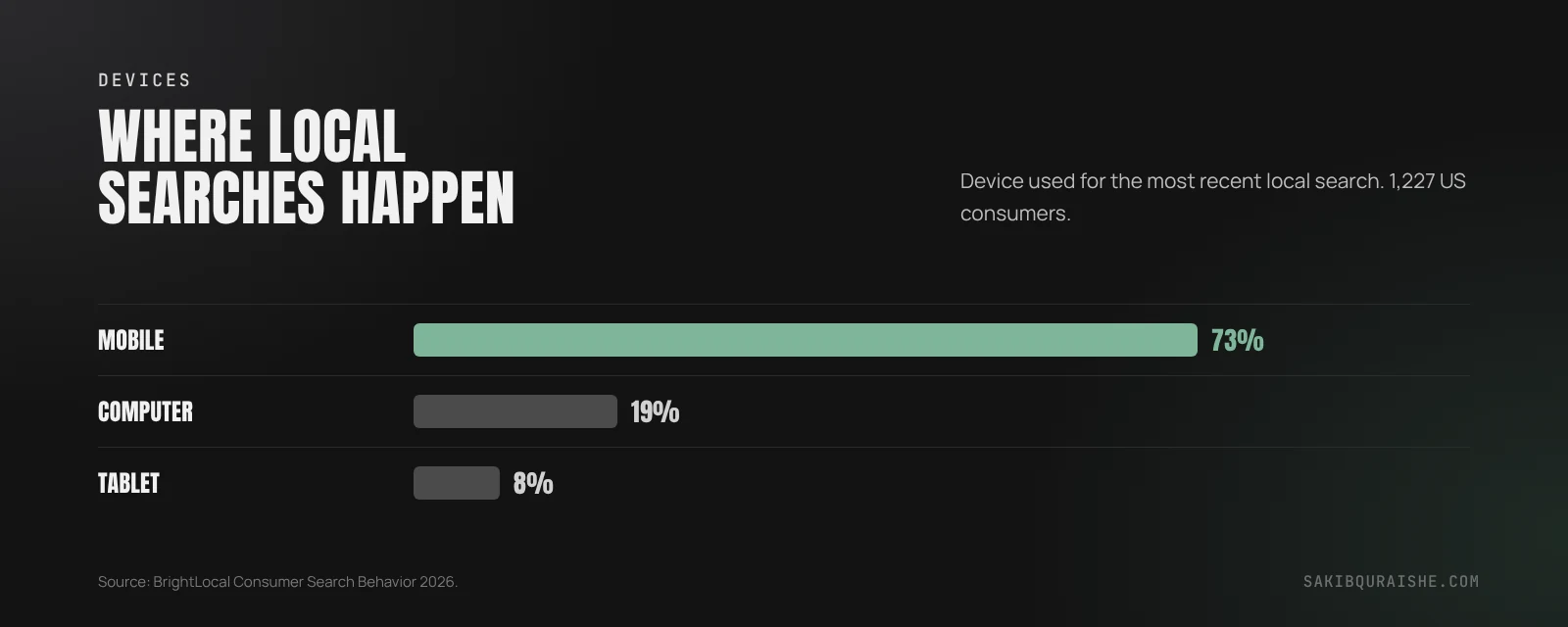
- 73% of their most recent local searches were on a phone, 19% on a computer and 8% on a tablet.
- 75% used more than one channel during their search, such as Google, Maps, social media or an AI tool.
- 75% decided which business to use in under 30 minutes, and 28% in under five minutes.
- 72% looked at three businesses or fewer before deciding. Only 1% looked at more than ten.
From BrightLocal's 2025 edition of the same survey:
- 46% always or often add "near me" to local searches.
- About one in five search for local businesses directly inside a maps app.
An older survey adds frequency: SOCi's 2024 Consumer Behavior Index found 80% of US consumers search for local businesses at least weekly and 32% daily.
What this means for you: most customers see only your top few results, on a small screen, for a few minutes. If you're not in the first three, you're rarely considered. "Near me" searches work differently from what most people think; see how "near me" searches work.
How important is Google for local search?
Google is still where most local searches start, but it no longer has the whole journey to itself. InBrightLocal's 2026 channel data:
| Where consumers started their most recent local search | Share |
|---|---|
| Google Search | 52% |
| Google Maps | 9% |
| Social media | 9% |
| AI tools | 8% |
During the whole search, 71% used Google Search at some point, 30% used social media, 23% used an AI tool and 19% used review sites.
Being in the map pack matters. InBacklinko's user behavior study, 42% of people searching for a local business clicked a map pack result. That study is small (259 US participants, published 2020), so treat it as a direction rather than a precise figure.
What this means for you: your Google Business Profile is the front door for most customers, and your website is the second. See how the map pack and organic results differ and how to rank on Google Maps.
What do reviews mean for local businesses?
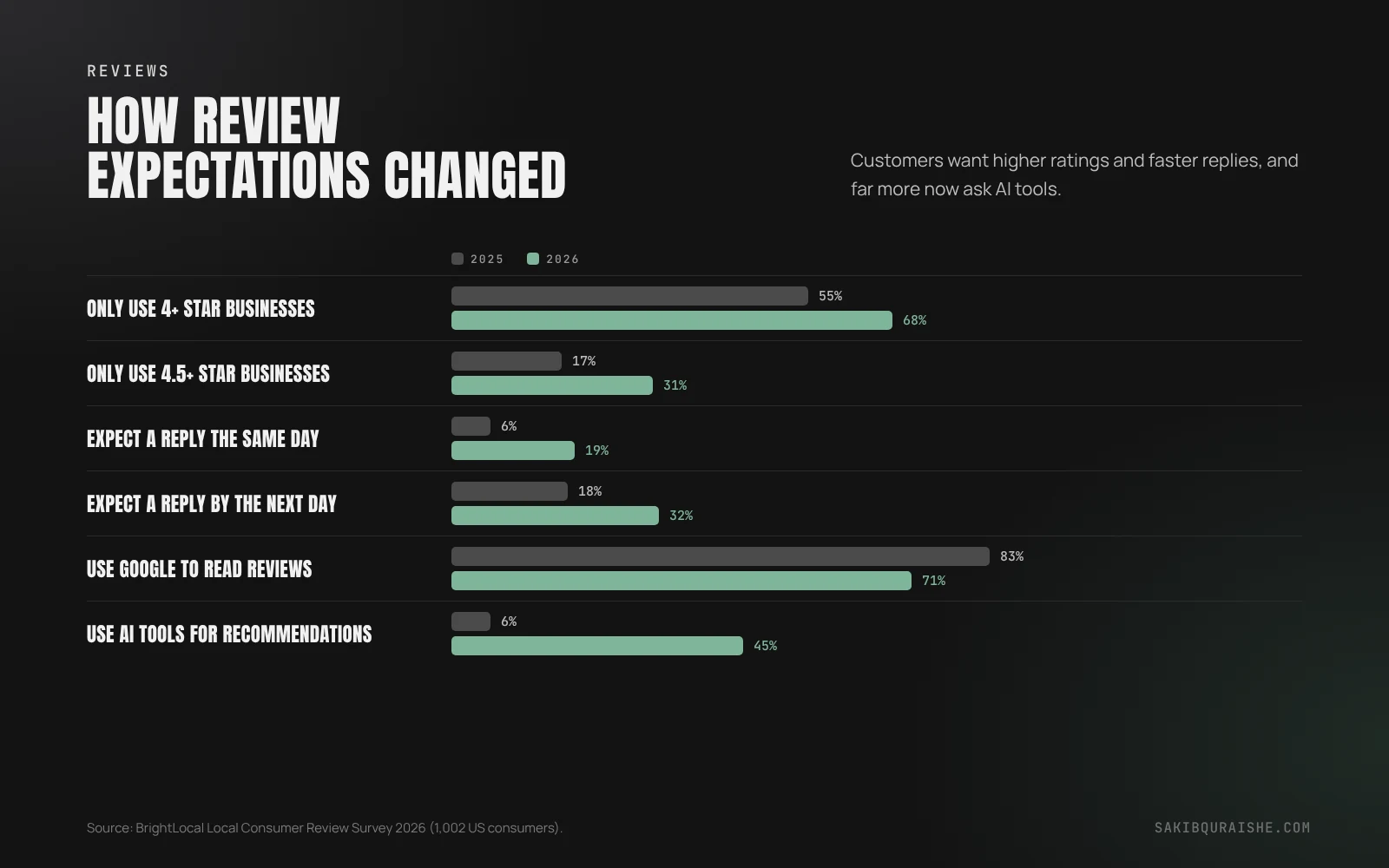
Reviews are one of the biggest deciding factors for local customers, and expectations rose sharply in 2026.BrightLocal's Local Consumer Review Survey 2026 (1,002 US consumers, published February 2026) found:
- 97% read reviews for local businesses, and 41% always read them, up from 29%.
- 47% won't use a business with fewer than 20 reviews. Only 9% will use one with five or fewer.
- 89% expect business owners to reply to reviews.
- 80% are likely to use a business that replies to all its reviews, and 42% are unlikely to use one that never replies.
- 50% are put off by generic, templated replies.
- 45% left a Google review in the past year, more than on any other platform.
How have review expectations changed since 2025?
| Expectation | 2025 | 2026 |
|---|---|---|
| Only use businesses rated 4+ stars | 55% | 68% |
| Only use businesses rated 4.5+ stars | 17% | 31% |
| Expect a reply the same day | 6% | 19% |
| Expect a reply by the next day | 18% | 32% |
| Use Google to read local reviews | 83% | 71% |
| Use AI tools for local recommendations | 6% | 45% |
Reviews also decide who gets the call. BrightLocal's 2026 decision data shows 65% of consumers who rejected a business did so for a review-related reason, and "most or best reviews" was the second most common reason for choosing one (30%).
What this means for you: a 4.2-star average with 15 reviews now loses customers it would have won a year ago. You need a steady flow of new reviews and a reply to every one, written by a person. See how to get more Google reviews and how to respond to reviews.
How many small businesses use Google Business Profile?
Most small businesses have a Google Business Profile, but few keep it active.BrightLocal's Small Business Marketing Report (published October 2026, 1,002 US owners of businesses with 1 to 50 employees) found:
- 85% have a Google Business Profile, and 63% manage it themselves.
- 35% maintain an active presence on it.
- 30% updated it in the past week (hours, photos, posts or review replies), 72% in the past three months, and 21% not for more than three months.
Active presence by channel shows Google isn't even first:
| Channel | Small businesses with an active presence |
|---|---|
| Facebook page | 43% |
| Website | 41% |
| 40% | |
| Google Business Profile | 35% |
| TikTok | 31% |
When owners named their top two sources of new customers, word of mouth led (35%), followed by social media (33%), AI tools (23%), their website (22%) and Google (22%).
Google says complete profiles pay off. ItsBusiness Profile help page says customers are 70% more likely to visit and 50% more likely to consider buying from businesses with a complete profile, and 2.7 times more likely to consider them reputable.
What this means for you: with two-thirds of competitors not keeping their profile active, regular updates are an easy edge. See the complete Google Business Profile guide, or myGoogle Business Profile optimization service.
Why does accurate business information matter?
Accurate business information matters because it's the top reason people choose a business, and wrong details send them elsewhere.
- 32% of consumers named clear, complete information (hours, address, phone) as a top reason for choosing which business to contact, the most of any factor (BrightLocal, 2026).
- 96% say it's important for local businesses to actively manage how they appear online, and 33% call it essential (BrightLocal, 2026).
- 62% would avoid a business if they found incorrect information online (BrightLocal Local Business Discovery and Trust Report, 2023).
What this means for you: check your hours, phone and address on Google, Apple Maps, Bing and your main directories at least every quarter. See NAP consistency.
What decides map pack rankings?
Your primary category, your distance from the searcher and keywords in your business name are the top map pack ranking factors, according toWhitespark's 2026 Local Search Ranking Factors survey of 47 local SEO experts (published November 2025).
| Rank | Map pack factor | Local organic factor |
|---|---|---|
| 1 | Primary GBP category | Dedicated page for each service |
| 2 | Proximity of address to the searcher | City or neighborhood relevance of content |
| 3 | Keywords in GBP business name | Quality and authority of inbound links |
| 4 | Physical address in the city of search | Keywords in the GBP landing page title tag |
| 5 | Business is open at the time of search | Links from industry-relevant sites |
The 2026 edition also says review signals and behavioural signals gained importance, while on-page and link signals dropped slightly. For AI search visibility, three of the top five factors were citation factors.
Keywords in your business name rank third, but adding keywords that aren't part of your real name breaks Google's guidelines. See keywords in your business name.
What this means for you: choosing the right primary category is the single biggest thing you control. See how to choose GBP categories.
How is AI changing local search?
AI is changing local search fast. Consumers are using AI tools far more than a year ago, and AI tools recommend far fewer businesses than Google shows.
- 45% of consumers used ChatGPT or another AI tool for local business recommendations, up from 6% the year before (BrightLocal, 2026).
- 42% trust AI recommendations as much as reviews, and 40% trust AI platforms for business recommendations (BrightLocal, 2026).
- 23% of consumers used an AI tool during their most recent local search, and 8% started there (BrightLocal, 2026).
- 23% of small business owners name AI tools as a top-two source of new customers (BrightLocal, 2026).
- AI Overviews appeared on 68% of local business queries and 15% of local-intent queries, while the map pack appeared on 93% (Whitespark AI Overviews study, 540 queries).
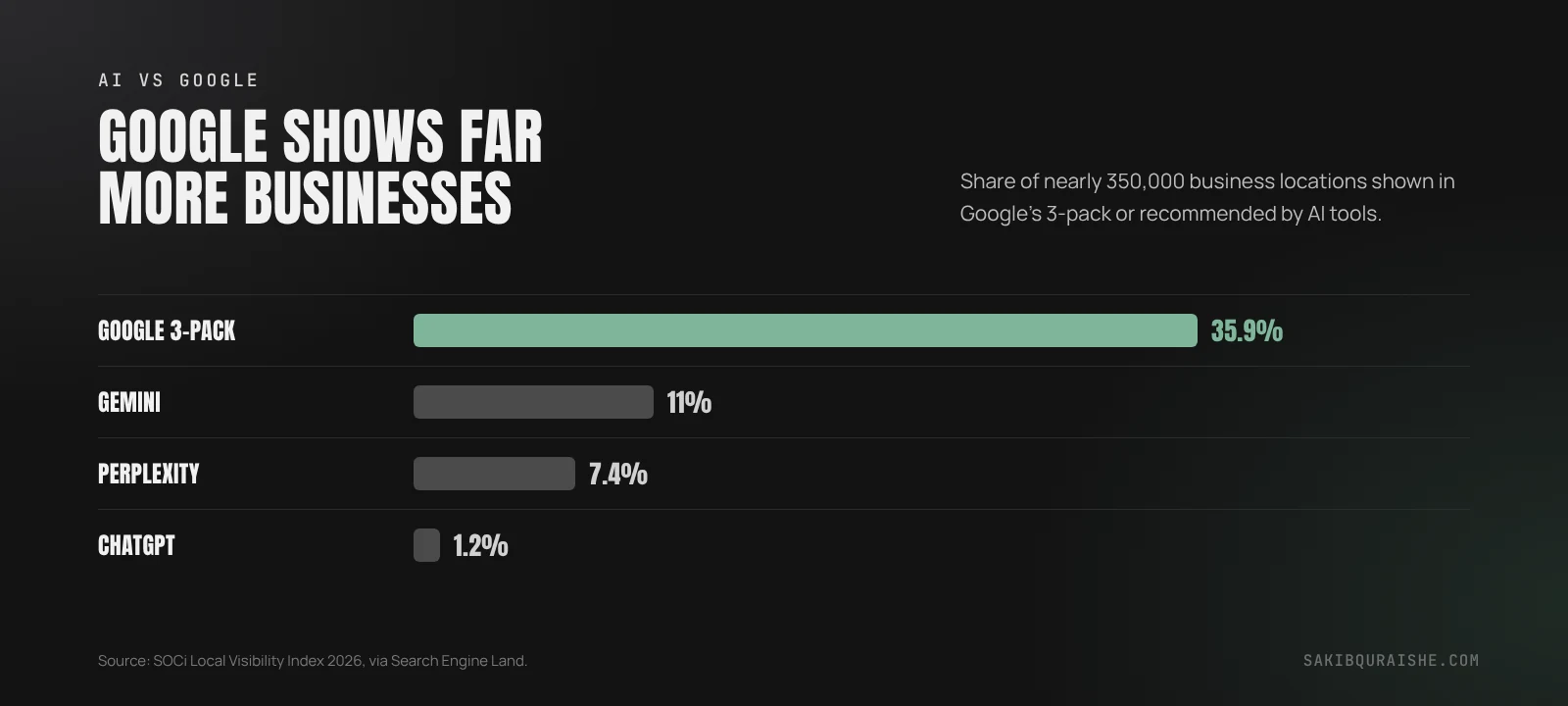
SOCi's 2026 Local Visibility Index tracked nearly 350,000 locations from 2,751 multi-location brands (Search Engine Land summary):
| Platform | Share of locations recommended or shown |
|---|---|
| Google local 3-pack | 35.9% |
| Gemini | 11% |
| Perplexity | 7.4% |
| ChatGPT | 1.2% |
What this means for you: AI tools pull from your website, reviews and listings across the web, so the same basics that win the map pack also feed AI answers. See AI search optimization for local businesses and what GEO is.
If you'd rather have this handled, myAI Search Optimization service covers profiles, listings and website content for AI answers.
What does local marketing cost?
Local SEO usually costs a few hundred to a few thousand dollars a month, and Google Ads leads cost tens of dollars each. These benchmarks help put the statistics above into money terms.
Local SEO pricing (Ahrefs survey of 439 SEO providers, updated August 2024):
- Average local SEO retainer: $1,557 a month (agencies $1,819, freelancers $1,150).
- 78.2% of providers charge monthly retainers, and $501 to $1,000 a month is the most common band.
Google Ads benchmarks (WordStream/LocaliQ 2026, 13,474 US campaigns, medians):
| Industry | Cost per click | Cost per lead |
|---|---|---|
| All industries | $5.42 | $66.69 |
| Home services | $8.33 | $90.92 |
| Dentists | $8.00 | $72.97 |
| Legal | $9.87 | $131.63 |
| Auto repair | $4.35 | $29.96 |
| Restaurants | $2.05 | $30.57 |
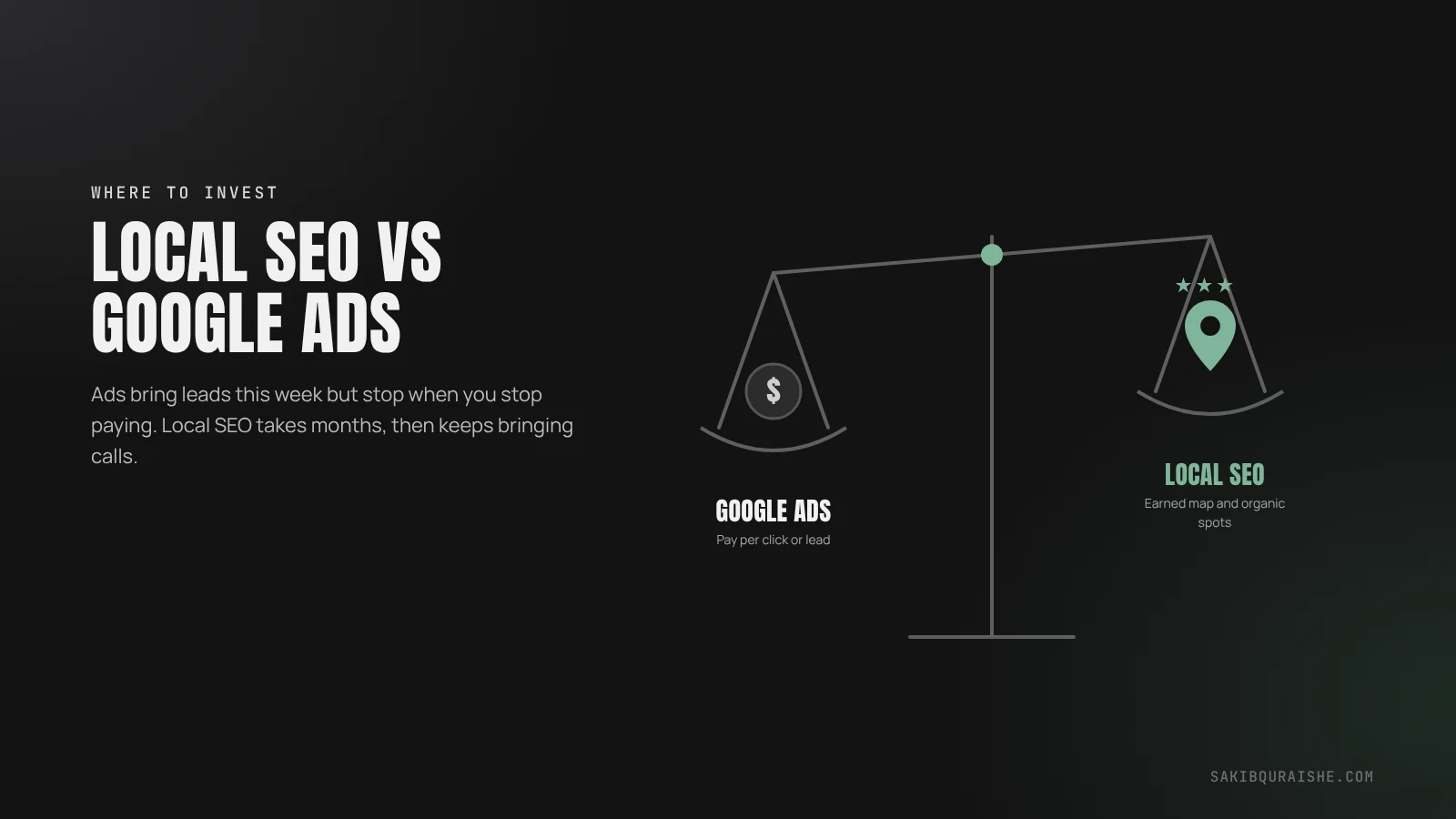
What this means for you: at $66.69 a lead, 20 paid leads a month cost about $1,334, close to a typical local SEO retainer. See what local SEO costs and local SEO vs Google Ads.
To work out your own numbers, see how to calculate local SEO ROI.
Which popular local SEO stats are out of date?
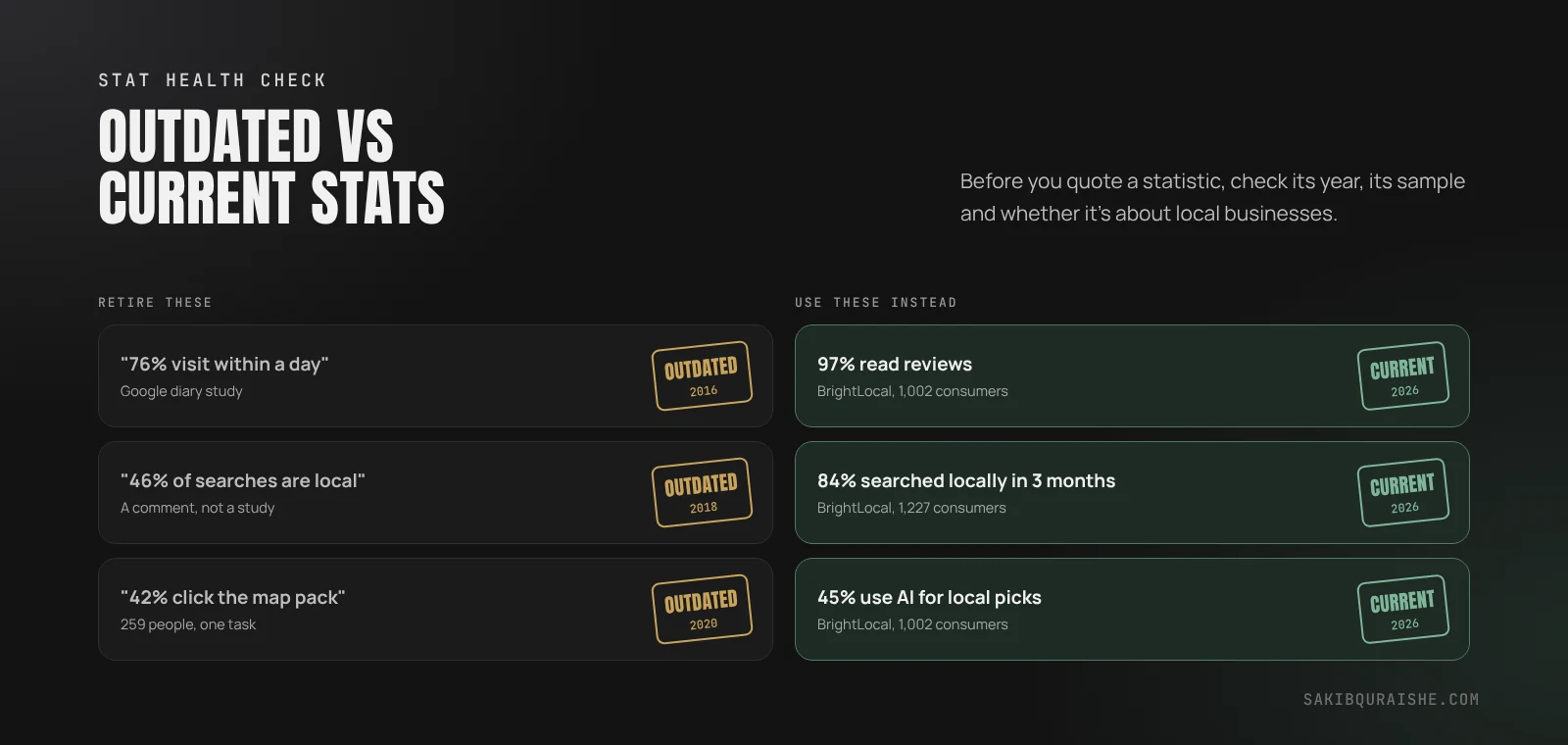
Several of the most-quoted local SEO statistics are years old, come from tiny samples, or aren't about local businesses at all. Here's a health check of the ones you'll see most often:
| Popular stat | Where it really comes from | Keep using it? |
|---|---|---|
| "46% of Google searches have local intent" | A comment by a Google employee in 2018, never published as a study | Only with the date; it's 8 years old |
| "76% who search nearby visit a business within a day; 28% buy" | Google diary study, May 2016, 634 local searchers | No; it predates AI Overviews and most of today's phones |
| "42% click the map pack" | Backlinko, 2020, 259 people, one local task (car accident lawyer) | With care, and with the sample size |
| "37% need at least 4 stars" | BrightLocal 2024 | No; 2026 says 68% need 4+ |
| "81% use Google to read reviews" | BrightLocal 2024 | No; 2026 says 71% |
| "88% trust reviews as much as personal recommendations" | An older BrightLocal survey | No; the 2024 edition said 50% |
| "58% of businesses don't optimize for local search" | Credited to ReviewTrackers or Semrush, no study date | No; can't be traced |
| "SEO leads close at 14.6% vs 1.7% outbound" | HubSpot inbound data, mostly B2B | Not for local businesses |
| "GBP signals are 32% of map pack rankings" | Whitespark group weights, quoted as 16% to 32% across pages | Only from the current report's chart, with the edition year |
What this means for you: before you quote a statistic in a pitch or a post, check its year, its sample and whether it's about local businesses. Most strong stats now come from 2025 and 2026 surveys.
How should you use these statistics?
Use these statistics to decide where to put your time first, not as promises of results. Averages across thousands of businesses won't match your town or your industry exactly. Here's how they translate into priorities:
- Your profile comes first. Most searches start on Google and most consumers look at three businesses or fewer, so a complete, active profile is the baseline.
- Reviews are the deciding factor. Two-thirds of consumers now want 4+ stars, and nearly half want 20 or more reviews.
- Accuracy builds trust. Clear, complete information is the top reason people choose who to call.
- AI is a second front. Nearly half of consumers have asked AI tools for recommendations, and those tools recommend very few businesses.
- Measure your own numbers. Track calls, direction requests and website clicks from your profile so you're working from your data, not averages. See how to measure local SEO results.
Real results vary. As one example, a roofing company I worked with went from showing in the top three on 0% of its map grid to 49% in four months (case study).
FAQ
What percentage of searches are local?
The often-quoted figure is 46%, but it comes from a 2018 comment by a Google employee, not a published study. Newer data shows 84% of US consumers searched for a local business in the past three months (BrightLocal, 2026).
Do people still read online reviews?
Yes. 97% of consumers read reviews for local businesses, and 41% always read them (BrightLocal, 2026).
How many businesses have a Google Business Profile?
85% of US small businesses have a Google Business Profile, but only 35% keep an active presence on it (BrightLocal, 2026).
Do people use ChatGPT to find local businesses?
Yes. 45% of consumers used ChatGPT or another AI tool for local recommendations in 2026, up from 6% a year earlier (BrightLocal, 2026).
What star rating do customers expect?
68% of consumers only use businesses rated 4 stars or higher, and 31% want 4.5 or higher (BrightLocal, 2026).
How often is this page updated?
This page is reviewed every quarter and fully updated when new BrightLocal and Whitespark studies are published.
Is local SEO worth it?
For most local businesses, yes, because most customers search on Google and choose from the top few results. See is local SEO worth it for a small business.
Want to see where your business stands?
I'll compare your Business Profile, reviews and map rankings with the top three competitors in your area and show you which numbers to improve first.Request a free local map audit, or see myLocal SEO service.
Sources
- BrightLocal
- BrightLocal
- BrightLocal
- BrightLocal
- BrightLocal
- BrightLocal
- Whitespark
- Whitespark
- Search Engine Land
- Backlinko
- Think with Google
- Ahrefs
- WordStream/LocaliQ