NAP consistency still matters for local SEO, but not in the way many guides suggest. What counts is that your business name, address and phone number are accurate and point to one business everywhere online. "St." versus "Street" rarely matters; a wrong phone digit, an old address or a duplicate listing does. In 2026 it also matters for whether AI tools recommend you.
- NAP means business name, address and phone number. Keep them accurate and the same everywhere.
- Fix errors that send customers to the wrong place first: wrong numbers, old addresses, closed locations, duplicates.
- Abbreviation differences barely matter. Wrong digits and old names do.
- Your website must match your Google Business Profile exactly; that ranked #15 of 187 local pack factors in Whitespark's 2026 survey.
- Consistent listings are even more important for AI search than for Maps rankings.
A citation check is part of every audit I run, because NAP problems are common, easy to miss and quietly cost businesses calls. Typical culprits are an old address from before a move, a former agency's tracking number, or a duplicate listing nobody remembers creating. For the full profile picture, see my complete guide to Google Business Profile optimization.
What is NAP in local SEO?
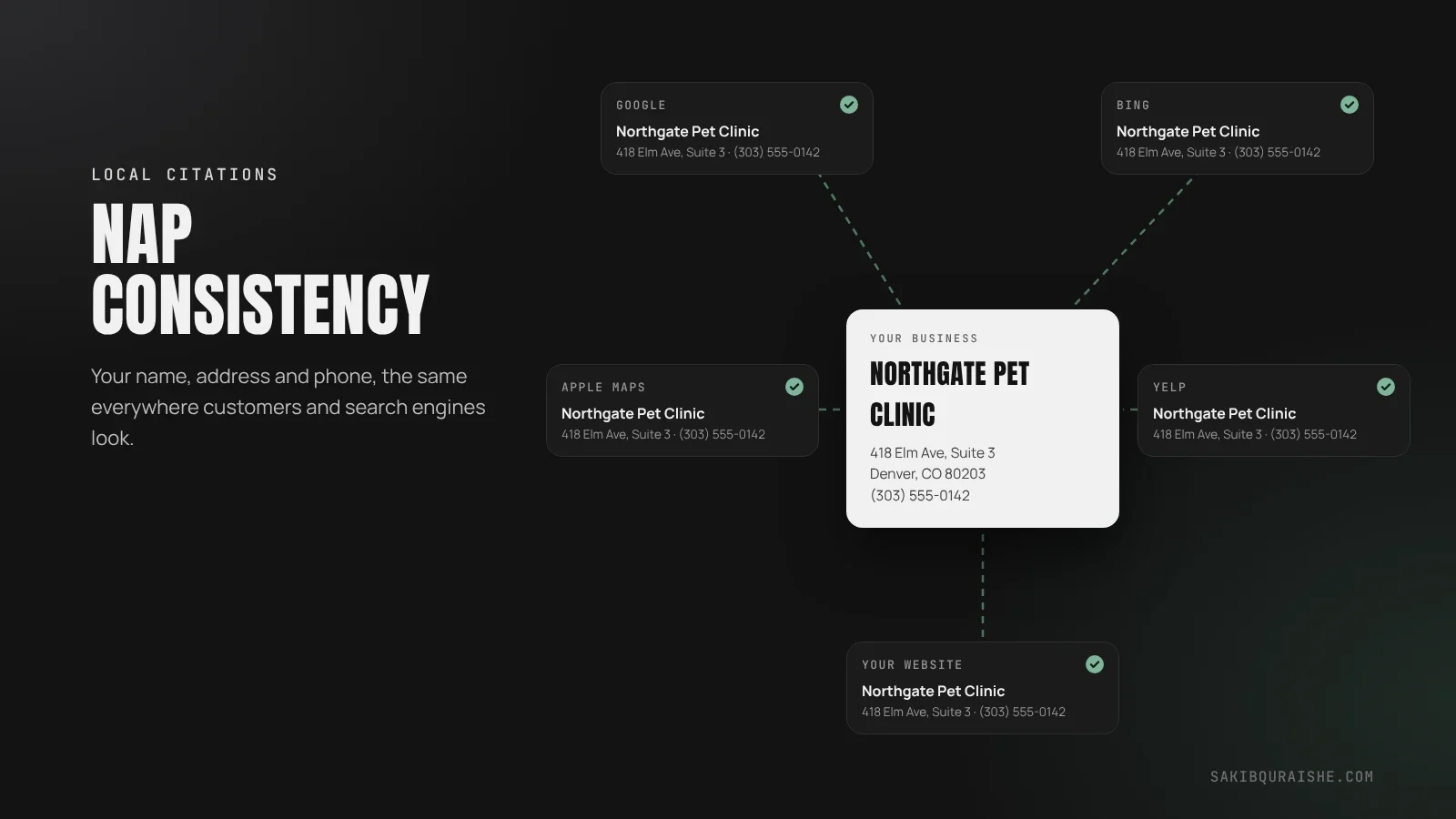
NAP in local SEO stands for name, address and phone number: the three details that identify a local business online. Every place these details appear online is called a citation, whether it's your Google Business Profile, a directory like Yelp, a social profile, a news article or your own website. Some marketers add a W for website (NAPW).
More local SEO terms in plain English in the local SEO glossary.
Does NAP consistency still matter in 2026?
NAP consistency still matters in 2026, for three reasons:
- Rankings. In Whitespark's 2026 Local Search Ranking Factors survey, "HTML NAP matching GBP NAP" (your website showing the same details as your Google Business Profile) ranked #15 of 187 factors for local pack rankings. Consistency on Google Maps, Bing Maps and Apple Maps ranked #28.
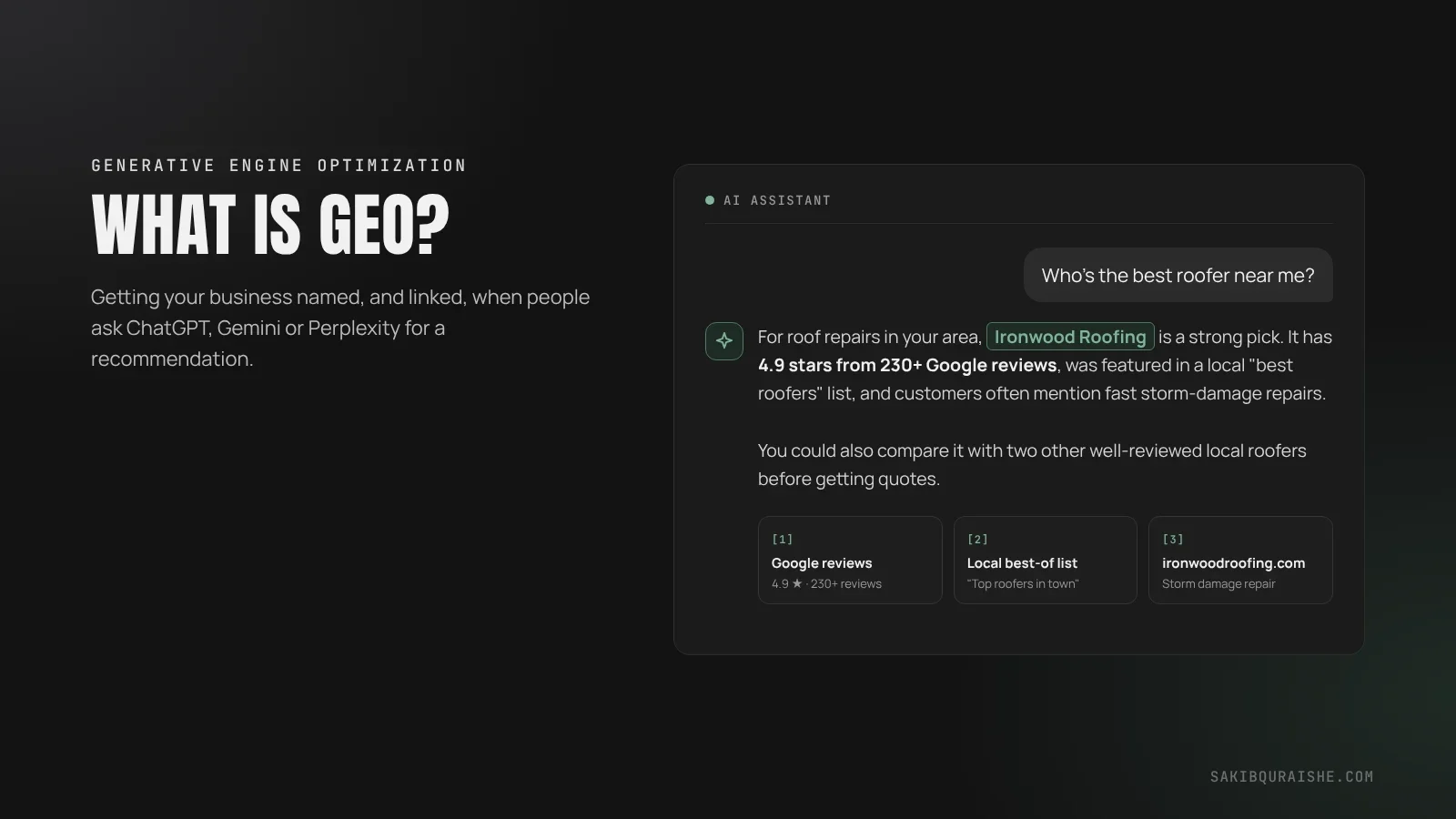
- AI search. Whitespark added AI visibility scoring in 2026, and three of the top five AI visibility factors were citation factors. AI tools need consistent details to be confident they're recommending the right business.
- Customers. Wrong details send people to the wrong door or the wrong number.
To be honest about its weight: citations alone won't push you to the top of the map. Your categories, reviews and relevance do more. Think of NAP as a foundation: if it's wrong, everything built on it is weaker.
NAP is one of several local SEO building blocks. See what is local SEO and how it works.
Which matters more: accuracy or identical formatting?
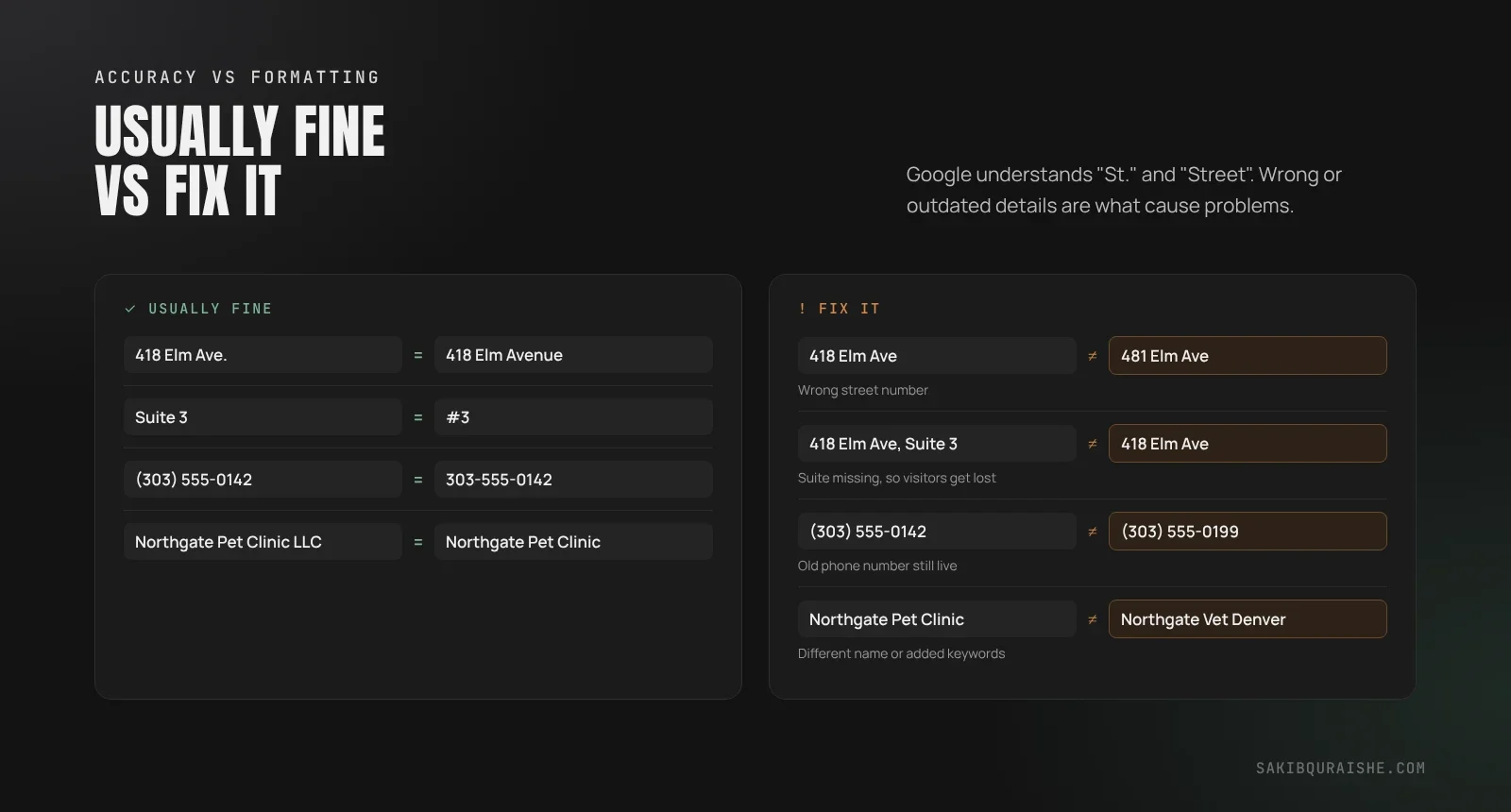
Accuracy matters more than identical formatting. Search engines understand that "Street" and "St.", or "Suite 200" and "#200", mean the same thing. What causes real problems is information that is wrong or contradictory. Google's guidelines for representing your business focus on accuracy: your real-world name, a real address you operate from, and a phone number under your direct control.
| Usually fine | Fix it |
|---|---|
| "123 Main St." vs "123 Main Street" | "123 Main St" vs "132 Main St" |
| "Suite 200" vs "#200" | Suite number missing on some listings, so mail and visitors go astray |
| (555) 123-4567 vs 555-123-4567 | Old phone number still live on directories |
| "Smith Plumbing LLC" vs "Smith Plumbing" | "Smith Plumbing" vs "Smith Plumbing & Heating Dallas" |
| Same details with or without a website URL | An old address from before you moved |
Still, pick one format and use it everywhere you control. It's easier to spot real errors when your own listings are tidy.
Why do wrong business details cost customers?
Wrong business details cost customers because people act on them. BrightLocal's 2023 Local Business Discovery & Trust Report, a survey of 1,138 US consumers, found:
- 62% would avoid a business with incorrect information online.
- 46% lose trust over a wrong address, and 45% over a wrong phone number.
- 56% come across incorrect business information at least every few months.
Those numbers are lower than BrightLocal's 2018 figures, which many articles still quote as current, but they still mean a wrong listing turns away a large share of potential customers.
Where does your NAP need to match?
Your NAP needs to match everywhere it appears, but some places matter far more than others. Fix in this order:
| Priority | Where | Why |
|---|---|---|
| 1 | Google Business Profile | Your main local listing on Search and Maps |
| 2 | Your website (contact page, footer, location pages, schema) | Must match your profile; ranked #15 in Whitespark's survey |
| 3 | Bing Places and Apple Business Connect | The other major map platforms; Bing also feeds some AI tools |
| 4 | Data aggregators (in the US: Data Axle, Localeze, Foursquare) | They feed many smaller sites automatically |
| 5 | Major directories and review sites (Yelp, Facebook, BBB, Yellow Pages) | High traffic and trusted by AI tools |
| 6 | Industry and local directories | Relevance for your niche and city |
| 7 | Social profiles and everything else | Clean up over time |
More in the best citation sites for US local businesses and whether you still need data aggregators.
How do you check your NAP consistency?
You check your NAP consistency by searching for every version of your details and logging what you find:
- Write your master NAP: the exact name, address and phone you want everywhere.
- Search your business name in quotes plus your city on Google.
- Search every phone number you've ever used, including old and tracking numbers.
- Search your current and previous addresses.
- Check the priority platforms in the table above directly.
- Log each listing in a spreadsheet: site, URL, what it shows, whether you can log in, and what needs fixing.
Citation tools from BrightLocal, Whitespark, Semrush or Moz can speed this up, but a manual search catches old numbers and addresses that tools sometimes miss.
How do you fix NAP inconsistencies?
You fix NAP inconsistencies starting with whatever sends customers to the wrong place:
- Correct your Google Business Profile and website first, so your two main sources agree.
- Fix wrong phone numbers, old addresses and closed locations on the major platforms.
- Merge or remove duplicate listings. See how to find and remove duplicate Google Business Profile listings.
- Update data aggregators, so corrected details flow to smaller sites.
- Claim and correct the rest, using each site's correction form where you can't log in.
- Update old listings rather than deleting them, so you keep their history and links.
- Recheck in two to three months. Old data can reappear as sites re-import it.
More in citation building vs citation cleanup.
Niche and local citations are part of my Local Link Building service.
Can you use call tracking numbers without breaking NAP consistency?
You can use call tracking numbers without breaking NAP consistency if you set them up carefully. Google's guidelines don't ban call tracking, but they require the number to be under the business's direct control and allow additional phone numbers on your profile. A common, safe setup:
- Use a local tracking number you own as the primary number on your Google Business Profile.
- Add your main business number as an additional phone number on the profile.
- Keep your main business number on your website and every other citation.
- Never use premium-rate numbers, which Google doesn't allow, or numbers controlled by an agency you might leave.
How should service-area businesses handle NAP?
Service-area businesses should handle NAP by keeping the name and phone identical everywhere and showing their address only where it's appropriate. If customers don't visit you, Google says to hide your address on your Business Profile. On directories, use the "hide address" or "service area" option where it exists. Never invent a storefront address or use a virtual office to look local; Google says virtual offices aren't eligible. More in service-area business vs storefront businesses in local SEO.
What should you do when you move, rebrand or change phone numbers?
When you move, rebrand or change phone numbers, update every listing in the same order you'd fix an error, and do it within a few weeks:
- Update your Google Business Profile (moving can trigger re-verification).
- Update your website, schema and any location pages.
- Update Bing Places, Apple Business Connect and data aggregators.
- Update major directories, then everything else.
- Keep the old phone number forwarding for several months if you can.
Never create a new Business Profile for a move; update the existing one. See how to update your address without losing rankings.
How do you show NAP on your website?
You show NAP on your website as plain, crawlable text, not just in an image or embedded map:
- In the footer of every page.
- On your contact page, with a map and opening hours.
- On each location page for multi-location businesses.
- In LocalBusiness schema that matches the visible text exactly. See LocalBusiness schema.
Does NAP consistency matter for AI search?
NAP consistency matters a lot for AI search, possibly more than for Maps rankings. AI tools like ChatGPT, Gemini and Google's AI Overviews build their picture of your business from many sources at once. When those sources agree, the AI can confidently name you. When they conflict, it may skip you or show the wrong details. In Whitespark's 2026 Local Search Ranking Factors, three of the top five AI visibility factors were citation factors. More in GEO explained.
FAQ
Do abbreviations like "St." and "Street" hurt NAP consistency?
Abbreviations like "St." and "Street" don't hurt NAP consistency in any meaningful way. Search engines treat them as the same. Focus on wrong numbers, wrong addresses and old names.
How long does it take for NAP fixes to show up?
NAP fixes on your own profile and website show up within days. Directory and aggregator updates can take weeks or months to spread, and some old data may reappear and need fixing again.
Should I delete old listings with the wrong details?
You usually shouldn't delete old listings with the wrong details. Correct them instead, unless they're duplicates of a listing you already control.
Do I need a suite number in my NAP?
You need a suite number in your NAP if it's part of your real address. Google allows suite numbers; leaving them off on some sites creates a mismatch.
Can bad NAP get my Google Business Profile suspended?
Bad NAP alone rarely gets a profile suspended, but mismatched details can make a reinstatement appeal harder. See why your Google Business Profile might be suspended.
Want your listings checked?
I check NAP consistency and duplicates as part of every audit. Request a free local map audit, or see my Local SEO service. Running several locations? See my multi-location SEO service. For the rest of your profile, read my Google Business Profile checklist.
Sources
- Google: Guidelines for representing your business
- BrightLocal: Local Business Discovery & Trust Report 2023
- BrightLocal: Local Citations Trust Report 2018 (used only in the fact-check)
- Whitespark: 2026 Local Search Ranking Factors
Also read: Semrush, LocalBrain, BrightLocal (What is NAP), SearchScope, Third Marble, RankLoco, TDD Technology, SEO Inventiv