Hyperlocal SEO is local SEO focused on the small area closest to your business: the streets, neighborhoods and ZIP codes where you can realistically win the map pack. Instead of trying to rank across a whole city or county at once, you build strong relevance and trust in your immediate area first, then expand outward. It isn't a separate Google system. It's the same local ranking factors (relevance, distance and prominence) applied where distance works in your favor.
- Hyperlocal SEO = winning the area right around your business before chasing the whole city.
- It works because distance is one of Google's three main local ranking factors.
- There's no fixed radius. In a dense city it may be a few blocks; in a small town it may be several miles. A GeoGrid scan shows your real one.
- What helps: the right category, neighborhood-relevant service content, reviews from nearby customers, and links from local groups.
- What doesn't: geotagging photos, keyword-stuffed reviews, extra service areas, and copy-paste neighborhood pages.
- Expand once you hold the top three in your core area and leads are growing.
What is hyperlocal SEO?
Hyperlocal SEO is the practice of ranking for searches in a very small area, like a neighborhood, a ZIP code or the few miles around your business. It targets people searching nearby, often on a phone, who want something close and usually want it soon.
A few examples:
- A café wants to rank for "coffee shop" in its own neighborhood, not across the whole city.
- A dentist wants to win "dentist near me" within a short drive of the clinic.
- A plumber wants to own the map pack in the three suburbs closest to their base before targeting the rest of the metro area.
The term is mostly used by marketers. Google doesn't use the word "hyperlocal" in its ranking guidance. New to the basics? Start with what local SEO is and how it works.
How is hyperlocal SEO different from local SEO?
Hyperlocal SEO is different from local SEO in how wide you aim, not in how Google ranks you. Both use the same ranking signals. Hyperlocal SEO just narrows the focus to the area where you can win first.
| Local SEO | Hyperlocal SEO | |
|---|---|---|
| Target area | A city, metro area or service region | Neighborhoods, ZIP codes and nearby streets |
| Typical searches | "plumber Phoenix", "dentist in Tempe" | "plumber near me", "dentist Arcadia", "coffee shop open now" |
| Content | City-level service pages | Neighborhood details, landmarks, local projects |
| Competition | Everyone in the city | The few businesses closest to you |
| Main goal | Visibility across the market | Owning the map pack near you, then expanding |
Think of hyperlocal SEO as the first ring of a local SEO strategy, not a replacement for it.
Why does hyperlocal SEO work?
Hyperlocal SEO works because distance is built into how Google ranks local results. Google'slocal ranking help page lists three main factors: relevance, distance and prominence. It defines distance as "how far each business is from the customer who's searching."
Experts agree distance carries a lot of weight. InWhitespark's 2026 Local Search Ranking Factors survey, distance from the searcher ranked as the second most important map pack factor, just after the primary Business Profile category.
That means two things:
- Near your business, distance helps you. You compete with fewer businesses, and small improvements in relevance and reviews can move you into the top three.
- Far from your business, distance works against you. You need much stronger relevance and prominence to beat businesses that are closer to the searcher.
Hyperlocal SEO simply starts where the odds are best. More in why you rank at your office but not 2 miles away.
Which businesses benefit most from hyperlocal SEO?
The businesses that benefit most from hyperlocal SEO are those whose customers want something close and act quickly:
- Walk-in businesses: cafés, restaurants, salons, gyms and shops, where people rarely travel far.
- Urgent services: locksmiths, plumbers, towing and emergency dentists, where the nearest good option wins.
- Clinics and dentists in busy cities, where many competitors sit within a short distance.
- Service-area businesses building from their base outward, one town or suburb at a time.
- New businesses, which can win their own neighborhood long before they can compete city-wide.
Businesses that serve a whole region, like a specialist with few competitors, may not need a tight hyperlocal focus. More in which businesses need local SEO.
How far does "hyperlocal" reach?
"Hyperlocal" doesn't reach a fixed distance. Many articles say 1 to 3 miles or 1 to 5 miles, but there's no official number. Your real area depends on:
- How dense the area is. In a busy city, a dentist may only dominate a few blocks. In a small town, a plumber may win across several miles.
- How many competitors are near you. Ten similar businesses within a mile shrink your winnable area.
- What people search. "Coffee near me" usually shows very close results. "Roofer near me" can reach further, because there are fewer roofers.
- How strong your profile is. Better categories, reviews and links widen the area you can win.
The only reliable way to know your hyperlocal area is to measure it. See what is a GeoGrid scan.
How do you find your hyperlocal area?
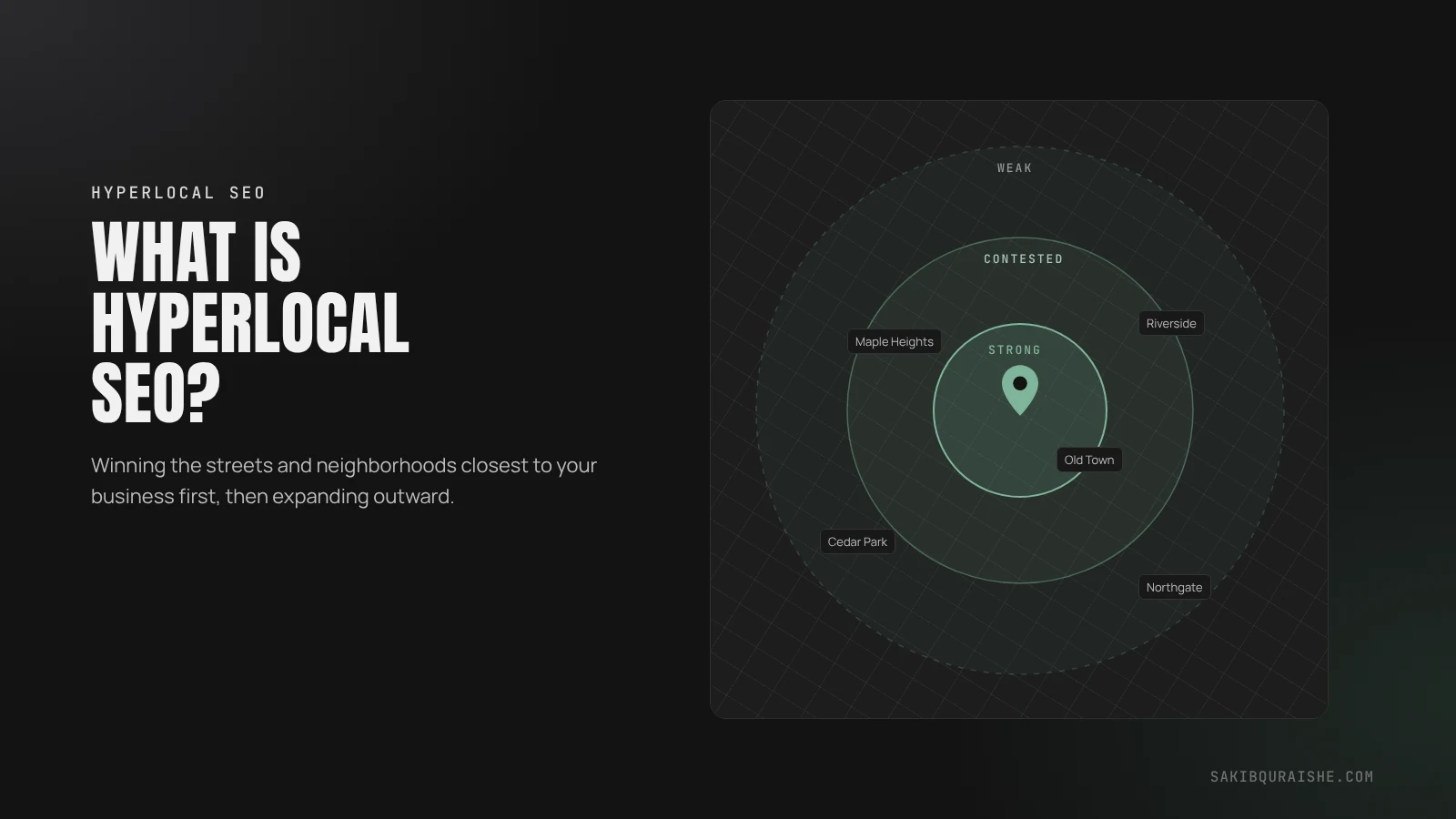
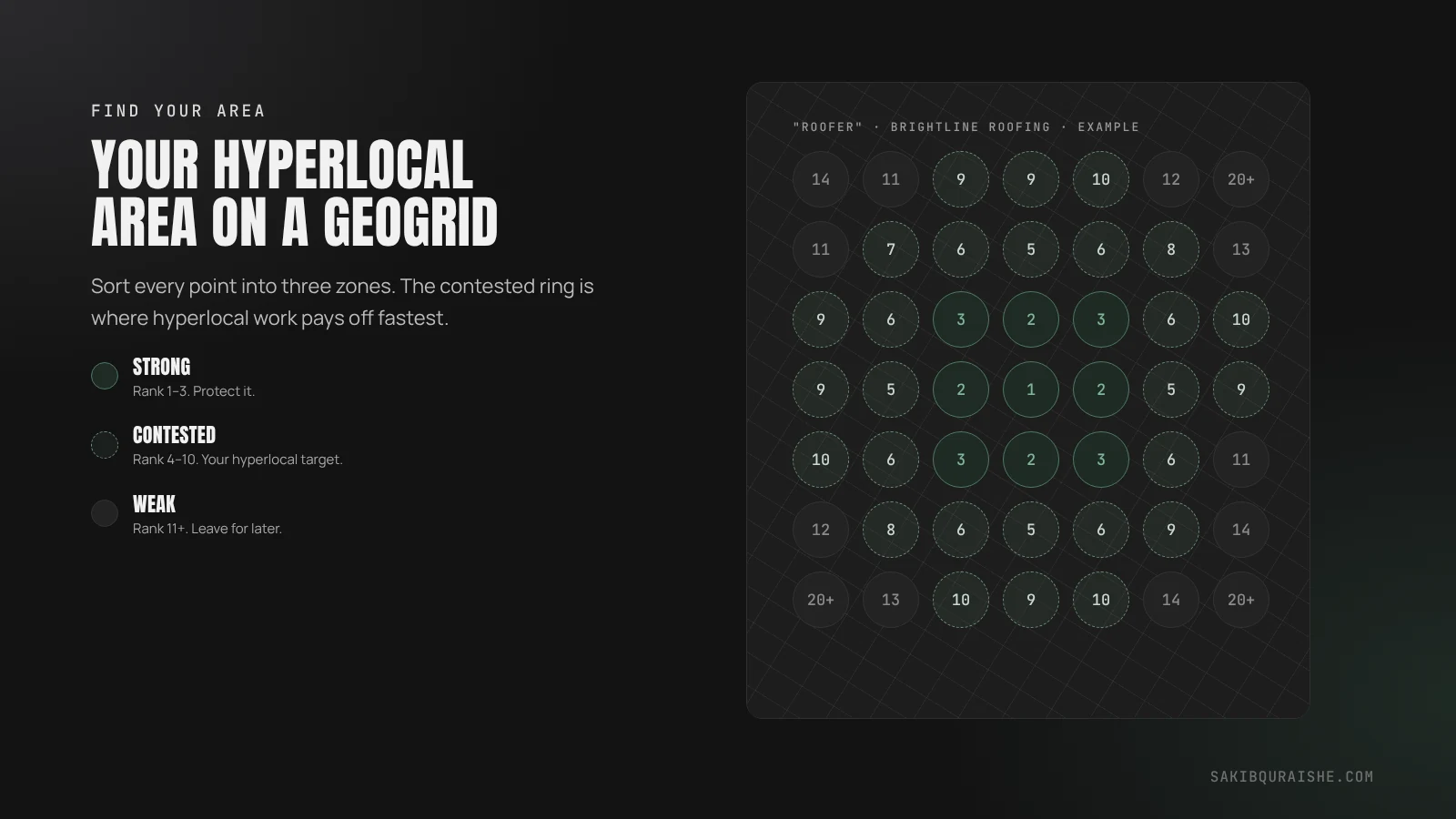
You find your hyperlocal area with a GeoGrid scan for your main keywords. A GeoGrid checks your map ranking at many points around your business and shows the results as a colored grid. Sort the points into three zones:
| Zone | What the grid shows | What to do |
|---|---|---|
| Strong | You rank 1 to 3 | Protect it: steady reviews, posts, accurate hours |
| Contested | You rank 4 to 10 | Your hyperlocal target: focused content, reviews and local links |
| Weak | You rank 11 or lower, or not at all | Leave for later, unless it's a key area |
Your contested zone is where hyperlocal SEO pays off fastest. As an example from my own work, a roofer in Scottsdale, Arizona went from 0% to 49% top-of-map coverage across their grid in four months (case study).
Also check your Business Profile's Performance report for the searches people used to find you, and ask new customers which neighborhood they're in. That tells you which areas already bring business.
How do you do hyperlocal SEO?
You do hyperlocal SEO by making your business the most relevant and trusted choice in your target zone. The steps:
- Get the primary category right. It's the strongest relevance signal you control. See how to choose GBP categories.
- Make your Business Profile complete. Services, hours, photos and a clear description that mentions the areas you serve naturally.
- Set accurate service areas. Google'sservice area help page allows up to 20, by city or postal code, within about 2 hours' driving. They tell customers where you work; they don't widen your ranking radius on their own.
- Add local detail to your website. Mention the neighborhoods you serve, nearby landmarks, local projects and real photos on your service pages.
- Get reviews from nearby customers. Ask every customer, every time. Reviews from people in your area help them, and their neighbors, trust you. See how to get more Google reviews.
- Earn local links and mentions. Neighborhood associations, local schools and sports teams, community events and nearby businesses.
- Keep your details identical everywhere. Same name, address and phone on every listing.
Prefer to have the profile side handled for you? See myGoogle Business Profile optimization service.
Do you need neighborhood pages?
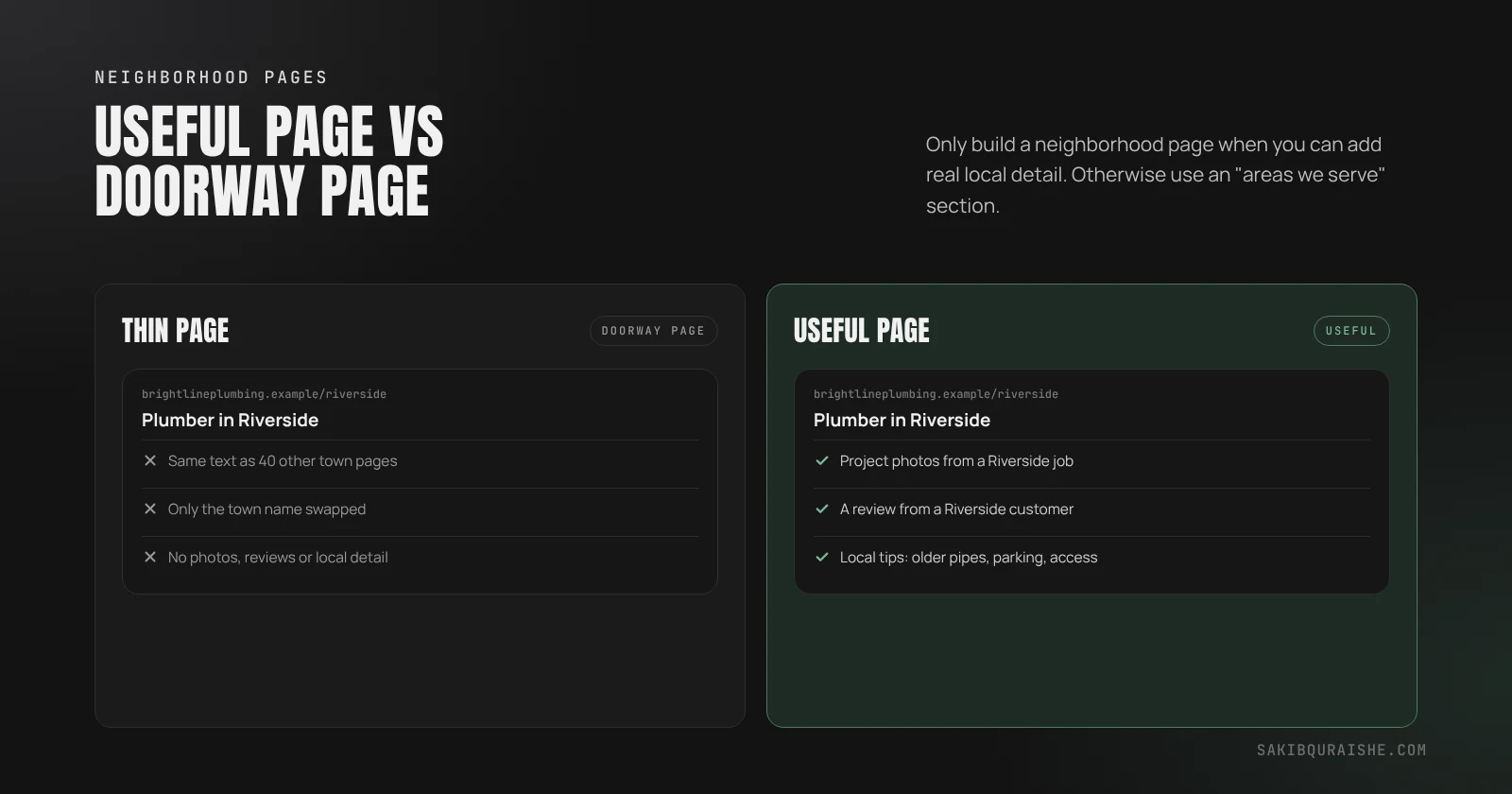
You need neighborhood pages only when each one can say something genuinely useful about that area. A page that copies your service page and swaps the neighborhood name is a doorway page, and Google's spam policies treat those as spam.
A useful neighborhood page includes at least a few of these:
- Real jobs or projects you've done there, with photos.
- Reviews from customers in that neighborhood.
- Local details that matter to the service, like older homes, typical problems, parking or access.
- Specific directions, travel time or service hours for that area.
- Answers to questions people in that area actually ask.
If you can't write that for a neighborhood, cover it in a short "areas we serve" section on your main service page instead. See ranking in multiple cities without thin pages.
What hyperlocal content works?
Hyperlocal content works when it shows you really know and serve the area. Ideas that are useful to readers and easy to keep genuine:
- Project spotlights: a short write-up of a real job in a named neighborhood, with before-and-after photos.
- Local guides: for example, "what to check before buying an older home in [neighborhood]" from a home inspector.
- Neighborhood FAQs: questions customers in that area really ask, like parking, access or typical problems.
- Community involvement: sponsorships, events and local partnerships, which can also earn local links.
- Business Profile posts about recent local jobs, offers or events.
Write these for customers first. If a piece would only make sense to a search engine, skip it.
What hyperlocal SEO advice should you ignore?
You should ignore hyperlocal advice that isn't backed by evidence. Some of it still appears in top-ranking articles:
| Advice you'll see | What the evidence says |
|---|---|
| "Geotag your photos" | Google's John Mueller has said there's "no need to geotag images for SEO." A 10-week test on 27 businesses, reported bySearch Engine Land, found it hurt rankings outside the targeted towns. |
| "Get reviews that mention keywords and neighborhoods" | ASterling Sky test found keywords in reviews didn't improve rankings. Place mentions can still help readers, but don't script them. |
| "Add more service areas to rank further away" | Google's help page says service areas help people find you, but nothing says they extend your rankings. |
| "Put the neighborhood name in your business name" | Google's guidelines don't allow extra information in your business name. See keywords in your business name. |
| "Hyperlocal needs a 1–3 mile radius" | There's no fixed radius. Measure yours with a GeoGrid. |
How do you measure hyperlocal SEO?
You measure hyperlocal SEO by tracking how your target zone changes over time, not just your overall ranking:
- GeoGrid by zone. Run the same grid every two to four weeks and watch your contested zone turn strong.
- Business Profile Performance report. Calls, direction requests and website clicks, plus the searches people used.
- Calls and leads by area. Ask new customers where they're located, or note it from bookings.
- Reviews from the area. How many new reviews come from customers in your target neighborhoods.
Checking your ranking from your own desk only shows one point, so it's misleading. More in how "near me" searches work.
When should you expand beyond your hyperlocal area?
You should expand beyond your hyperlocal area once you hold the top three in your core zone and leads from it are steady. Good signs:
- Your strong zone now covers most of what used to be your contested zone.
- Reviews keep coming in every week.
- Calls from your core area have grown and stayed steady for a couple of months.
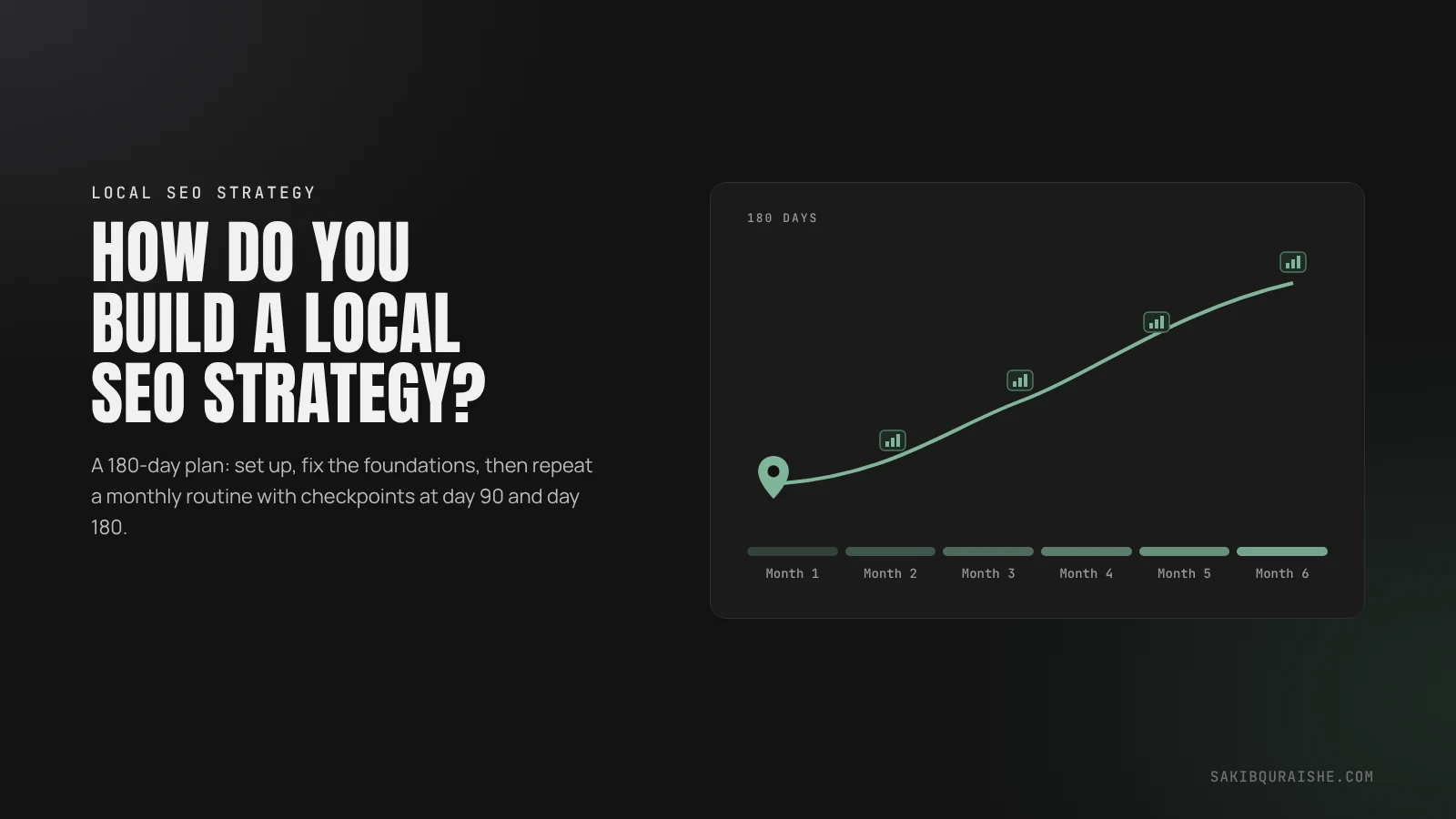
Then pick the next ring, one or two neighborhoods at a time, and repeat the same steps. For many businesses, this happens a few months into a structured plan. See how to build a local SEO strategy.
FAQ
Is hyperlocal SEO different from local SEO?
Hyperlocal SEO isn't a different system. It's local SEO focused on the small area closest to your business first.
What radius does hyperlocal SEO cover?
Hyperlocal SEO has no fixed radius. It can be a few blocks in a busy city or several miles in a small town, depending on density and competition.
Does geotagging photos help hyperlocal SEO?
Geotagging photos doesn't help hyperlocal SEO. Google's John Mueller says there's no need, and a 27-business test found it hurt rankings outside the targeted towns.
Do I need a page for every neighborhood?
You don't need a page for every neighborhood. Create one only when you can add real local detail, like projects, reviews and area-specific advice.
Does hyperlocal SEO work for service-area businesses?
Hyperlocal SEO works for service-area businesses. Rankings still start from your verified base, so you win the areas closest to it first. See service-area business vs storefront.
How long does hyperlocal SEO take?
Hyperlocal SEO often shows movement sooner than city-wide local SEO, because you're competing in a smaller area. Most businesses see clear map movement within 8 to 12 weeks.
Want to see your real hyperlocal area?
I'll run a GeoGrid scan for your main searches and show you your strong, contested and weak zones, and what to do in each.Request a free local map audit, or see myLocal SEO service.
Sources
- Google: how local ranking works
- Google: manage your service area
- Whitespark 2026 Local Search Ranking Factors
- Search Engine Land: geotagging test
- Search Engine Roundtable on Sterling Sky's review keyword test
- Google Business Profile guidelines
- Your roofing case study and Local SEO service page (8–12 weeks).