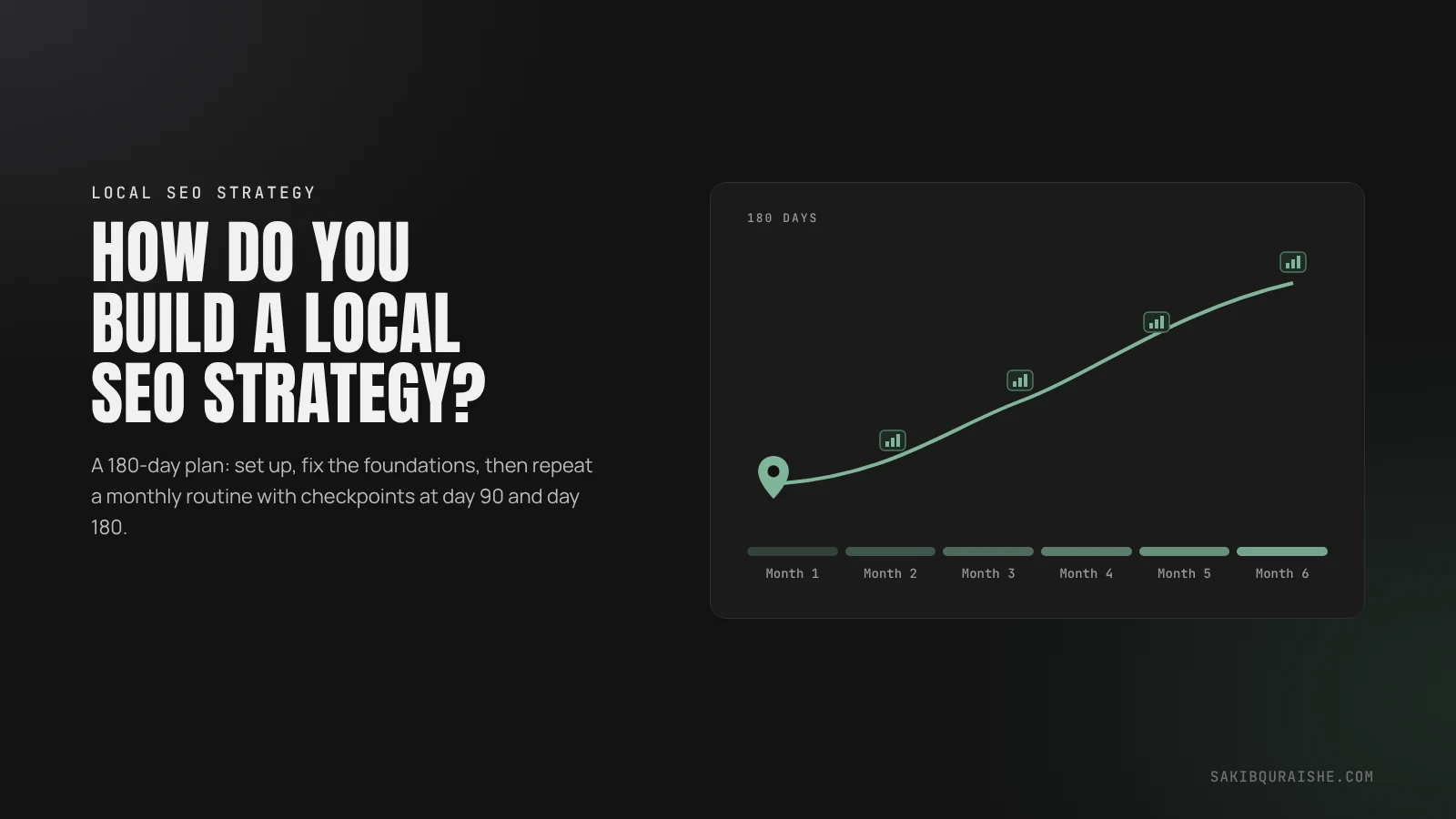
You build a local SEO strategy by measuring where you stand, fixing your foundations, then repeating a monthly routine that builds relevance and trust in your area. In practice that means five days of setup and baselines, a heavy first month of audits and fixes, then four to five months of steady work on your Business Profile, pages, reviews, links and AI visibility, with checkpoints at day 90 and day 180. This guide walks through the exact 180-day plan I use with clients.
- Days 1 to 5: get access, back everything up, and record baselines for calls, rankings and AI visibility.
- Month 1: keyword and page plan, tracking, full audits, Business Profile fixes, review system, and the first quick wins.
- Months 2 to 6: a monthly routine of profile updates, page work, content, reviews, local links, AI visibility and reporting.
- Day 90: a full review against your baseline, and a plan for the next 90 days.
- Day 180: re-audit, deep-dive review and a plan for months 7 to 12.
- Track three things: Maps, regular search and AI answers, plus the calls and leads they bring.
How do you build a local SEO strategy?
You build a local SEO strategy in five stages:
- Measure. Record calls, leads, map rankings and AI visibility before changing anything.
- Plan. Decide which keywords and areas matter most, and which page targets each one.
- Fix. Correct your Business Profile, website and listings so the basics are right.
- Build. Add reviews, pages, content and local links every month.
- Review. Check results against your baseline every month, and properly at day 90 and day 180.
Most strategies fail at stage 1 or stage 5: people skip the baseline, so they can't prove what worked, or they never stop to review and adjust. If you're new to the basics, start with what local SEO is and how it works.
What does a 180-day local SEO plan look like?
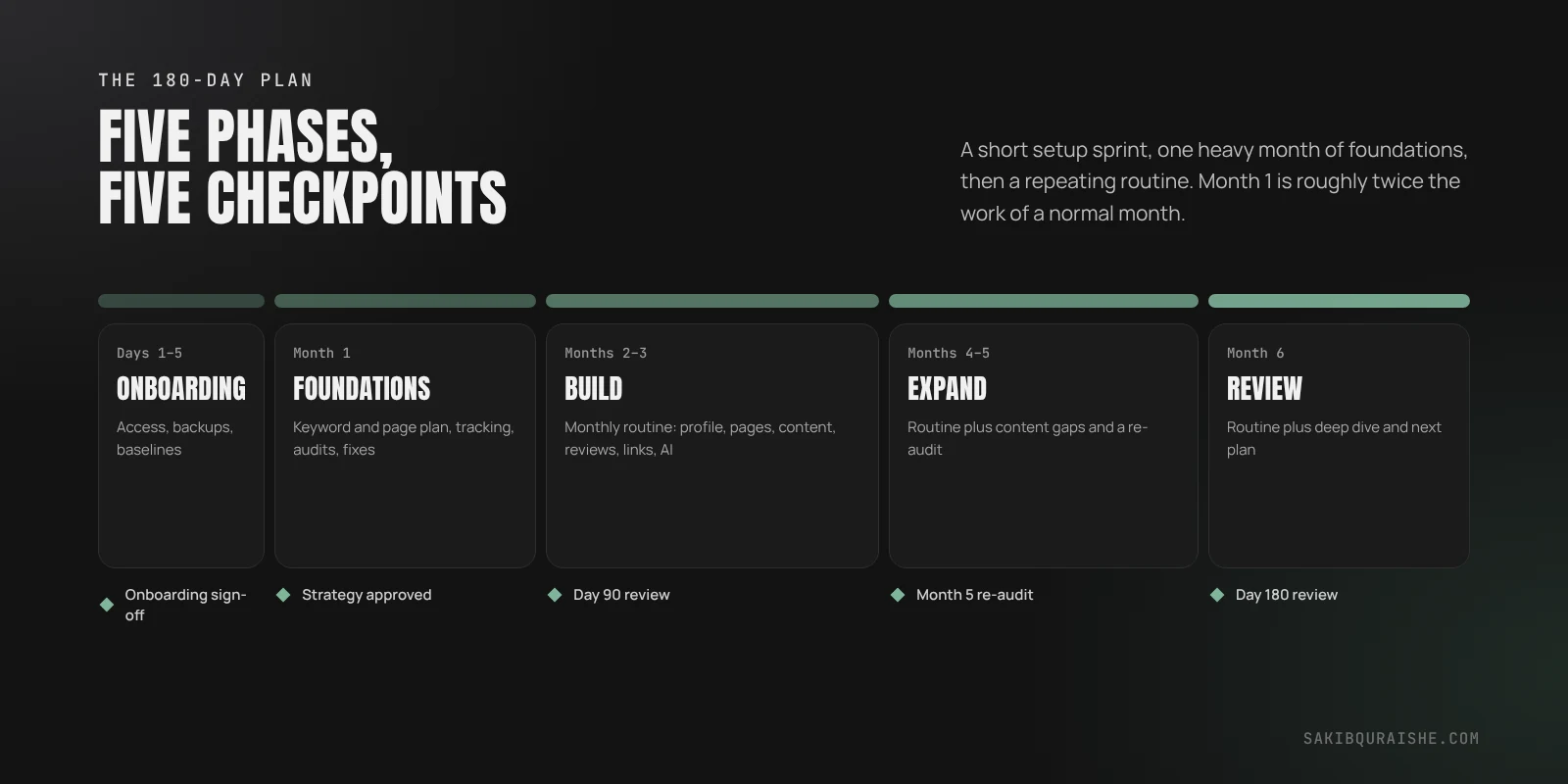
A 180-day local SEO plan looks like a short setup sprint, one heavy month of foundations, then a repeating monthly routine with two big checkpoints. Here's the shape of my own plan:
| Phase | When | Focus | Checkpoint |
|---|---|---|---|
| Onboarding | Days 1–5 | Access, backups, baselines | Onboarding sign-off |
| Foundations | Month 1 | Keyword and page plan, tracking, audits, fixes | Strategy approved before any changes go live |
| Build | Months 2–3 | Monthly routine: profile, pages, content, reviews, links, AI | Day 90 review |
| Expand | Months 4–5 | Monthly routine plus content gaps, re-audit | Month 5 re-audit |
| Review | Month 6 | Monthly routine plus deep dive and next plan | Day 180 review and months 7–12 plan |
My full plan has about 930 individual tasks over the six months. Month 1 is the heaviest, with roughly twice the work of a normal month.
What should you do in the first 5 days?
In the first 5 days, you should get access to everything, protect what's already there, and record where you stand. Nothing gets changed yet.
Access and protection
- Get access to the Google Business Profile, website, Search Console, Analytics, Tag Manager and call tracking.
- Collect logins for Yelp, Facebook, Nextdoor, the Better Business Bureau and any industry platforms.
- Claim or verify Apple Business Connect and Bing Places.
- Take a full screenshot backup of the Business Profile and a full website backup before any change.
- Record the profile's IDs: Place ID, Maps URL and review link.
The kickoff call
Ask the questions that shape the whole plan: which services make the most profit, which areas and ZIP codes matter, what's seasonal, and how many new customers the business wants each month.
Baselines
- Leads: calls, forms and bookings per month for the last three months.
- Business Profile: searches, calls, direction requests and website clicks from the Performance report.
- Maps rankings: a GeoGrid scan for the top five keywords. See what is a GeoGrid scan.
- AI visibility: 25 to 50 real customer questions run through ChatGPT, Gemini, Google AI Mode, Perplexity and Copilot, noting who gets recommended and which websites the AI cites as sources.
End with a simple sign-off: every login works, every baseline is recorded, and the business details are confirmed character by character against the profile.
What happens in month 1?
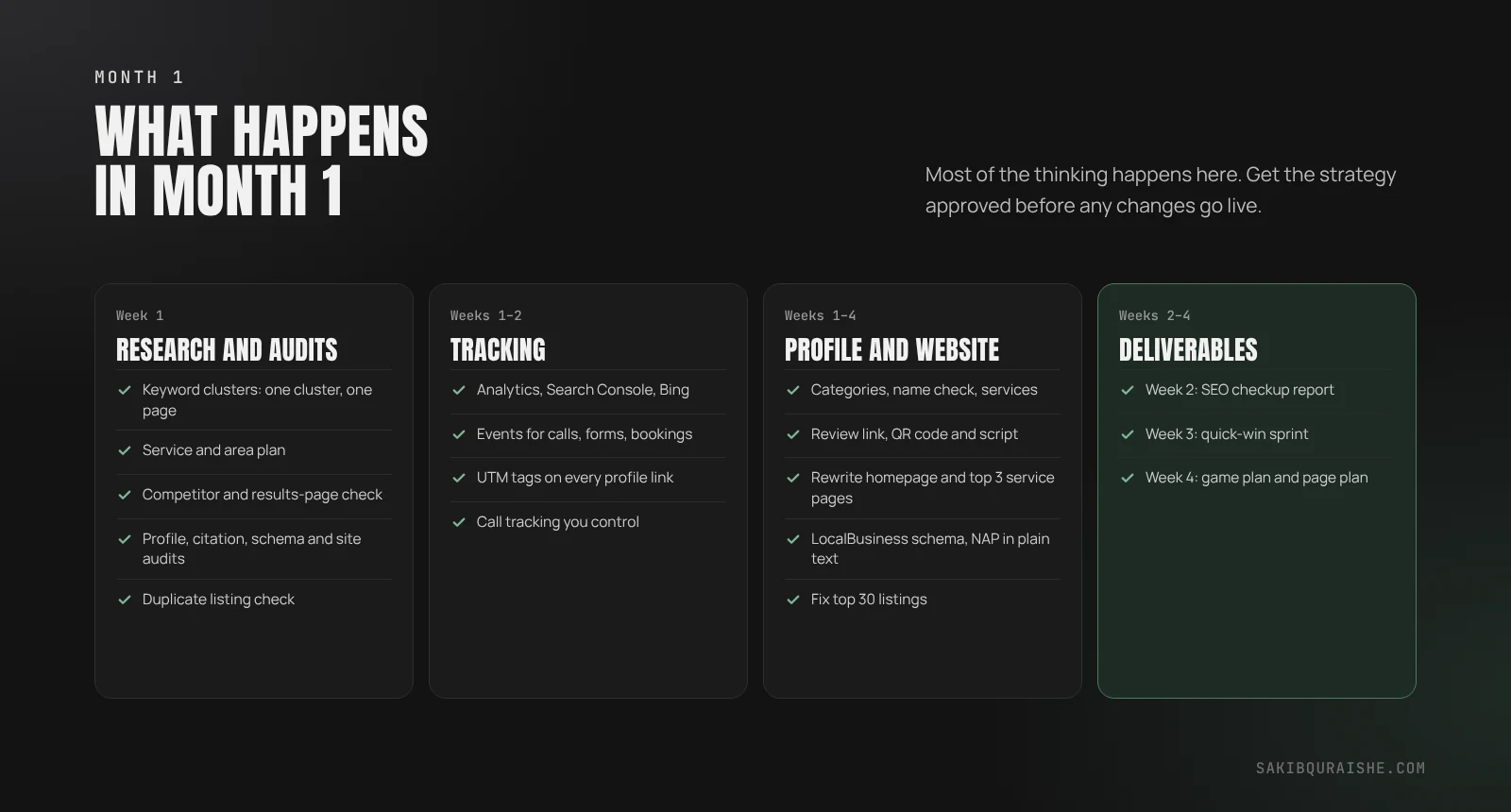
Month 1 is where most of the thinking happens. By the end of it, you should know exactly which page targets which keyword, what's broken, and what you'll do about it.
Week 1: research and audits
- Keyword clustering: group keywords so each group gets one page. One cluster, one page.
- Service and area plan: a matrix of services, cities and ZIP codes, so every important service and area has a page that can rank.
- Competitor check: the three to five businesses that win the map pack, with their categories, review counts, photos and links.
- Search results check: for each main keyword, note whether there's a map pack, AI Overview, Local Services Ads or "People also ask".
- Audits: Business Profile, citations, schema, website quality and a ranking radius check showing your strong and weak zones on the map.
- Duplicate check: find old or duplicate listings. See how to find and remove duplicate listings.
Then stop and get the strategy approved before changing anything.
Weeks 1 to 2: tracking
Set up or check Google Analytics, Search Console, Bing Webmaster Tools and Tag Manager events for calls, forms, bookings and direction clicks. Add UTM tags to the website link on every profile (Google, Apple, Bing, Yelp, Facebook), so you can see which visits each one sends. Set up call tracking with a number the business controls.
Weeks 1 to 3: Business Profile
- Choose the primary and secondary categories from competitor research. See how to choose GBP categories.
- Check the business name against Google's rules. Google'sBusiness Profile guidelines say "including unnecessary information in your business name isn't permitted."
- Fill in services, products, a 750-character description, attributes, hours and holiday hours.
- Decide which page the profile links to: the homepage or a location page.
- Set up a review system: review link, QR code, message templates and a short script for staff, plus a weekly review target based on your top competitor.
See the Google Business Profile checklist, or have it done by myGoogle Business Profile optimization service.
Weeks 2 to 4: website
- Rewrite the homepage and top three service pages so each one answers the main question in its first lines.
- Add a cost section to each main service page ("[service] cost in [city]").
- Put your name, address, phone, hours and service areas in plain text, matching the profile exactly.
- Add LocalBusiness schema with areaServed and sameAs links to your profiles. See LocalBusiness schema.
- Check HTTPS, canonicals, mobile layout, Core Web Vitals and that every money page is indexed. Bigger fixes may need aTechnical SEO service.
- Strengthen trust: an About page, credentials, project or case study pages with real cities and photos, and an owner or expert author page.
Weeks 2 to 4: listings and other platforms
Fix name, address and phone on the top 30 listings, add 10 industry citations found in the competitor gap, and add your chamber of commerce and local business groups. Complete Apple Business Connect, Bing Places, Yelp, Facebook and Nextdoor. See NAP consistency.
Month 1 deliverables
- Week 2: an SEO checkup report with baselines, audit findings and quick wins.
- Week 3: a quick-win sprint: better titles and descriptions on pages already ranking between positions 5 and 20.
- Week 4: a game plan: early wins, the page plan with one keyword per page, and a website recommendation (keep, partly rebuild or redesign).
What does the monthly routine look like in months 2 to 6?
The monthly routine in months 2 to 6 repeats the same core work, so rankings and trust build steadily. Here's what each month includes in my plan:
| Area | Monthly work |
|---|---|
| Business Profile | Regular posts, about 10 new photos and a short video, 2 offer posts, updated products, holiday hours, a weekly health check for unwanted edits |
| Maps rankings | GeoGrid scans every two weeks, plus an action plan for 1 or 2 weak zones (a location page, a local post, citations or links) |
| Pages | Optimize 5 service pages, publish 1 new service page and 1 new location page, push 2 pages ranking between 4 and 20 |
| Content | 2 new blog posts, 2 older posts improved, 1 old post refreshed, 5 to 10 new internal links |
| Reviews | Reply to every review within 48 hours, track review speed against your target, ask on a second platform (Yelp, Facebook or industry) |
| Local links | 1 local PR, sponsorship or community link, 3 expert quote pitches, 2 unlinked brand mentions turned into links |
| Listings | Fix wrong listings and check the main data sources |
| AI visibility | Monthly AI share of voice, get listed on 2 sites AI tools cite, correct wrong facts, 1 cost or comparison page, 2 short FAQ videos, 3 to 5 new FAQs |
| Technical | Search Console coverage, Core Web Vitals, keyword cannibalization, schema and conversion tracking checks |
| Conversion | One quick fix a month from heatmap review |
| Reporting | A weekly green/yellow/red health check and a monthly report |
Weak-zone plans are the part most strategies miss. If a GeoGrid shows you rank well near your office but poorly in a nearby suburb, pick that zone and give it focused work for a month: a location page, local posts, citations and links from that area. See why you rank at your office but not 2 miles away.
Local link work in this plan is about real local relationships, not volume. See local link building or myLocal Link Building service.
Striking-distance pages are pages ranking between positions 4 and 20 in Search Console. They're the fastest wins, because a better title, clearer answer or a few internal links can push them into the top three.
What changes at day 90?
At day 90, you stop and compare everything with your baseline. This is a proper review, not just another monthly report:
- Maps: GeoGrid now vs day 1, by keyword and by zone.
- Search: clicks, impressions and positions from Search Console.
- AI: a full re-run of every AI question across every AI tool.
- Leads: calls, forms and bookings vs the three-month baseline.
- Next 90 days: keep what worked, drop what didn't, and pick the next weak zones and pages.
Most businesses see clear map movement within 8 to 12 weeks, so day 90 is usually when you can see whether the plan is working. Crowded cities and new profiles can take three to six months. See how long it takes to rank in the 3-Pack.
From my own work: a cash home buyer in Oak Creek, Wisconsin went from an average map rank of 20.23 to 1.53 in four months (case study), and a roofer in Scottsdale, Arizona went from 0% to 49% top-of-map coverage in four months (case study).
What happens in months 4 and 5?
Months 4 and 5 keep the monthly routine running and add work that only makes sense once the foundations are in place:
Month 4
- Content gap analysis: topics your competitors cover that you don't.
- Featured snippets: target five keywords where you could win the answer box.
- Competitor backlink gap: sites linking to competitors but not to you.
- AI competitor check: which sources AI tools cite for competitors.
Month 5
- Re-audit: Business Profile, competitors and website again, to catch new problems and new competitor moves.
- Topical map refresh: update your content plan with what you've learned.
- Service page conversion audit: pages that get traffic but not calls.
- Brand mention outreach: turn mentions of your business into links.
- AI progress report: how your AI share of voice has changed since day 1.
What should you have by day 180?
By day 180, you should have a measurable change in calls and leads, a stronger map position across more of your area, and a clear plan for the next six months. The final month includes:
- A second re-audit of your profile, competitors and website.
- A 6-month performance deep dive: Maps, search, AI and leads vs day 1.
- A full AI visibility report.
- A local PR plan for the next stage.
- A strategy for months 7 to 12, including new areas, services or content.
Typical outputs after 180 days of this plan: a fully optimized profile with steady reviews, around 10 new service and location pages, around 12 new blog posts, a set of real local links, and a tracking setup that shows exactly where calls come from. More in how to calculate local SEO ROI.
How do you track a local SEO strategy?
You track a local SEO strategy with a simple scorecard across three areas, plus the leads they bring:
| Pillar | What to track | Where |
|---|---|---|
| Maps | GeoGrid rankings, calls, direction requests, website clicks | GeoGrid tool, Business Profile Performance report |
| Search | Clicks, impressions, positions, pages ranking 4–20 | Google Search Console |
| AI | How often AI tools recommend you, and which sources they cite | Manual checks or an AI visibility tool |
| Leads | Calls, forms and bookings by source | Call tracking, Google Analytics, Tag Manager events |
Use a weekly health check (green, yellow or red) to catch problems early, and a monthly report for trends. Judge the strategy on leads, not just rankings. See local SEO KPIs.
How do you build AI search into the plan?
You build AI search into the plan from day one, because the same signals feed both Google and AI tools.BrightLocal's 2026 consumer survey found 45% of consumers now use ChatGPT or other AI tools to find local recommendations, up from 6% a year earlier. For clear "near me" searches, the map pack still leads:Whitespark's 2025 study found the map pack on 93% of local-intent searches and AI Overviews on only 15%.
The AI work in this plan:
- Baseline: 25 to 50 real customer questions, from "best plumber in Tempe" to "how much does a water heater cost".
- Cited-source map: list the websites AI tools quote for those questions, then get your business onto them (directories, "best of" lists, local news).
- Consistent facts: the same short business description everywhere, plus schema linking your website to your profiles.
- Answer-first content: pages that answer cost, comparison and "how to choose" questions clearly.
- Monthly share of voice: how often you're recommended compared with competitors.
You don't need special AI-only files or rewrites. Google's AI optimization guidance lists tactics like llms.txt as not needed for its AI features (Search Engine Journal). More in GEO explained or myAI Search Optimization service.
What should you leave out of a local SEO strategy?
You should leave out tactics that are outdated or that break Google's rules, even if they still appear in some agency checklists:
- Link networks and "stacking". Networks of self-made sites, map embeds or driving-direction links built only to pass links. Google'sspam policies treat links "intended to manipulate rankings in Google Search results" as link spam.
- Bulk citations. Hundreds of low-quality directories don't help. See why citation blasts don't work.
- Geotagging photos. Google's John Mueller has said there's "no need to geotag images for SEO", and a 10-week test reported bySearch Engine Land found it hurt rankings outside the targeted towns.
- Posting Q&A on your profile. Google removed Q&A from Maps in December 2025.
- Keyword-stuffed names, fake addresses and fake reviews. These can get your profile suspended.
- Near-identical city pages. See ranking in multiple cities without thin pages.
More in common local SEO mistakes.
How much work does a 180-day plan take?
A full 180-day plan takes a lot of steady work. My plan has about 930 tasks and roughly 1,500 hours of estimated work across six months for one location, with month 1 taking almost twice as long as a typical month.
| Phase | Tasks | Estimated hours |
|---|---|---|
| Onboarding (days 1–5) | 34 | 60 |
| Month 1 | 207 | 380 |
| Months 2–6 (each) | 130–143 | 205–240 |
That's why most businesses hire help, or run a smaller version themselves. If you're doing it yourself, keep the order (baseline, plan, fix, build, review) and cut the volume: fewer posts, fewer pages, but the same weekly review habit. See how much local SEO costs and what a local SEO service includes.
FAQ
What should I do first in local SEO?
The first thing to do in local SEO is record your baseline: calls, leads, map rankings and how your profile looks today. Then fix your primary category and business details.
How long does a local SEO strategy take to work?
A local SEO strategy usually shows clear map movement within 8 to 12 weeks. Crowded cities and new profiles can take three to six months.
Can I run a local SEO strategy myself?
You can run a local SEO strategy yourself if you keep the same order and review results weekly. Most owners do a smaller version, with fewer posts and pages each month.
Is a 90-day plan enough?
A 90-day plan is enough to fix foundations and see early movement, but most businesses need six months to build steady rankings and reviews.
What if my profile is suspended or has duplicates at the start?
If your profile is suspended or has duplicates, fix that first, before any other work. See how to get a suspended profile back.
Does the plan change for multi-location businesses?
The plan works the same way for multi-location businesses, but each location needs its own profile, baseline, GeoGrid and location page. See multi-location SEO.
Want this plan run for you?
I'll start with the same baseline: your profile, rankings across your area, AI visibility and competitors, and show you what the first 90 days should focus on.Request a free local map audit, or see myLocal SEO service.
Sources
- Your Client Local SEO Management sheet, "Project management New" tab
- Your "RoadMap New" tab
- Your Local SEO service page
- Google Business Profile guidelines
- Google spam policies
- BrightLocal Local Consumer Review Survey 2026
- Whitespark AI Overviews study (2025)
- Search Engine Land: geotagging test
- Search Engine Journal on Google's llms.txt guidance
- Search Engine Roundtable
- Competitors checked