Local SEO terms are the words used to describe how businesses show up in Google Maps, the map pack and local search results. This glossary explains more than 100 of them in plain English, grouped by topic: search results, ranking, Google Business Profile, reviews, listings, your website, links, tracking, AI search and ads. It also flags the terms that are outdated, so you don't get confused by old advice.
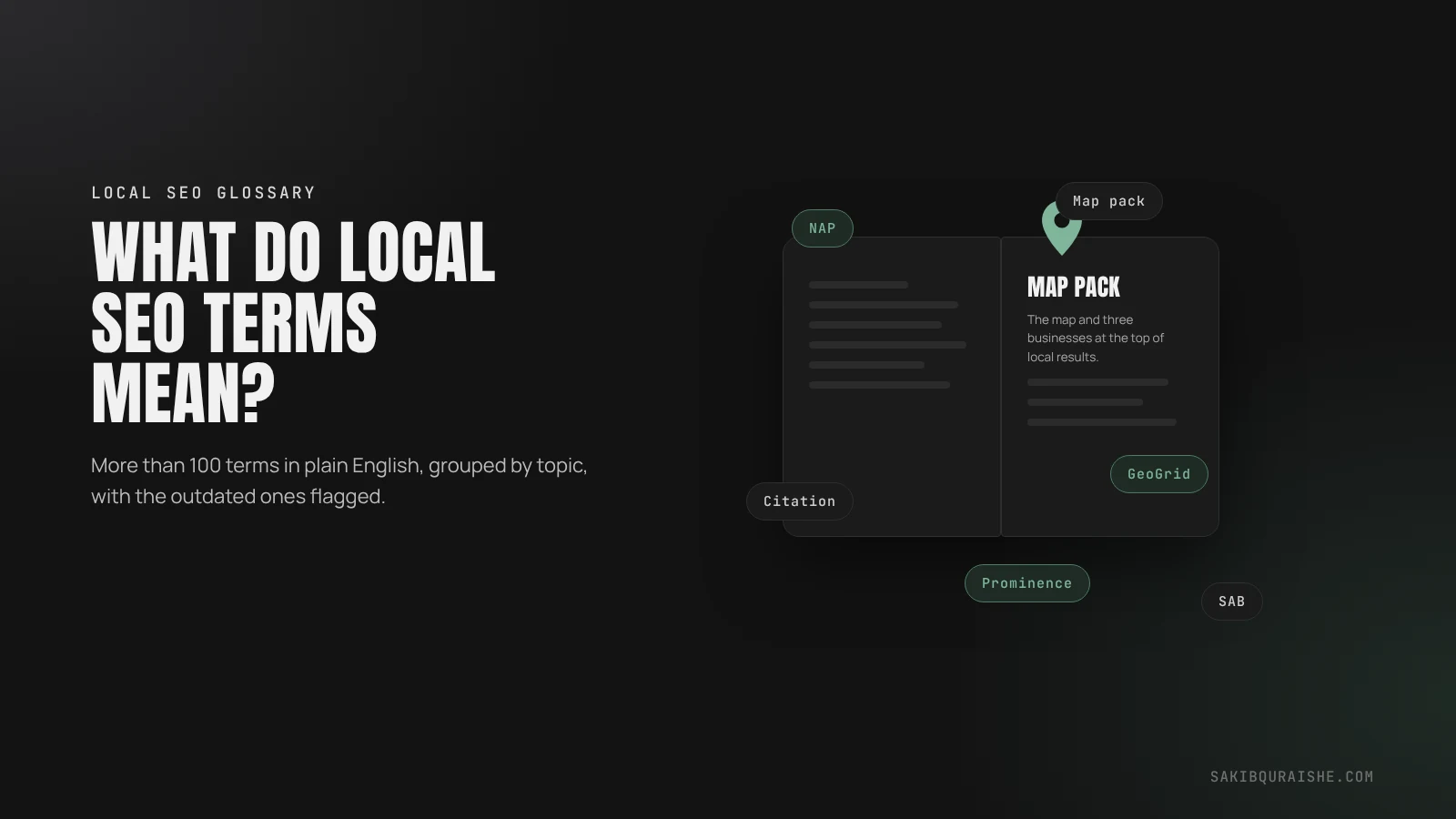
- Map pack = the map and three businesses at the top of Google. Local finder = the longer list you see after clicking "more places".
- NAP = your business name, address and phone. Citation = any place online that lists them.
- Relevance, distance and prominence are the three main factors Google uses to rank local results.
- GeoGrid = a scan showing your map ranking across many points in your area.
- GEO and AEO = getting your business mentioned in AI answers.
- Outdated: "Google My Business" is now Google Business Profile, and Q&A was removed from Google Maps in late 2025.
What do local SEO terms mean?
Local SEO terms describe three things: where your business shows up, how Google decides who ranks, and the work that improves your position. You don't need to learn all of them. Start with these five, which come up in almost every conversation about local SEO:
| Term | Plain meaning |
|---|---|
| Google Business Profile | Your free listing on Google Search and Maps |
| Map pack | The map and three businesses at the top of local results |
| NAP | Your business name, address and phone number |
| Citation | Any website that lists your business details |
| GeoGrid | A scan of your map ranking across your whole area |
The rest are grouped by topic below. If you're new to local SEO, start with what local SEO is and how it works.
What do the local search results terms mean?
These terms describe the different places your business can appear when someone searches.
- Local search: any search where the person wants something nearby, like "dentist near me" or "pizza".
- Local intent: when Google decides a search is about something nearby, even without a place name.
- "Near me" search: a search that asks for results close to the searcher. See how "near me" searches work.
- Geo-modifier: a place name added to a search, like "Tempe" in "roof repair Tempe".
- SERP: search engine results page, the page of results you see after searching.
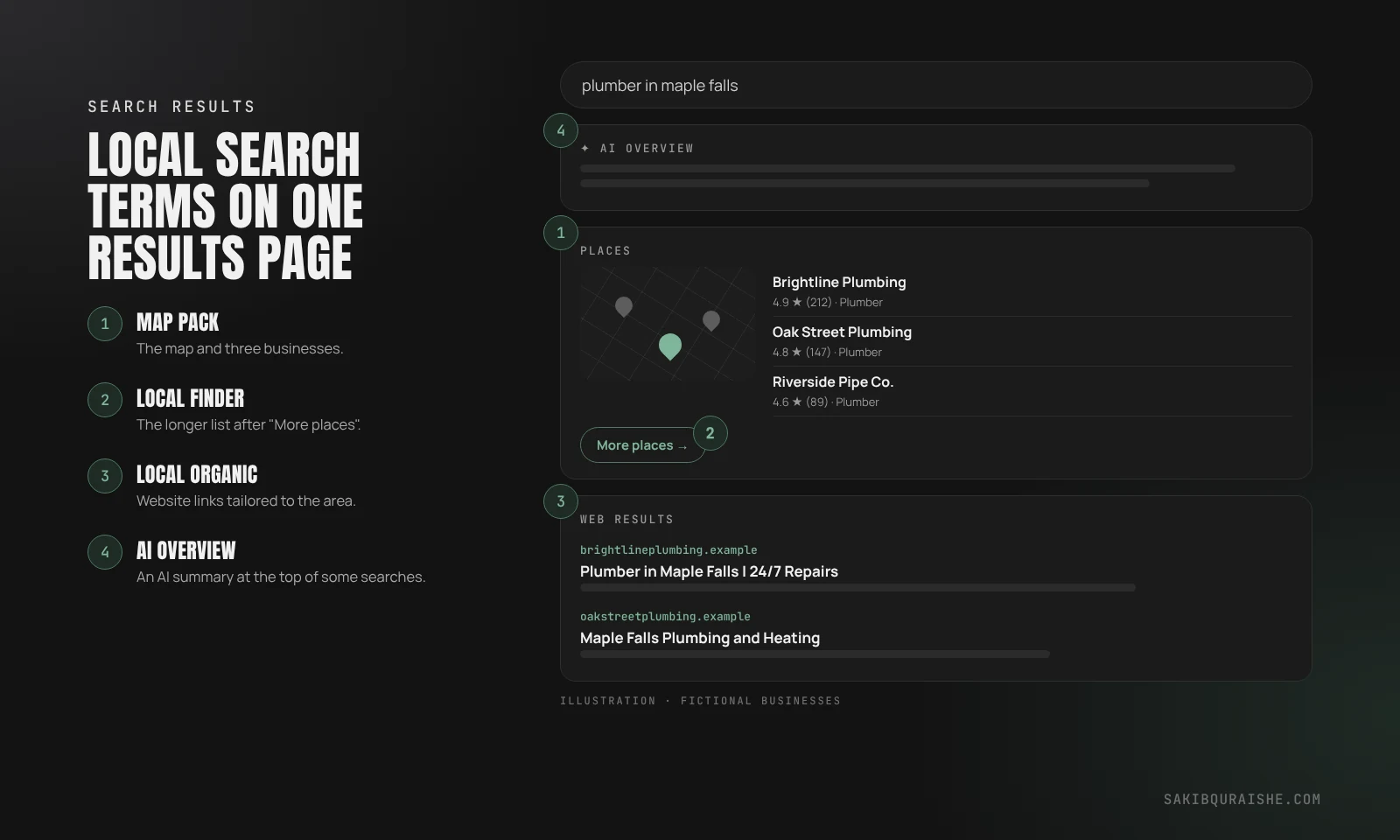
- Map pack (also local pack or 3-Pack): the map and three business listings at the top of local results.
- Local finder: the longer list of businesses you see after clicking "more places" or "more businesses" under the map pack.
- Local organic results: normal website links below the map pack, tailored to the searcher's area.
- Knowledge panel: the box with one business's details (photos, hours, reviews) that appears when you search for that business by name.
- Google Maps results: the list of businesses you see when searching inside the Maps app.
- Zero-click search: a search where people get what they need on the results page (a phone number, hours, an AI answer) without clicking a website.
What do the ranking terms mean?
These terms describe how Google decides which businesses to show.
- Relevance: how well your business matches the search. Google'slocal ranking help page defines it as "how well a Business Profile matches what someone is searching for."
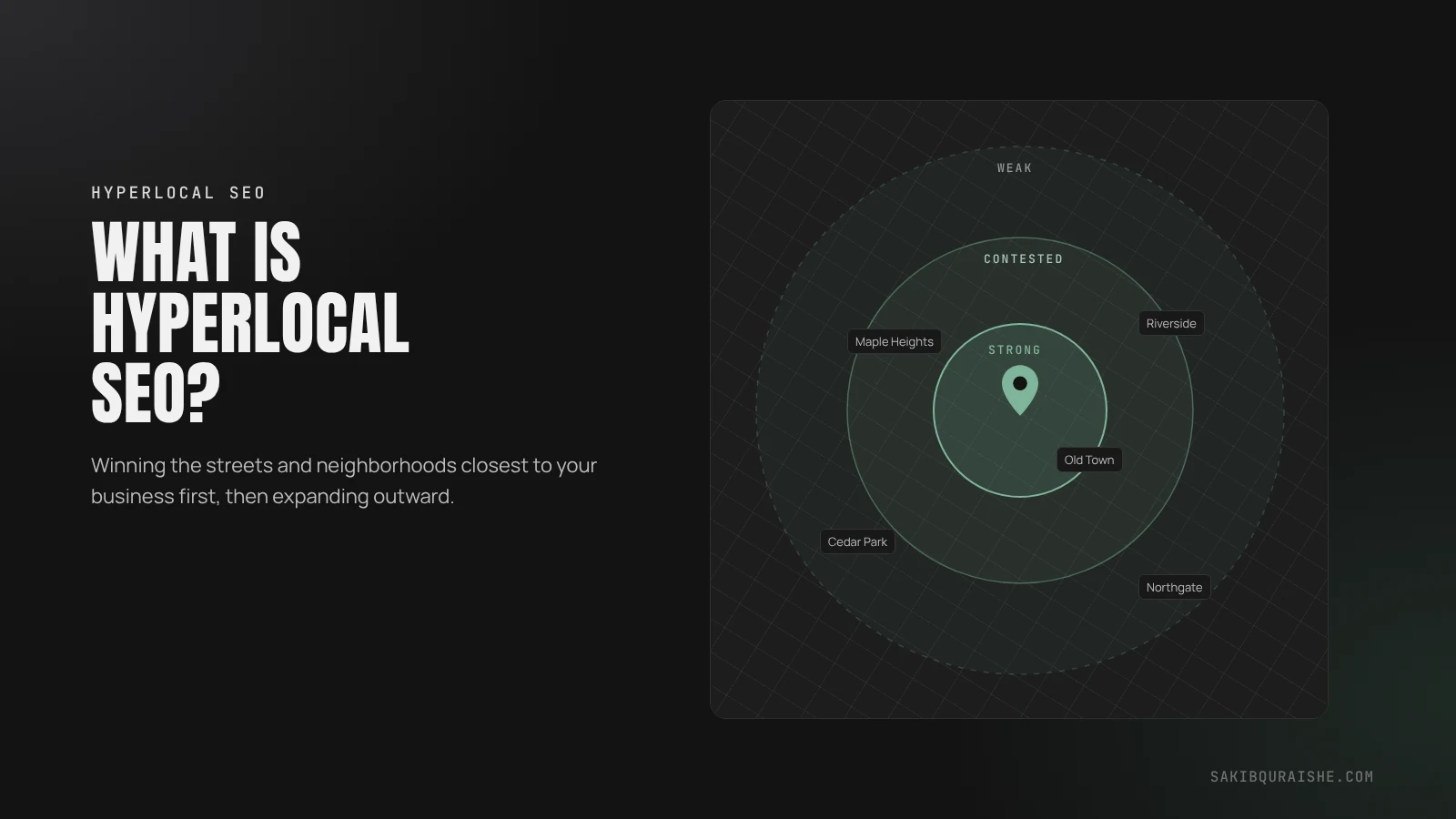
- Distance (also proximity): how far your business is from the person searching, or from the place they named.
- Prominence: how well known your business is, based on things like reviews and links. Google's help page now summarizes local results as "mainly based on relevance, distance, and popularity."
- Ranking factor: anything that affects where you rank. Google confirms only the broad ones; most detailed lists, likeWhitespark's Local Search Ranking Factors, are expert surveys.
- Centroid: an industry term for the center point Google may use for a city when it doesn't know exactly where the searcher is.
- Filter: when Google hides some businesses that look too similar, such as several businesses at the same address in the same category.
- Spam: fake listings, keyword-stuffed names or fake reviews that break Google's rules. See how to report fake competitors on Google Maps.
What do the Google Business Profile terms mean?
These terms describe your free listing on Google and its settings.
- Google Business Profile (GBP): your free business listing on Google Search and Maps. It was called Google My Business until November 2021.
- Primary category: the one category that best describes your business, like "Plumber". It's one of the strongest ranking signals. See how to choose GBP categories.
- Secondary categories: extra categories for other things you really do.
- Services: the list of services shown on your profile, with optional descriptions.
- Products: items or packages you can show on your profile, with photos and prices.
- Attributes: extra details like "wheelchair accessible", "women-owned" or "online appointments".
- Business description: a short summary of your business, up to 750 characters.
- Hours, special hours and more hours: your regular opening times, holiday times, and separate times for things like delivery or pickup.
- Posts: short updates, offers or events published on your profile.
- Photos and videos: images of your work, team and premises shown on your profile.
- Storefront: a business customers visit at its address.
- Service-area business (SAB): a business that travels to customers and hides its address. Google says the service area "shouldn't extend farther than about 2 hours of driving time" from the business base, per itsBusiness Profile guidelines.
- Hybrid business: a business that serves customers at its address and also travels to them.
- Practitioner listing: a separate profile for an individual professional, like a doctor or lawyer, who deals with the public at the verified location.
- Verification: proving to Google that you own or manage the business, often by video.
- Owner and manager: the two main access levels on a profile. You should stay the owner; agencies only need manager access.
- Suggested edit: a change to your profile proposed by the public or by Google. Check these regularly.
- Duplicate listing: a second profile for the same business, which splits your reviews and signals. See how to find and remove duplicate listings.
- Suspension: when Google disables a profile, usually for breaking its guidelines. See how to get a suspended profile back.
- Reinstatement: getting a suspended profile restored after an appeal.
- Performance report: the stats in your profile showing searches, views, calls, direction requests and website clicks. It used to be called Insights.
- Place ID: a unique code Google gives every place on Maps. It's used to build review links and in tools.
- Keyword stuffing (in names): adding extra words to your business name to rank. Google's guidelines say "including unnecessary information in your business name isn't permitted." See keywords in your business name.
Prefer to have your profile set up and managed for you? See myGoogle Business Profile optimization service.
What do the review terms mean?
These terms describe customer reviews and how you manage them.
- Star rating: the average score from your reviews, from 1 to 5.
- Review count: how many reviews you have.
- Review velocity: how fast new reviews come in, for example 8 a month.
- Review recency: how recent your newest reviews are.
- Owner response: your public reply to a review. See how to respond to Google reviews.
- Review link: a direct link that opens the review form for your profile.
- Review gating: asking only happy customers for reviews, or filtering unhappy ones out first. Google's policy bans "selectively soliciting positive reviews from customers."
- Incentivized review: a review given in exchange for a discount, gift or payment. Not allowed on Google.
- Fake review: a review not based on a real customer experience.
- First-party reviews: reviews collected on your own website.
- Third-party reviews: reviews on other sites, like Yelp or industry directories.
- Reputation management: monitoring and improving what people say about your business online.
More in how to get more Google reviews.
What do the listing and citation terms mean?
These terms describe where your business details appear across the web.
- NAP: your business name, address and phone number. NAP+W adds your website.
- NAP consistency: having the same NAP everywhere. See NAP consistency.
- Citation: any mention of your business details online, with or without a link.
- Structured citation: a listing on a directory with set fields, like Yelp or Bing Places.
- Unstructured citation: a mention in a news story, blog post or article.
- Directory: a website that lists businesses, like Yelp, Yellow Pages or industry-specific sites.
- Data aggregator: a company that collects business data and supplies it to many other sites and apps. See data aggregators.
- Citation building: adding your business to relevant directories.
- Citation cleanup: fixing or removing wrong listings. See citation building vs cleanup.
- Citation blast: submitting a business to hundreds of low-quality directories at once. Rarely useful.
- Unclaimed listing: a listing for your business that nobody has taken control of.
- Apple Business Connect: Apple's free tool to manage your listing on Apple Maps.
- Bing Places for Business: Microsoft's free tool to manage your listing on Bing and Bing Maps.
What do the website terms mean?
These terms describe the parts of your website that help local SEO.
- On-page local SEO: optimizing your website pages for local searches. See on-page local SEO.
- Service page: a page about one service, like "Water Heater Repair".
- Location page (also city page): a page about one location or area you serve.
- Local landing page: the page your Business Profile links to, usually your homepage or a location page.
- Doorway page: a near-identical page made only to rank for a place name, such as the same page copied for 50 cities with only the town changed. Google's spam policies treat these as spam. See ranking in multiple cities without thin pages.
- Title tag: the clickable headline of your page in search results.
- Meta description: the short summary under the title in search results. Google may rewrite it.
- Schema markup (structured data): code that tells search engines facts about your page in a standard format.
- LocalBusiness schema: the schema type for local business details like name, address, hours and geo coordinates. See LocalBusiness schema.
- Click-to-call: a phone number on your site that dials when tapped on a phone.
- Mobile-friendly: a site that's easy to use on a phone.
- Core Web Vitals: Google's measures of how fast and stable your pages feel to users. See myCore Web Vitals service.
What do the link and authority terms mean?
These terms describe how other websites build trust in your business.
- Backlink: a link from another website to yours.
- Local link: a backlink from a local website, like a local news site, chamber of commerce or community group.
- Anchor text: the clickable words in a link.
- Unlinked mention: a mention of your business name with no link.
- Authority: how trusted a website is, often estimated by third-party tools. Google doesn't use those tool scores.
- E-E-A-T: experience, expertise, authoritativeness and trust, the qualities Google's quality rater guidelines use to judge content.
- Entity: a real-world thing Google understands, like your business, with facts connected to it from many sources.
More in local link building, or see myLocal Link Building service.
What do the tracking and reporting terms mean?
These terms describe how you measure local SEO results.
- Rank tracking: checking where you rank for chosen keywords over time.
- GeoGrid (also grid scan or heat map): a scan showing your map ranking at many points across your area, in a grid. See what is a GeoGrid scan.
- Share of local voice (SoLV): the share of grid points where you appear in the top three. Used by some GeoGrid tools.
- Google Search Console: Google's free tool showing which searches bring people to your website.
- Google Analytics (GA4): Google's free tool showing what visitors do on your site.
- UTM tag: extra text added to a link, like your profile's website link, so its visits show up separately in Analytics.
- Call tracking: using special phone numbers to see which calls come from which source.
- Conversion: a valuable action, like a call, a booking or a form sent.
- KPI: key performance indicator, a main number you track, like calls per month. See local SEO KPIs.
- Local SEO audit: a full check of your profile, website, listings, reviews and competitors. See how to run a local SEO audit.
What do the AI search terms mean?
These terms describe how AI tools find and recommend local businesses.
- AI Overview: an AI-written summary at the top of some Google results.Whitespark's 2025 study found AI Overviews on 68% of local business queries but only 15% of clear local-intent searches.
- AI Mode: Google's chat-style search mode that answers with AI and follow-up questions.
- LLM (large language model): the type of AI behind tools like ChatGPT, Gemini and Claude.
- GEO (generative engine optimization): making your business more likely to be mentioned in AI answers. See GEO explained.
- AEO (answer engine optimization): making your content easy for search and AI tools to quote as a direct answer. See AEO vs GEO vs SEO.
- AI citation (or AI mention): when an AI answer names or links to your business or website.
- Ask button on Maps: Google's AI feature that answers questions about a business using its profile and reviews. It replaced the public Q&A section.
More on getting found in AI answers in myAI Search Optimization service.
What do the ads terms mean?
These terms describe paid options that appear near local results. They're separate from local SEO.
- Local Services Ads (LSA): ads at the top of some local searches where you pay per lead, not per click. Google says "you're charged for each valid lead" in itsLocal Services help.
- Google Guaranteed and Google Screened: badges shown on Local Services Ads after Google's checks. Google Guaranteed is used for many home services; Google Screened for professional services.
- Google Ads: pay-per-click ads in search results and on Maps.
- Promoted pins: paid listings shown on Google Maps.
Which local SEO terms do people mix up?
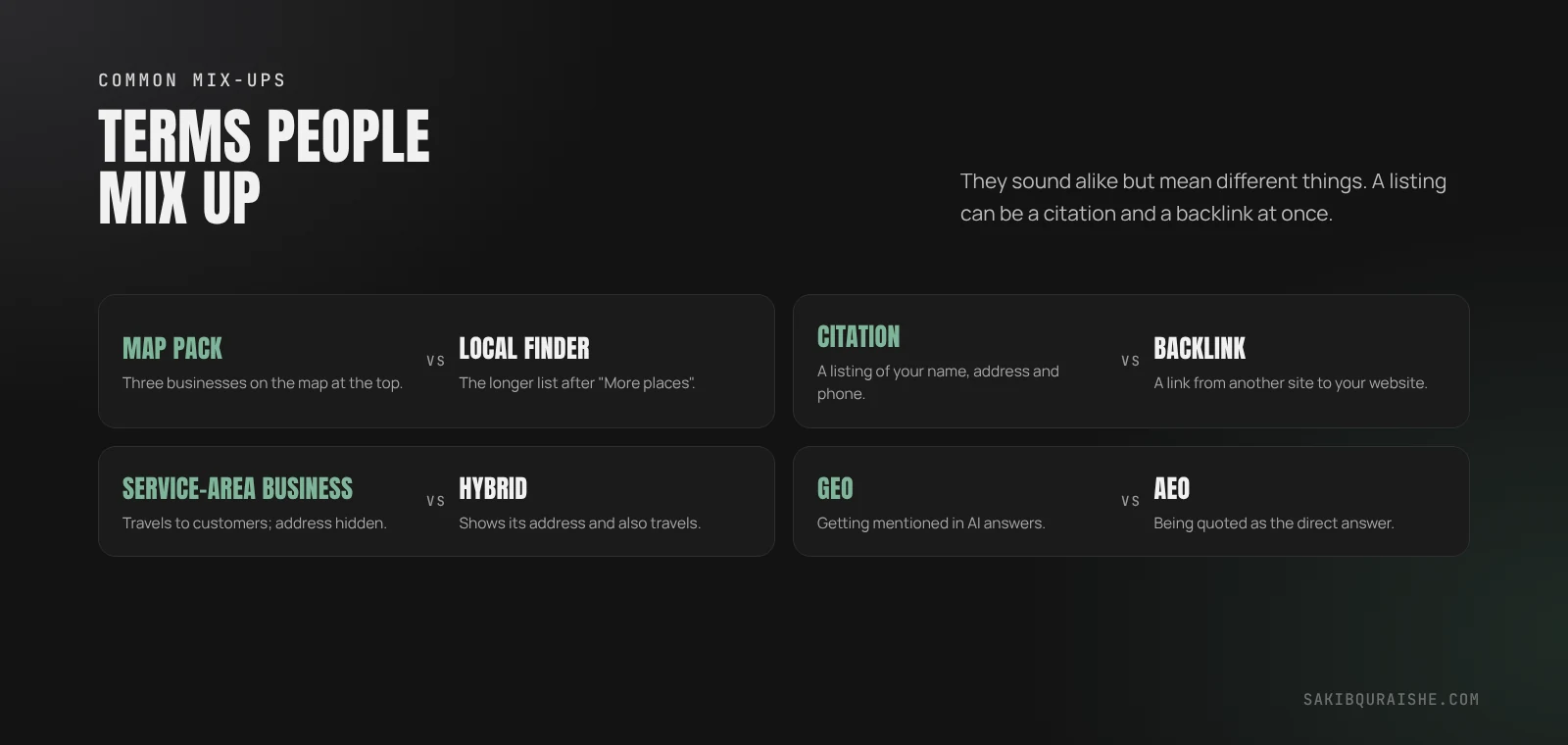
People mix up local SEO terms that sound alike but mean different things:
| Terms | The difference |
|---|---|
| Map pack vs local finder | The map pack shows three businesses; the local finder is the longer list after you click "more places" |
| Map pack vs local pack vs 3-Pack | Different names for the same thing |
| Distance vs proximity | Different names for the same factor |
| Prominence vs popularity | Google's help page defines prominence, then sums up the factors as "relevance, distance, and popularity" |
| Citation vs backlink | A citation lists your business details; a backlink links to your website. A listing can be both |
| Service-area business vs hybrid | A service-area business hides its address; a hybrid shows it and also travels to customers |
| Owner vs manager | The owner controls the profile; a manager can edit it but can't remove the owner |
| GEO vs AEO | GEO aims for mentions in AI answers; AEO aims for being quoted as the direct answer. They overlap |
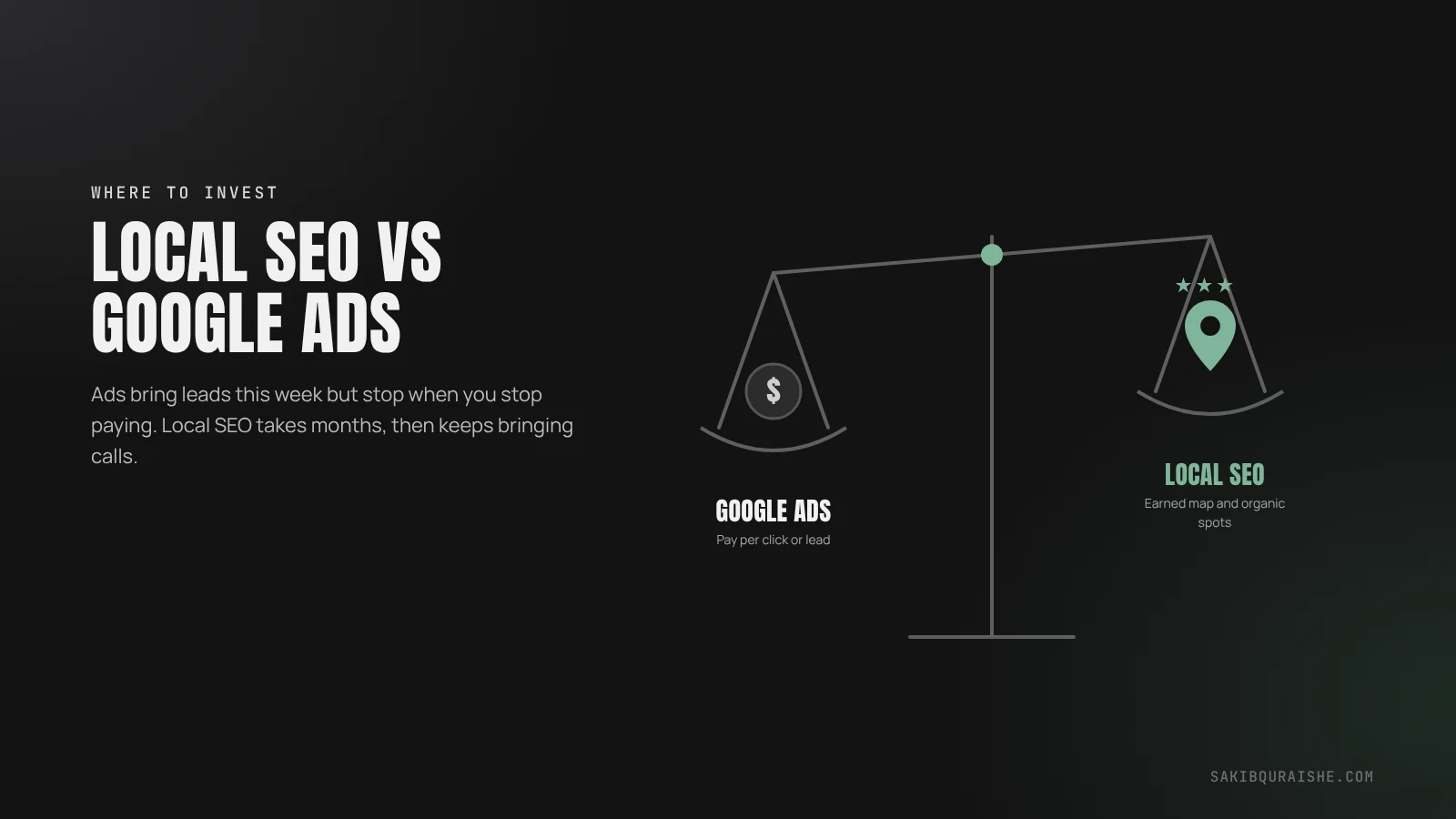
| Local SEO vs Local Services Ads | Local SEO is free placement you earn; Local Services Ads are paid per lead |
Which local SEO terms are outdated?
These local SEO terms are outdated, but you'll still see them in older articles and in some agency proposals:
| Old term | What it is now | When it changed |
|---|---|---|
| Google My Business (GMB) | Google Business Profile | Renamed in November 2021 (Search Engine Roundtable) |
| Google My Business app | Managed in Google Search and Maps instead | Retired after the 2021 rename |
| Google Places, Google+ Local | Older names for Google's business listings | Replaced when Google My Business launched in 2014 |
| Insights | Performance report | Renamed inside Business Profile |
| Google Business Messages | Retired chat feature | Shut down in 2024 |
| Q&A on Google Maps | AI-powered Ask button | Removed from Maps in December 2025 (Search Engine Roundtable); the Q&A API ended November 3, 2025 |
| FAQ rich results | No longer shown in Google Search | Ended May 7, 2026 |
| Possum | An industry nickname for a 2016 Google local update that filtered similar nearby businesses | Still used as shorthand for filtering |
If a provider still talks about "optimizing your GMB Q&A", their advice may be out of date.
A–Z index
A: AEO, AI citation, AI Mode, AI Overview, Anchor text, Apple Business Connect, Ask button, Attributes, Authority · B: Backlink, Bing Places, Business description · C: Call tracking, Centroid, Citation, Citation blast, Citation building, Citation cleanup, Click-to-call, Conversion, Core Web Vitals · D: Data aggregator, Directory, Distance, Doorway page, Duplicate listing · E: E-E-A-T, Entity · F: Fake review, Filter, First-party reviews · G: GEO, Geo-modifier, GeoGrid, Google Ads, Google Analytics, Google Business Profile, Google Guaranteed, Google Maps results, Google Screened · H: Hours, Hybrid business · I: Incentivized review · K: Keyword stuffing, Knowledge panel, KPI · L: LLM, Local finder, Local intent, Local landing page, Local link, Local organic results, Local search, Local Services Ads, LocalBusiness schema, Location page · M: Manager, Map pack, Meta description, Mobile-friendly · N: NAP, NAP consistency, "Near me" search · O: On-page local SEO, Owner, Owner response · P: Performance report, Place ID, Posts, Practitioner listing, Primary category, Products, Promoted pins, Prominence · R: Rank tracking, Ranking factor, Reinstatement, Relevance, Reputation management, Review count, Review gating, Review link, Review recency, Review velocity · S: Schema markup, Secondary categories, SERP, Service page, Service-area business, Services, Share of local voice, Spam, Star rating, Storefront, Structured citation, Suggested edit, Suspension · T: Third-party reviews, Title tag · U: Unclaimed listing, Unlinked mention, Unstructured citation, UTM tag · V: Verification · Z: Zero-click search
FAQ
What does NAP mean in local SEO?
NAP means your business name, address and phone number. Keeping it the same everywhere helps customers and search engines trust your details.
What is a citation in local SEO?
A citation in local SEO is any online mention of your business details, like a listing on Yelp or a mention in a local news story.
What's the difference between the map pack and the local finder?
The map pack shows three businesses at the top of results. The local finder is the full list you see after clicking "more places".
Is Google My Business the same as Google Business Profile?
Google My Business is the old name for Google Business Profile. Google renamed it in November 2021.
What happened to Q&A on Google Business Profile?
Q&A was removed from Google Maps in December 2025 and replaced by an AI-powered Ask button. Businesses can still answer questions in their profile dashboard, and Google may use those answers.
What is a GeoGrid in local SEO?
A GeoGrid in local SEO is a scan showing your map ranking at many points across your area, so you can see where you're strong and where you're weak.
Want help with any of this?
If you'd rather not learn every term, I'll check your Business Profile, listings and rankings and explain what matters for your business in plain English.Request a free local map audit, or see myLocal SEO service.
Sources
- Google: how local ranking works
- Google Business Profile guidelines
- Google: Local Services Ads leads
- Search Engine Roundtable, Nov 5, 2021
- Search Engine Roundtable, Dec 15, 2025
- PPC Land
- Google review policy on "selectively soliciting positive reviews" (via Search Engine Roundtable).
- Whitespark Local Search Ranking Factors
- FAQ rich results ended May 7, 2026 (Google statement, checked for an earlier post).
- Google Business Messages retired in 2024 (noted in BrightLocal's glossary; recheck the exact date before publishing).