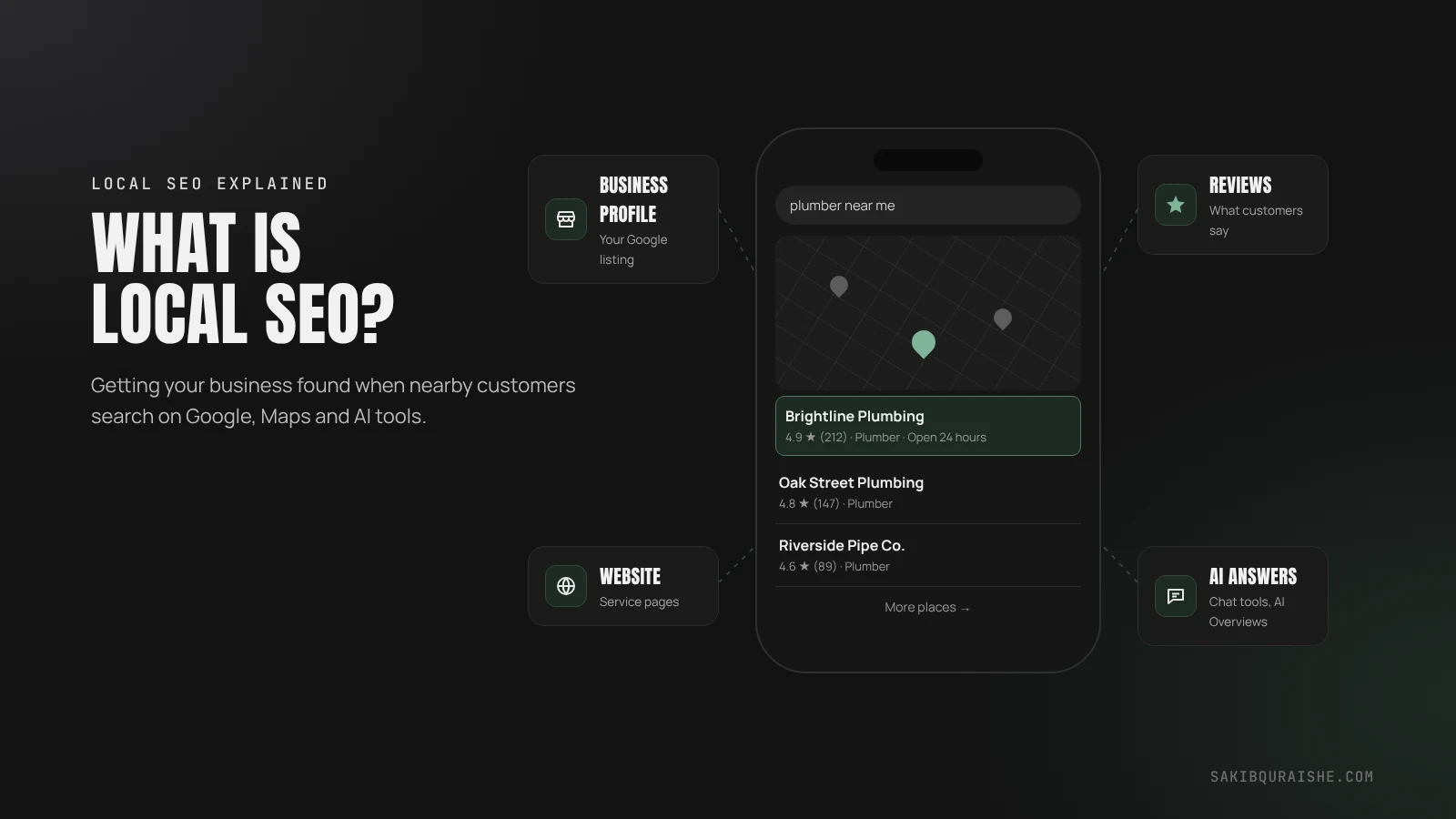
Local SEO is the work that helps nearby customers find your business when they search on Google, Google Maps and AI tools like ChatGPT. It covers your Google Business Profile, your website, your reviews and your listings across the web. Google ranks local results on relevance, distance and prominence, and local SEO improves the two you can control.
- Local SEO gets you found by people searching for what you do, near where you do it.
- It helps you show up in five places: the map pack, Google Maps, regular search results, AI answers and other map apps.
- Google ranks local businesses on relevance, distance and prominence. You can't change distance, so you work on the other two.
- The six building blocks: Google Business Profile, website, reviews, consistent business details, local links and mentions, and tracking.
- Most real campaigns see strong map results in four to six months.
I've spent more than four years doing nothing but local SEO, across 200+ Google Business Profiles. This guide explains it without jargon: what it is, how it works, and where to start.
What is local SEO?
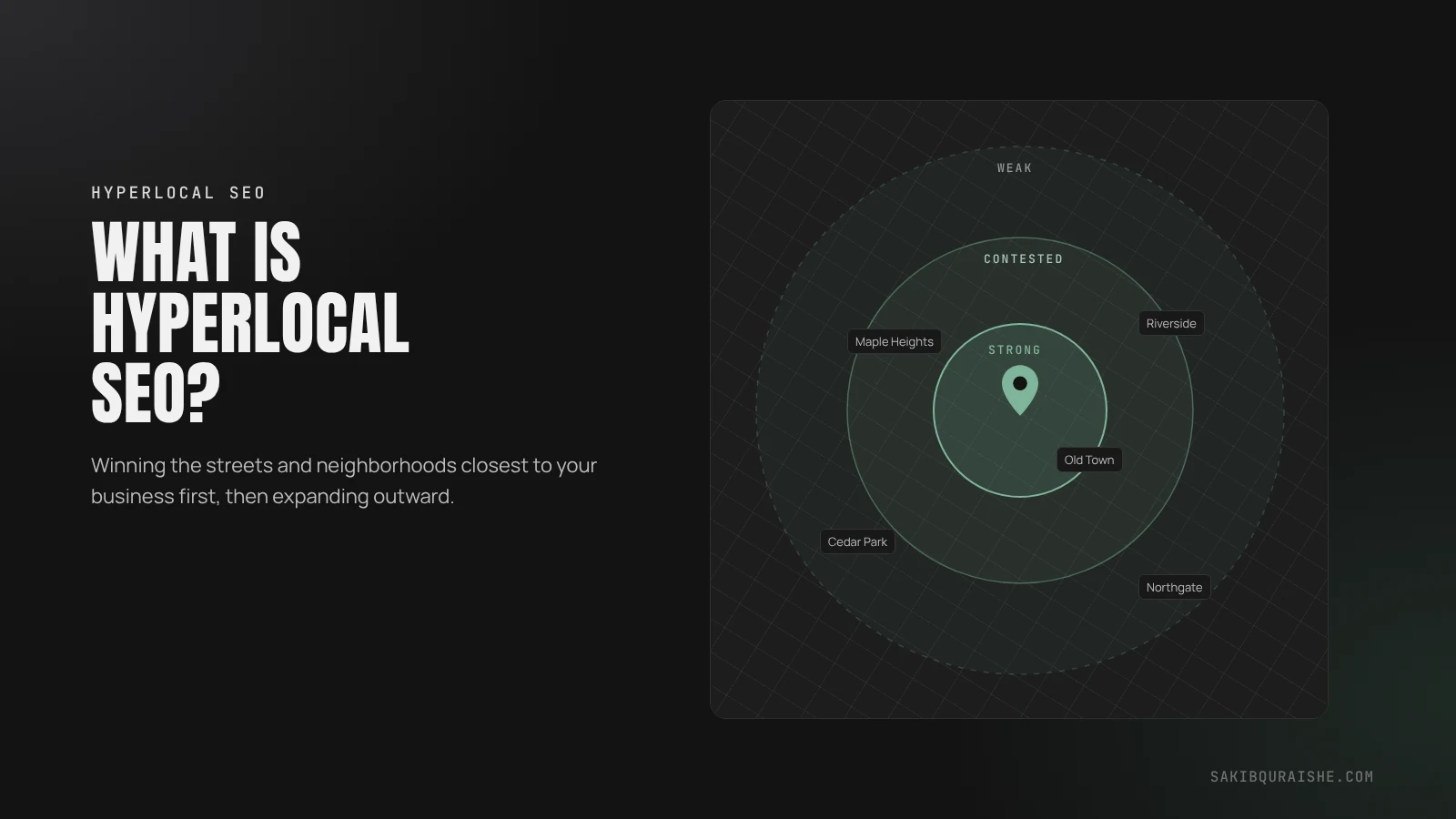
Local SEO (local search engine optimization) is the process of making your business more visible in search results for people near you. When someone searches "plumber near me", "dentist in Tempe" or "best coffee shop open now", Google shows nearby businesses first. Local SEO is how you become one of them.
It's different from paid ads: you don't pay per click, and results last after the work is done. It's also different from regular SEO, which tries to rank a website anywhere in the country. More in local SEO vs regular SEO.
Why does local SEO matter for small businesses?
Local SEO matters for small businesses because it puts you in front of people who already need what you sell, close to where you are. They aren't browsing. They need a plumber, a dentist or a lunch spot now, and they usually choose from the first few businesses they see.
The numbers back this up:
- Google says customers are 2.7 times more likely to consider a business reputable when it has a complete Business Profile, and 50% more likely to consider buying from it.
- BrightLocal's 2026 consumer survey found 97% of people read reviews when choosing a local business, and 71% use Google to read them.
Local SEO for small business also has three practical advantages:
- You compete on being close, not on budget. Google says you can't pay to rank higher in local results, so a national chain can't simply outspend you.
- The results keep working. Unlike ads, a well-built profile and website keep bringing calls after the work is done.
- It feeds AI answers too. The same reviews, listings and website content are what AI tools read when they recommend a local business.
Wondering whether it pays off for you? See is local SEO worth it for a small business and how to calculate local SEO ROI.
Where does local SEO help you show up?
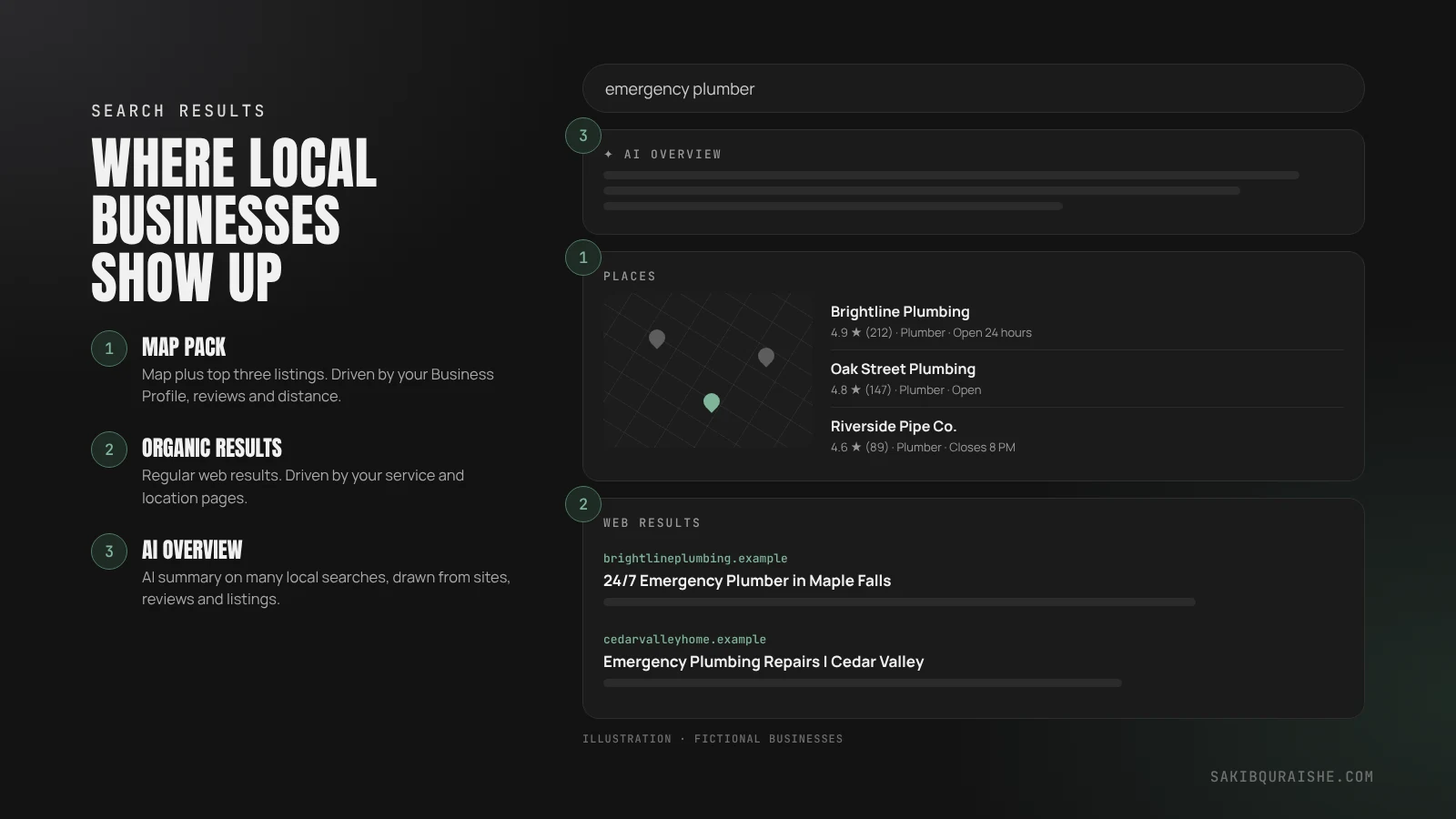
Local SEO helps you show up in five places when people search for local businesses:
| Where | What it looks like | What ranks there |
|---|---|---|
| Map pack (also called the local pack or 3-Pack) | A map and three businesses at the top of Google results | Your Google Business Profile |
| Google Maps | Results when people search inside the Maps app | Your Google Business Profile |
| Organic results | The regular blue links below the map pack | Your website pages |
| AI answers | Google AI Overviews and AI Mode, ChatGPT, Gemini, Perplexity | What's written about you across the web |
| Other maps | Apple Maps, Bing Maps, in-car navigation | Your listings on those platforms |
A business can appear in several of these at once for the same search. More on the map pack in how long it takes to rank in the Google Maps 3-Pack.
How does local SEO work?
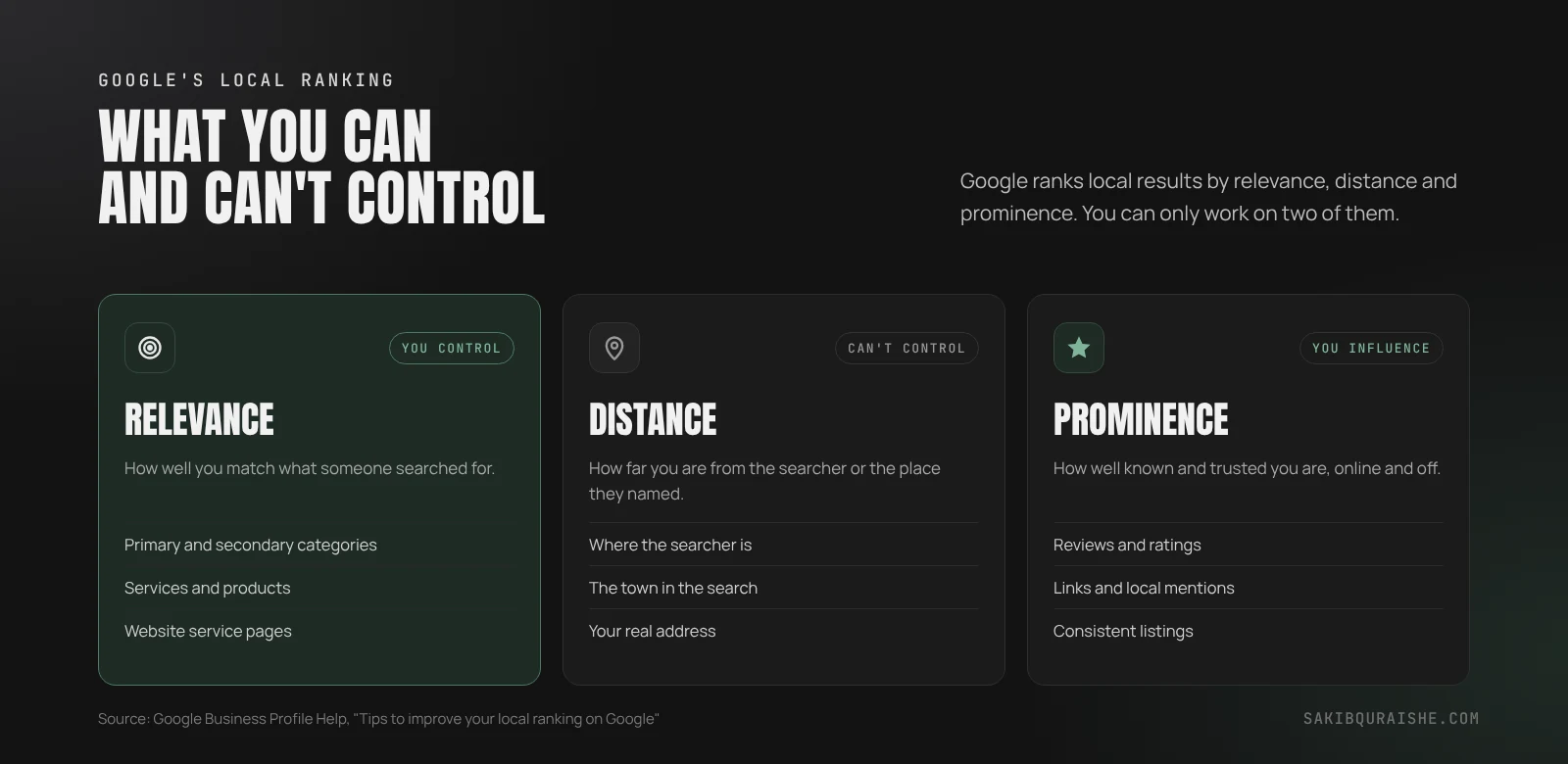
Local SEO works by giving Google enough clear, trustworthy information to choose your business for a nearby search. Google'shelp page on local rankings says local results are based mainly on three things:
- Relevance: how well your business matches what someone searched for.
- Distance: how far your business is from the searcher, or from the location in their search.
- Prominence: how well-known and trusted your business is, based on reviews, links, articles and listings across the web.
Google also says you can't pay to rank higher in local results. Ads appear separately and are labeled.
Industry research adds detail. InWhitespark's 2026 Local Search Ranking Factors survey of local SEO experts, the top factors for the map pack were your primary Business Profile category, distance from the searcher, keywords in the business name, having an address in the city searched, and being open at the time of the search. That's expert opinion, not Google confirmation, but it's the best data available.
What can you control and what can't you?
You can control relevance and prominence, but not distance. That's the most useful thing to understand about local SEO.
| Factor | Can you control it? | How to improve it |
|---|---|---|
| Relevance | Yes | Pick the right primary category, list every service, write clear service pages |
| Distance | No | Your verified address is your address. Never use a fake or virtual office |
| Prominence | Yes | Earn reviews, keep business details consistent, get mentioned and linked locally |
If you rank well at your office but not a few miles away, that's distance at work. The fix is to push relevance and prominence harder, not to fake addresses. See why you rank at your office but not 2 miles away.
What's the difference between local SEO and regular SEO?
The difference between local SEO and regular SEO is where you're trying to rank. Regular SEO helps a website rank for anyone searching anywhere. Local SEO helps a business rank for people searching nearby, so it includes things regular SEO doesn't:
| Local SEO | Regular SEO | |
|---|---|---|
| Main goal | Calls, visits, direction requests | Website traffic and sales |
| Key platform | Google Business Profile + website | Website |
| Location matters? | Yes, a lot | Usually not |
| Reviews | A major factor | Less important |
| Business listings | Important | Not relevant |
Most local businesses need both, because the same website pages support your map rankings and your organic rankings.
Which businesses need local SEO?
Local SEO helps any business that serves customers in a specific area, whether customers come to you or you go to them:
- Storefronts: restaurants, shops, clinics, salons, gyms.
- Service-area businesses: plumbers, roofers, electricians, cleaners, movers. See service-area business vs storefront.
- Professional services: lawyers, accountants, real estate agents.
- Multi-location brands: franchises and chains with several branches. See myNational & Enterprise SEO service.
Online-only businesses with no service area usually don't need it. More in which businesses need local SEO.
What are the main parts of local SEO?
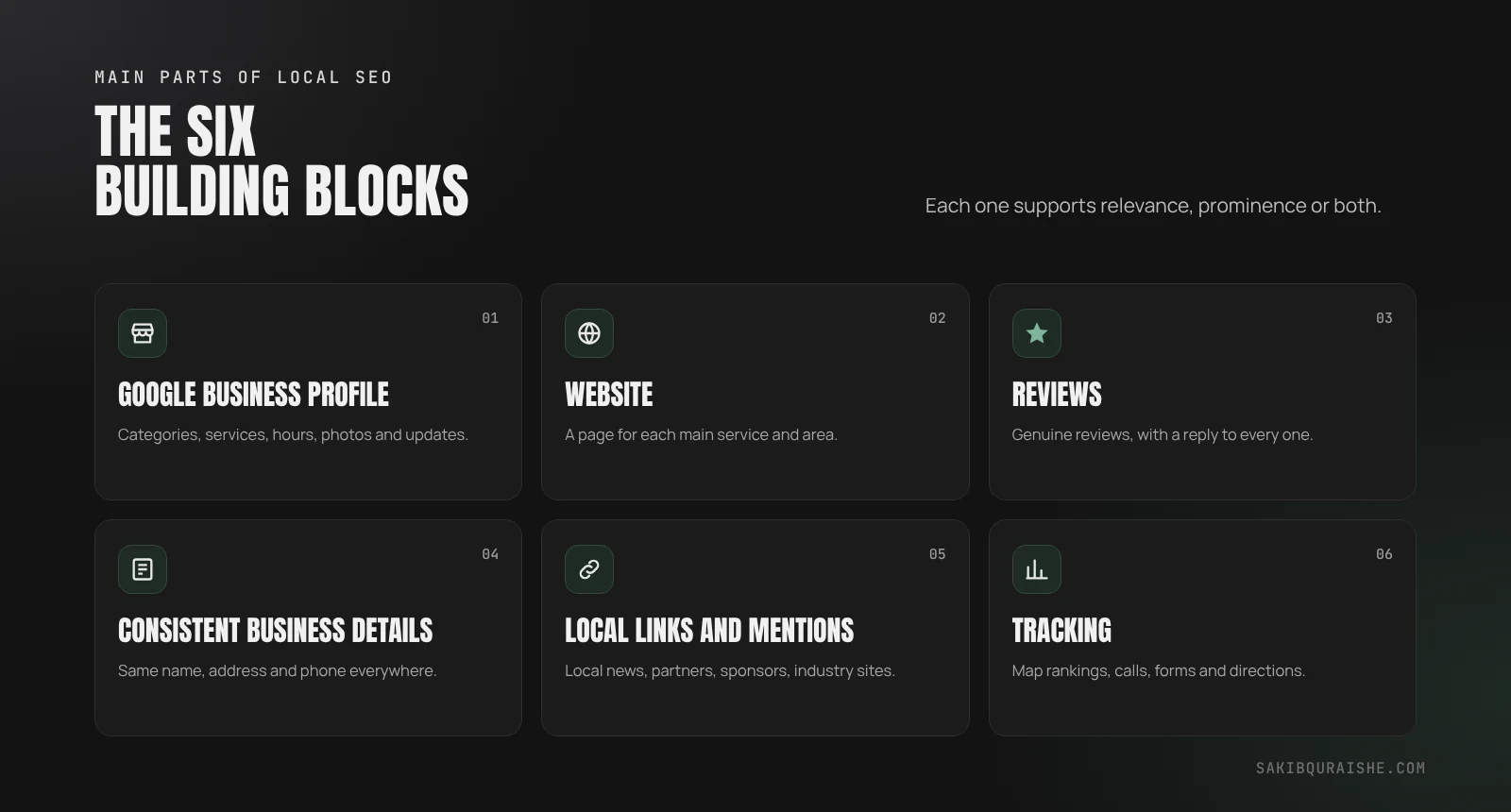
The main parts of local SEO are six building blocks. Each one supports relevance, prominence or both:
1. Google Business Profile
Your free listing on Google Search and Maps: categories, services, hours, photos and reviews. Google says customers are70% more likely to visit a business with a complete profile. The basics:
- Choose the most specific primary category, then add secondary categories only for services you really offer.
- List every service, your real hours (including holiday hours) and a plain description.
- Add real photos of your work, team and premises, and keep adding them.
See the Google Business Profile optimization guide, or have it handled by myGoogle Business Profile optimization service.
2. Your website
Your website tells Google what you do and where, and it's what ranks in the organic results below the map pack. The basics:
- One page per main service, with the service and city in the title tag and heading (for example "Water Heater Repair in Tempe").
- Your name, address and phone on every page, matching your Business Profile exactly.
- A site that loads quickly and works well on a phone.
- LocalBusiness schema so search engines read your details correctly. See LocalBusiness schema.
More in on-page local SEO. For schema, site structure and indexing fixes, see myTechnical SEO service. If your pages are slow on mobile, myCore Web Vitals service fixes that.
3. Reviews
BrightLocal's 2026 survey found 97% of consumers read reviews for local businesses. Reviews also feed prominence, one of Google's three ranking areas. The basics:
- Ask every customer, right after a good experience, with a direct review link or QR code.
- Reply to every review, good and bad. See how to respond to Google reviews.
- Never buy reviews or ask only happy customers. Google'sreview rules ban "selectively soliciting positive reviews from customers".
See how to get more Google reviews.
4. Consistent business details (NAP) and citations
Your name, address and phone (NAP) should be the same everywhere. BrightLocal found 62% of consumers would avoid a business with incorrect information online. Citations are the places those details appear: directories like Yelp, Bing Places, Apple Business Connect, Facebook and sites for your industry.
Start with the big platforms, fix any old or wrong listings, then add a few trusted industry directories. See NAP consistency and local citations.
5. Local links and mentions
Links and mentions from other local websites show Google (and AI tools) that real people know your business. Good sources:
- Local news stories and community blogs.
- Sponsorships of local teams, charities and events.
- Your chamber of commerce and local business groups.
- Nearby businesses you work with, and "best of" lists for your city.
See local link building, or myLocal Link Building service.
6. Tracking
Track rankings across your whole area, plus calls, leads and direction requests, so you know what's working. See what is a GeoGrid scan.
How do you find local keywords?
You find local keywords by looking at how real customers search for your service in your area, then matching your Business Profile and website pages to those words. Free ways to start:
- Type your service into Google and note the autocomplete suggestions and "People also ask" questions.
- Check the categories and services of the businesses already in the map pack. See how to choose GBP categories.
- UseGoogle Search Console to see which searches already show your website.
- Read your reviews and note the words customers use to describe what you did.
You don't need to stuff "near me" into your pages. Google already uses the searcher's location. More in how "near me" searches work.
Then give each main keyword one page on your site and one matching service on your profile, so your pages don't compete with each other.
How does local SEO work in AI search?
Local SEO works in AI search by making sure AI tools find accurate, consistent and positive information about your business. AI Overviews, ChatGPT, Gemini and Perplexity build their answers from your Business Profile, your website, reviews and what other sites say about you.
It's already common:
- BrightLocal's 2026 survey found 45% of consumers now use ChatGPT or other AI tools to find local recommendations, up from 6% a year earlier.
- Whitespark's2025 study of 540 local searches found AI Overviews on 68% of local business queries, but on only 15% of clear local-intent searches like "dentist near me", where the map pack appeared 93% of the time.
So for "near me" searches, the map pack still matters most. AI answers matter more for research questions like "how much does a roof replacement cost". The same local SEO work feeds both. See GEO explained and myAI Search Optimization service.
How long does local SEO take to work?
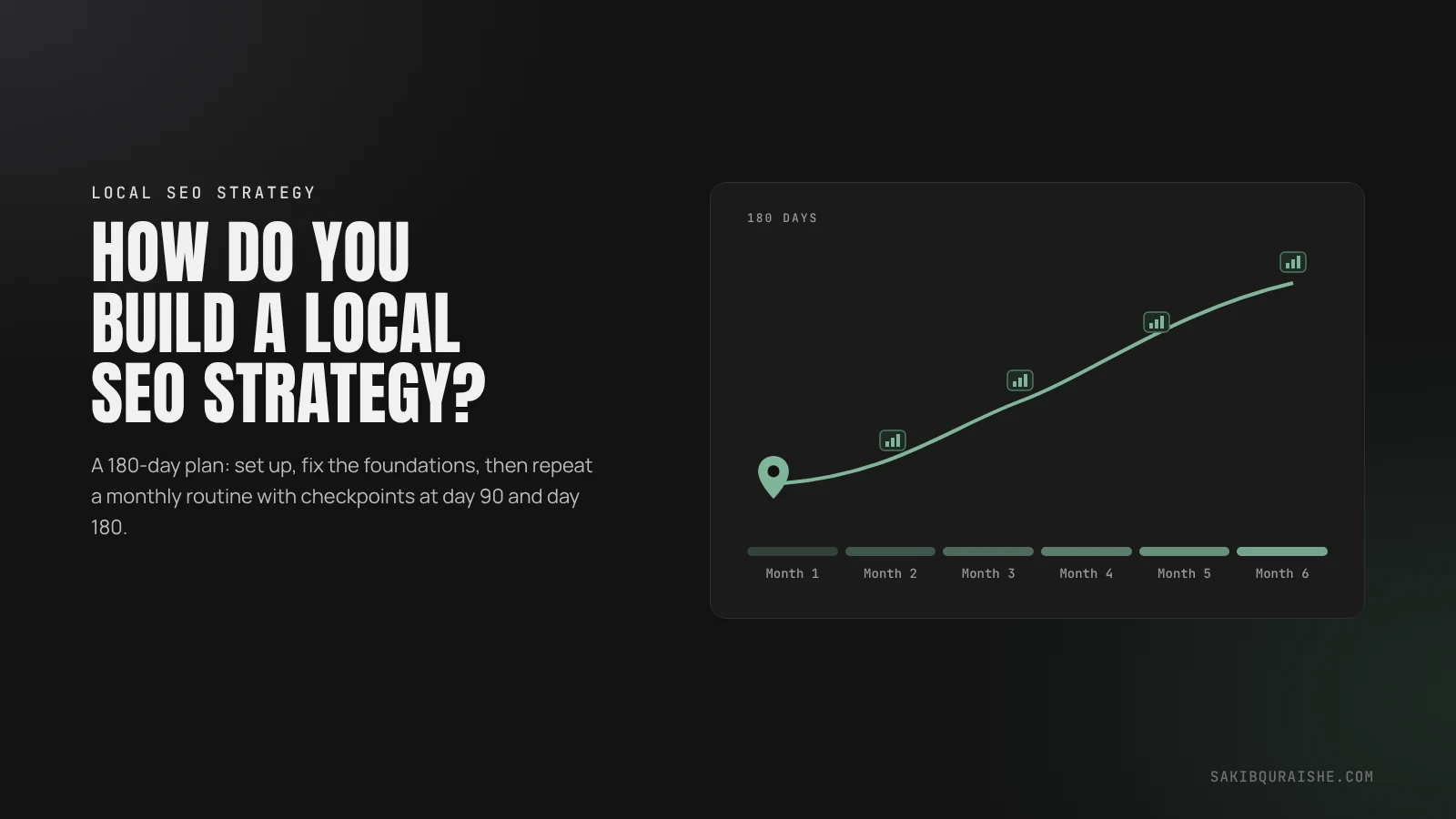
Local SEO usually takes four to six months to show strong results in the map pack, though quick fixes like correcting your category or hours can help within weeks. From my own campaigns:
- A cash home buyer in Oak Creek, Wisconsin went from an average map rank of 20.23 to 1.53 in four months.See the case study.
- A roofer in Scottsdale, Arizona went from 0% to 49% top-of-map coverage in four months.See the case study.
- A brand-new electrician in La Puente, California went from 2 to 28 calls a month in six months.See the case study.
New businesses and competitive markets take longer. More in how long it takes to rank in the Google Maps 3-Pack.
How do you measure local SEO?
You measure local SEO by the customer actions it brings, not just rankings:
- Calls, direction requests and website clicks from your Business Profile's Performance report.
- Leads and bookings from your website, tracked in Google Analytics.
- Rankings across your area, using a GeoGrid scan instead of one search from your office.
- Reviews, both the number and how recent they are.
One ranking check from your desk is misleading, because results change with every searcher's location.
Three free tools cover most of this: your Business Profile's Performance report (calls, directions, website clicks and the searches people used to find you), Google Search Console (which searches show your website) and Google Analytics (what visitors do next). Add a UTM tag to your profile's website link so those visits show up separately in Analytics. More in how to measure local SEO results.
What are the most common local SEO mistakes?
The most common local SEO mistakes are shortcuts that break Google's rules or quietly split your signals:
- Stuffing keywords into your business name. Google'sBusiness Profile guidelines say "including unnecessary information in your business name isn't permitted". See keywords in your business name.
- Using a virtual office or remote P.O. box. Google says these locations aren't eligible for a Business Profile.
- Picking a broad primary category when a more specific one exists.
- Leaving duplicate listings live. See how to find and remove duplicate listings.
- Buying reviews or asking only happy customers.
- Publishing near-identical city pages with only the town name swapped. See ranking in multiple cities without thin pages.
- Judging rankings from one search at your desk.
See the full list in common local SEO mistakes.
What tools do you need for local SEO?
You only need a few free tools to start. Paid tools mainly save time and show rankings across your area.
| Tool | Cost | What it's for |
|---|---|---|
| Google Business Profile | Free | Your listing on Google Search and Maps |
| Google Search Console | Free | Which searches show your website |
| Google Analytics | Free | Visits and leads from local search |
| Bing Places and Apple Business Connect | Free | Your listings on Bing Maps and Apple Maps |
| GeoGrid rank trackers (for example Local Falcon, BrightLocal, Whitespark) | Paid | Rankings across your whole area |
| Citation tools (for example BrightLocal, Whitespark) | Paid | Finding and fixing your listings |
Start with the free tools. Add a GeoGrid tracker once you're actively working on map rankings.
Where should you start with local SEO?
You should start with the five things that move rankings most:
- Claim and verify your Google Business Profile.
- Choose the most specific primary category. See how to choose GBP categories.
- Fill in every field honestly: services, hours, description, photos.
- Set up a simple review system so every customer is asked.
- Check your name, address and phone match on your website and main directories.
Steps 1 to 4 are the core of myGoogle Business Profile optimization service, if you'd rather have them done for you.
Then work through the full Google Business Profile checklist and build a 90-day local SEO strategy. If any terms are new, see the local SEO glossary.
FAQ
Do I need a website for local SEO?
You don't strictly need a website for local SEO, since a Business Profile can rank on its own. But a website makes ranking much easier and gives you organic results too.
Can I do local SEO myself?
You can do local SEO yourself, especially the basics like your Business Profile and reviews. Competitive markets usually need more time or expert help.
How much does local SEO cost?
Local SEO costs vary with your market, competition and number of locations. See how much local SEO costs in 2026.
Does local SEO work for service-area businesses?
Local SEO works for service-area businesses. You hide your address, set your service areas, and rank around your verified base.
Can I pay Google to rank higher in the map pack?
You can't pay Google to rank higher in the organic map pack. Ads appear separately and are labeled.
Is local SEO worth it?
Local SEO is worth it for most businesses that serve a local area, because it brings calls and visits without paying per click. It's less useful if you have no service area or can't take on more customers. More in is local SEO worth it.
Is local SEO better than Google Ads?
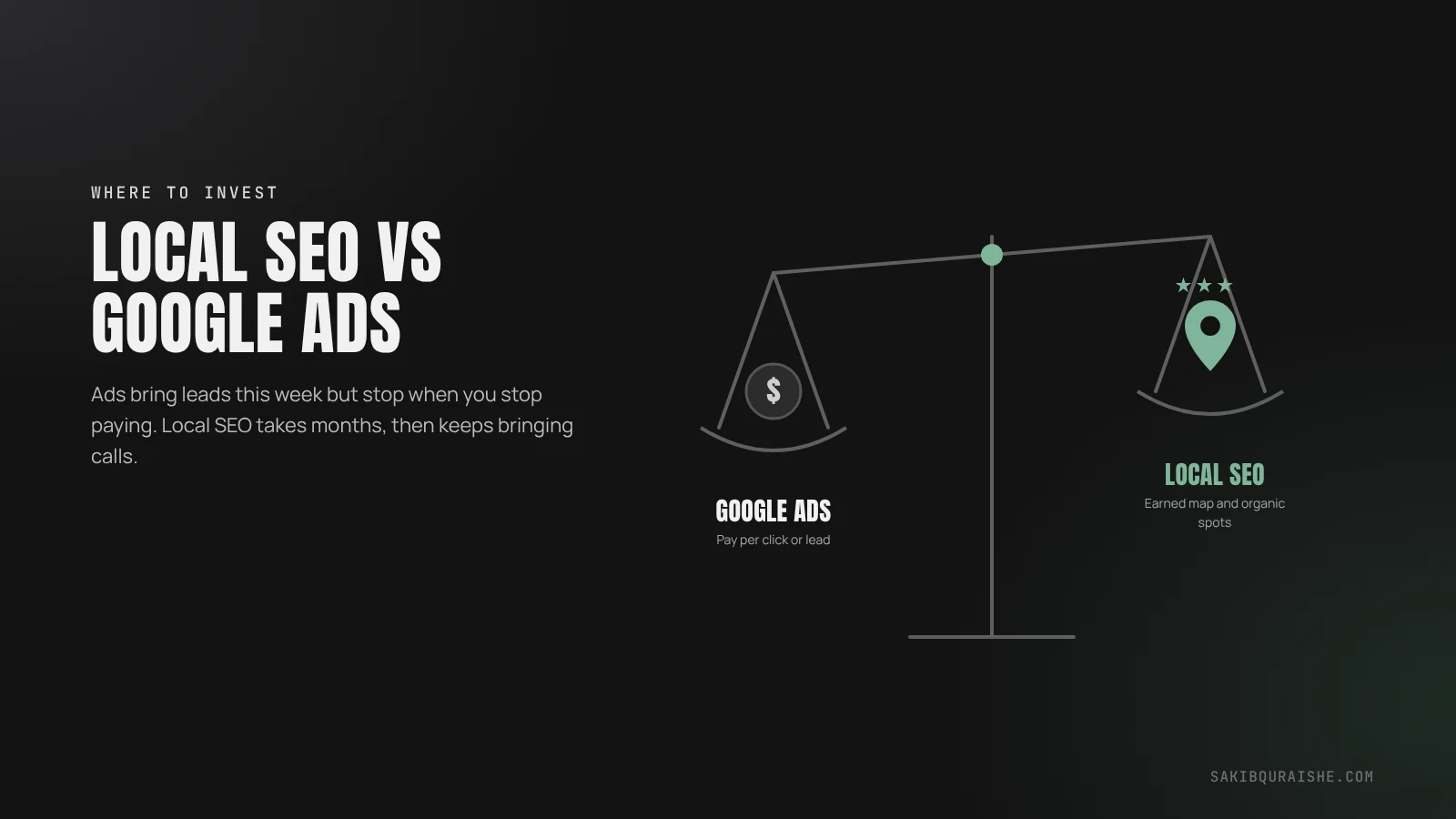
Local SEO isn't better or worse than Google Ads; they do different jobs. Ads bring leads the day you switch them on and stop when you stop paying. Local SEO takes months but keeps working. Many businesses use both. See local SEO vs Google Ads.
Ready to get found locally?
Local SEO is the most direct way to turn nearby searches into calls and customers. If you want to know where you stand,request a free local map audit, or see myLocal SEO service.
Sources
- Google: How Google determines local ranking
- Google: Tips to improve your local ranking / complete profile
- Whitespark 2026 Local Search Ranking Factors
- BrightLocal Local Consumer Review Survey 2026
- BrightLocal Local Business Discovery & Trust Report 2023
- Whitespark: The prevalence of AI Overviews in local search (May 2025)
- Your case studies