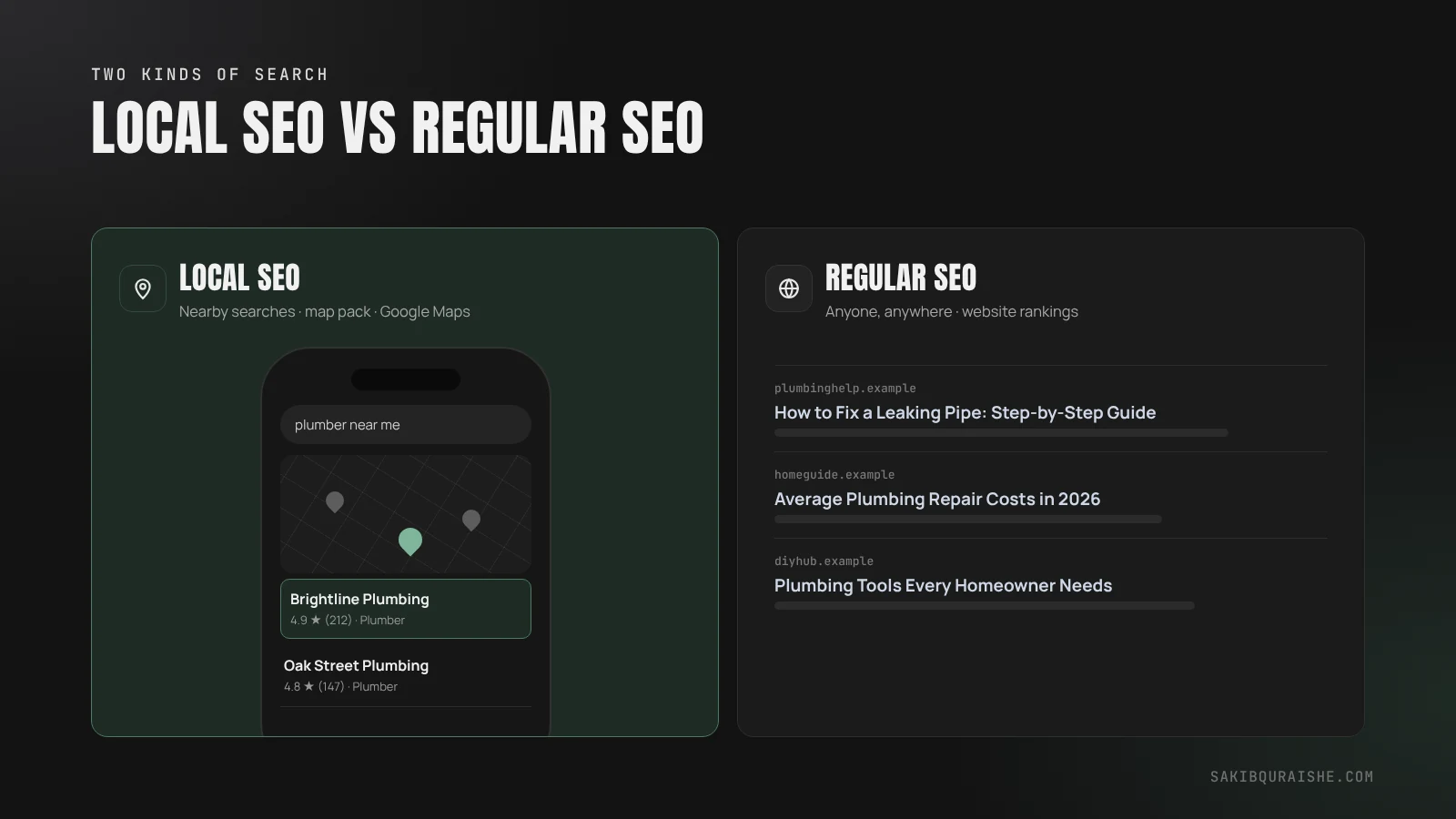
The difference between local SEO and regular SEO is who you're trying to reach and where you show up. Regular SEO helps your website rank for people searching anywhere. Local SEO helps your business rank for people searching nearby, in the map pack, on Google Maps and in local organic results. Local SEO uses everything regular SEO does, then adds your Google Business Profile, reviews and consistent business listings.
- Regular SEO ranks your website in the normal search results, for anyone, anywhere.
- Local SEO ranks your business for nearby searches: the map pack, Google Maps and local organic results.
- The map pack is driven by your Google Business Profile, distance and reviews. Organic results are driven by your website and links.
- Local SEO is built on regular SEO, not separate from it. A strong website helps both.
- For clear "near me" searches, the map pack still dominates and AI Overviews rarely appear.
- Most local businesses need both. Online-only businesses usually need only regular SEO.
What's the difference between local SEO and regular SEO?
The main difference between local SEO and regular SEO is location. Regular SEO tries to rank a website for a topic, whoever is searching and wherever they are. Local SEO tries to rank a business for people in a specific area, often people ready to call or visit.
| Local SEO | Regular SEO | |
|---|---|---|
| Who you want to reach | People near you, or in the area you serve | Anyone searching your topic |
| Where you show up | Map pack, Google Maps, local organic results | Organic results |
| Main asset | Google Business Profile plus website | Website |
| Does location matter? | Yes, a lot | Usually not |
| Reviews | A major factor | A minor factor |
| Business listings (citations) | Important | Not relevant |
| Typical goal | Calls, visits, direction requests, bookings | Traffic, sign-ups, online sales |
| Example search | "emergency plumber near me" | "how to fix a leaking pipe" |
The two aren't rivals. Local SEO is regular SEO plus extra work for your location.
What is regular SEO?
Regular SEO (also called traditional, organic or national SEO) is the work of getting your website to rank in Google's normal results. It covers three main areas:
- Content: pages that answer what people are searching for.
- Technical SEO: making sure Google can crawl, understand and load your site quickly.
- Authority: links and mentions from other trusted websites.
Regular SEO suits businesses that sell online or serve customers anywhere: online shops, software companies, publishers and national brands.
What is local SEO?
Local SEO is the work of making your business visible to nearby customers on Google Search, Google Maps and AI tools. On top of regular SEO, it adds:
- Google Business Profile: your free listing, with categories, services, hours, photos and reviews.
- Reviews: Google'slocal ranking help page says "more reviews and positive ratings can help your business's local ranking."
- Consistent business details (NAP): the same name, address and phone across directories.
- Local pages and signals: service and location pages, LocalBusiness schema and local links.
Local SEO suits any business that serves a specific area: storefronts, clinics, restaurants, and service-area businesses like plumbers and roofers. More in what local SEO is and how it works.
Where do local SEO and regular SEO show up in Google?
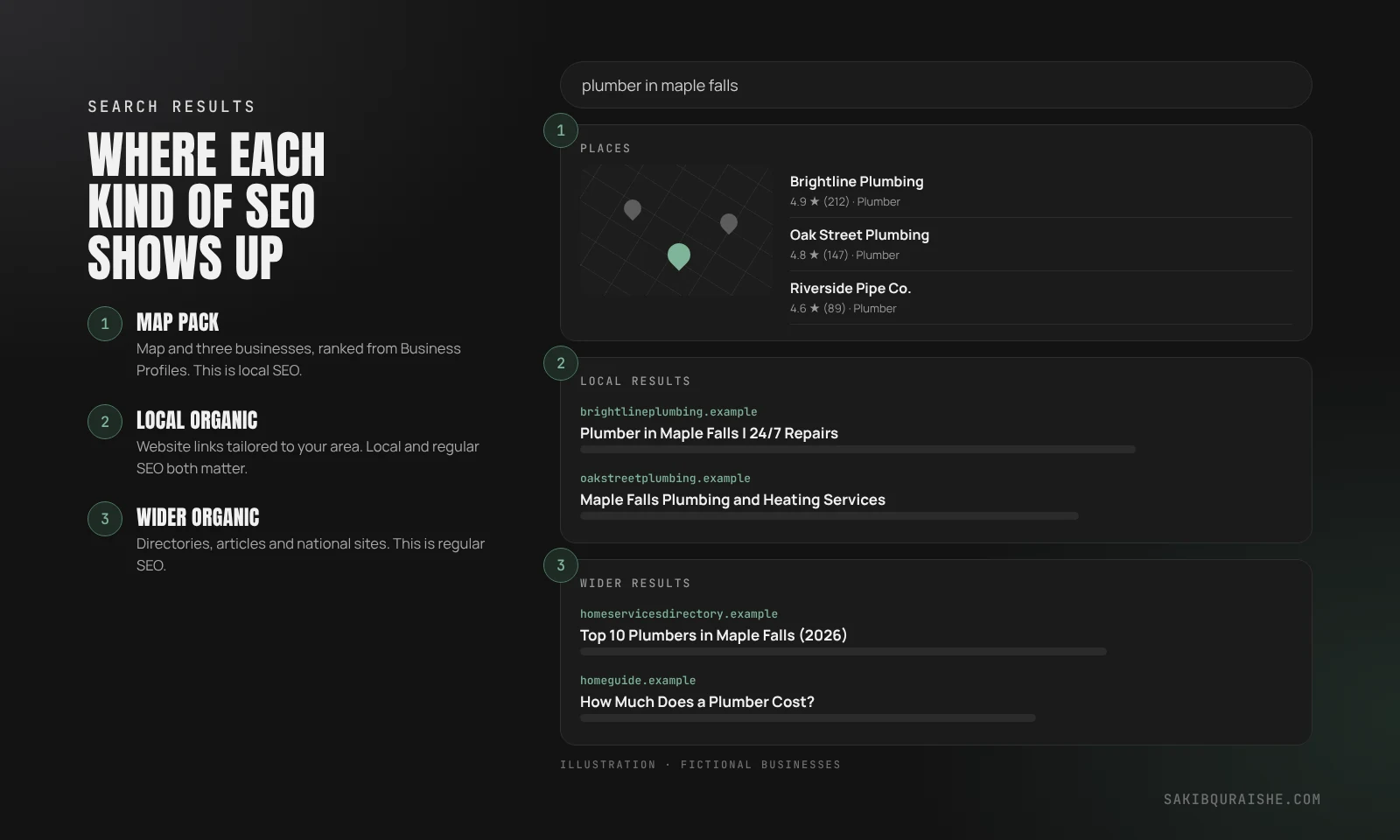
Local SEO and regular SEO often show up on the same page, for the same search. Search "dentist in Tempe" and you'll usually see:
- The map pack: a map and three businesses, ranked from their Business Profiles. This is local SEO.
- Local organic results: normal website links, but tailored to your area. Local SEO and regular SEO both matter here.
- Wider organic results: directories, articles and national sites. This is regular SEO.
Google localizes organic results too. ItsHow Search Works page says it uses "your location, past Search history and Search settings" to decide what's relevant, and gives the example that "when you search for 'pizza', you get results about nearby businesses that deliver." So a local business's website pages can rank for nearby searches even without "near me" in the query.
More in local pack vs organic results.
How are the ranking factors different?
The ranking factors are different because the map pack ranks businesses, while organic results rank web pages.
For the map pack, Google says local results are based mainly on three things:
- Relevance: how well your business matches the search.
- Distance: how far you are from the searcher.
- Prominence: how well-known your business is, based on things like links and reviews.
InWhitespark's 2026 Local Search Ranking Factors survey of local SEO experts, the top map pack factors were your primary Business Profile category, distance from the searcher, keywords in the business name, having an address in the city searched, and being open at the time of the search. That's expert opinion, not Google confirmation.
For organic results, Google'sranking overview lists the meaning of the search, the relevance and quality of the content, how usable the page is, and the searcher's context. Links from other sites, content quality and technical health matter most here.
The biggest practical difference: you can't change your distance, so local SEO focuses on relevance and prominence. Regular SEO has no distance factor at all. See why you rank at your office but not 2 miles away.
How is the work different?
The work is different because local SEO spends a lot of time off your website, while regular SEO spends most of its time on it.
| Task | Local SEO | Regular SEO |
|---|---|---|
| Keyword research | Service + city ("roof repair Scottsdale"), "near me" searches | Topics and questions, national volume |
| Content | Service and location pages, local proof | Guides, articles, product and category pages |
| Business Profile | Categories, services, photos, posts, Q&A | Not used |
| Reviews | Ask every customer, reply to every review | Rarely a focus |
| Listings | Consistent NAP across directories | Not used |
| Links | Local news, chambers, sponsorships, local partners | Industry sites, publications, digital PR |
| Schema | LocalBusiness | Article, Product, Organization |
| Rank tracking | GeoGrid scans across your area | One national ranking per keyword |
For the profile side, see the Google Business Profile optimization guide or myGoogle Business Profile optimization service. For the website side (crawling, structure, schema), see myTechnical SEO service. For listings, see NAP consistency and LocalBusiness schema.
What do local SEO and regular SEO look like for the same business?
Local SEO and regular SEO target different searches, even for the same business. Take a made-up roofing company, Ridgeline Roofing in Mesa, Arizona:
| Local SEO for Ridgeline | Regular SEO for Ridgeline | |
|---|---|---|
| Searches it targets | "roofer near me", "roof repair Mesa", "emergency roof leak Gilbert" | "how long does a tile roof last", "signs you need a new roof", "roof replacement cost" |
| Where it shows up | Map pack and local organic results in Mesa and nearby cities | Organic results and AI answers, for people anywhere |
| What does the work | Business Profile, reviews, Mesa service pages, local links | Guides and FAQs on the website, links from home and building sites |
| What it brings | Calls and quote requests from nearby homeowners | Visitors who are still researching, some of whom later search "roofer near me" |
The local searches bring calls today. The research content builds trust, earns links and gets quoted by AI tools, which can also strengthen the local pages. That's the overlap in practice.
How do AI search tools treat local and regular searches?
AI search tools treat clear local searches differently from research questions. For "near me" style searches, Google still leans on the map pack. For broader questions, AI answers are much more common.
- Whitespark's 2025 study of 540 local searches found AI Overviews on 68% of local business queries, but on only 15% of clear local-intent searches like "dentist near me". For those, the map pack appeared 93% of the time.
- BrightLocal's 2026 consumer survey found 45% of consumers now use ChatGPT or other AI tools to find local recommendations, up from 6% a year earlier.
So local SEO still wins most "ready to buy nearby" searches, while regular SEO content (guides, FAQs, pricing pages) is what AI tools quote for research questions. Both feed AI answers: AI tools read your Business Profile, reviews, website and what other sites say about you. More in GEO explained, AEO vs GEO vs SEO and myAI Search Optimization service.
How do you measure local SEO vs regular SEO?
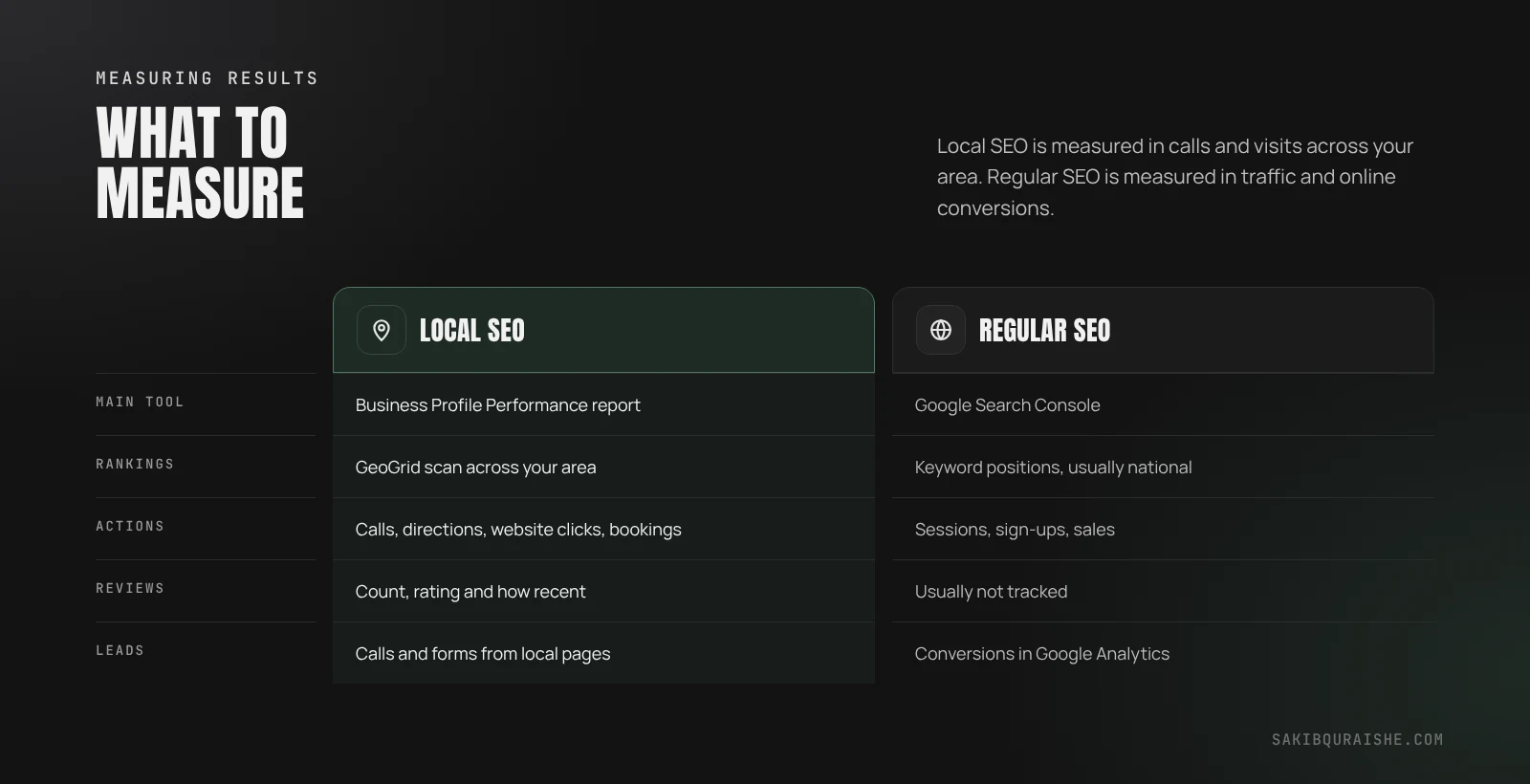
You measure local SEO by calls, visits and rankings across your area, and regular SEO by website traffic, rankings and online conversions.
| What to track | Local SEO | Regular SEO |
|---|---|---|
| Main tool | Business Profile Performance report | Google Search Console |
| Rankings | GeoGrid scan across your service area | Keyword positions, usually national |
| Actions | Calls, direction requests, website clicks, bookings | Sessions, sign-ups, sales |
| Reviews | Count, rating and how recent they are | Usually not tracked |
| Leads | Calls and form fills from local pages | Conversions in Google Analytics |
Checking your map ranking from one spot is misleading, because results change with every searcher's location. See what is a GeoGrid scan.
Which costs more and which is faster?
Local SEO usually costs less and shows results sooner than national SEO, because you're competing with fewer businesses in a smaller area.
- Cost: theAhrefs SEO pricing survey of 439 SEO providers found local SEO averages about $1,557 a month, against about $2,917 a month for SEO overall. See how much local SEO costs in 2026.
- Speed: local campaigns can move fast. From my own work, a cash home buyer in Oak Creek, Wisconsin went from an average map rank of 20.23 to 1.53 in four months (case study), and a roofer in Scottsdale, Arizona went from 0% to 49% top-of-map coverage in four months (case study).
Competitive cities, new businesses and national keywords take longer. More in how long it takes to rank in the Google Maps 3-Pack.
Where do local SEO and regular SEO overlap?
Local SEO and regular SEO overlap on your website. The same work helps both:
- Clear service pages help your website rank organically and tell Google what your Business Profile is about.
- A fast, crawlable site helps every page rank.
- Links from trusted sites build prominence for the map pack and authority for organic results. See local link building or myLocal Link Building service.
- Helpful content earns links, answers AI questions and supports your profile.
Your Business Profile also links to your website, so a weak website wastes the clicks your profile earns. That's why most local businesses need both.
Which one does your business need?
Your business needs local SEO if you serve customers in a specific area, and regular SEO if you sell to people anywhere. Many need both:
- Storefronts (restaurants, shops, clinics): local SEO first, with regular SEO on your website.
- Service-area businesses (plumbers, roofers, cleaners): local SEO first, with strong service pages. See service-area business vs storefront.
- Multi-location brands: local SEO for every location, plus regular SEO for the main brand site. See myNational & Enterprise SEO service.
- Online shops with a showroom: regular SEO for products, local SEO for the showroom.
- Online-only businesses: regular SEO. Local SEO usually won't help. See myE-commerce SEO service.
- Local businesses going national: keep local SEO running and add regular SEO for wider topics.
More in which businesses need local SEO.
FAQ
Is local SEO part of regular SEO?
Local SEO is a part of SEO focused on location. It uses the same website basics, then adds your Business Profile, reviews and listings.
Is local SEO better than regular SEO?
Local SEO isn't better than regular SEO; it's better for businesses that serve a local area. For online-only businesses, regular SEO is the better fit.
Can I rank in the map pack without a Google Business Profile?
You can't rank in the map pack without a Google Business Profile, because the map pack is built from profiles. Your website can still rank in organic results.
Can I do local SEO without a website?
You can do local SEO without a website, since a Business Profile can rank on its own. But a website makes ranking easier and gives you organic results too.
Does local SEO help my organic rankings?
Local SEO can help your organic rankings, because local links, service pages and schema also strengthen your website.
Which should I start with, local SEO or regular SEO?
Start with local SEO if you serve a local area, because your Business Profile and service pages bring calls fastest. Add regular SEO content once the basics are in place.
Is local SEO the same as national SEO?
Local SEO isn't the same as national SEO. National SEO targets a whole country with no location focus; local SEO targets one city or area.
Not sure which one you need?
I'll check how your business shows up in the map pack and organic results, and tell you where the quickest wins are.Request a free local map audit, or see myLocal SEO service.
Sources
- Google: how local ranking works
- Google: How Search Works, ranking results
- Google blog: how location helps provide more relevant results
- Whitespark 2026 Local Search Ranking Factors
- Whitespark AI Overviews study (2025)
- BrightLocal Local Consumer Review Survey 2026
- Ahrefs SEO pricing survey
- Your case studies