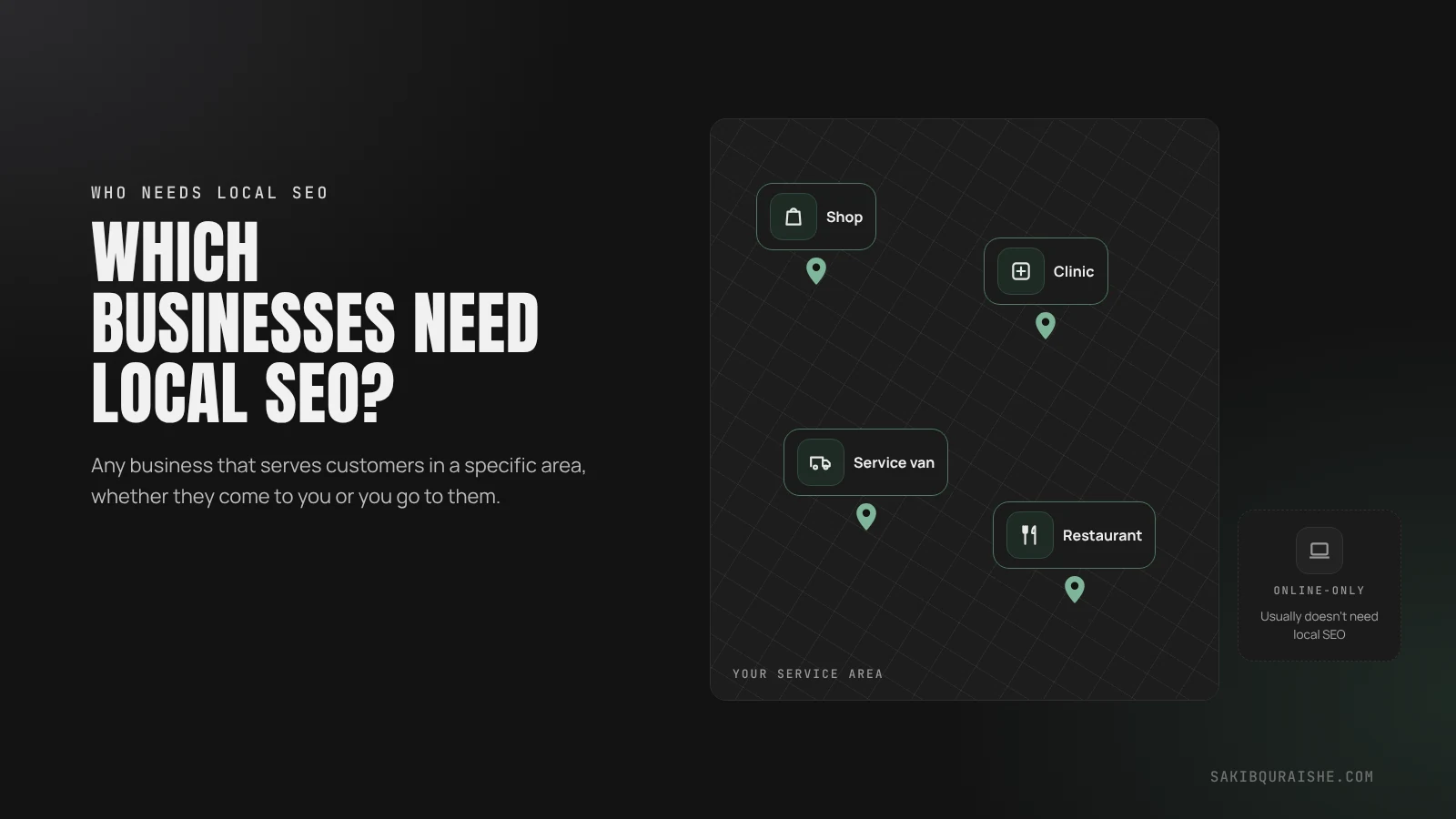
Local SEO is for any business that serves customers in a specific area, whether customers come to you or you go to them. Storefronts, clinics, restaurants, law firms and service-area businesses like plumbers and roofers all need it. Businesses that sell only online, or only to clients nationwide, usually don't.
- You need local SEO if people search for what you do plus a place, or "near me", and you serve them in person.
- That includes storefronts, service-area businesses (you travel to customers), professionals like dentists and lawyers, and multi-location brands.
- To appear in the map pack you need a Google Business Profile, and Google only allows one if customers can visit you or you travel to them.
- Online-only and national B2B businesses usually don't need local SEO.
- Hybrid businesses (an online shop with a showroom, say) need local SEO for the physical side.
- Take the five-question check below to see where your business fits.
Which businesses need local SEO?
The businesses that need local SEO are those whose customers search for them by location and buy from them in person. People search locally all the time: BrightLocal's 2026 Consumer Search Behavior Survey found 84% of consumers had searched for a local business in the previous three months, and 73% of local searches started on a phone.
In practice, local SEO matters most for four groups:
| Group | Examples | How customers find them |
|---|---|---|
| Storefronts | Restaurants, shops, salons, gyms, clinics | "near me" and "[service] in [city]" searches, Google Maps |
| Service-area businesses | Plumbers, roofers, electricians, cleaners, movers | "[service] near me", emergency searches, map pack |
| Professional services | Dentists, lawyers, accountants, real estate agents | "[profession] in [city]", reviews and reputation |
| Multi-location brands | Franchises, chains, clinic groups | Location-specific searches for each branch |
If you're new to the topic, start with what local SEO is and how it works.
How do you know if your business needs local SEO?
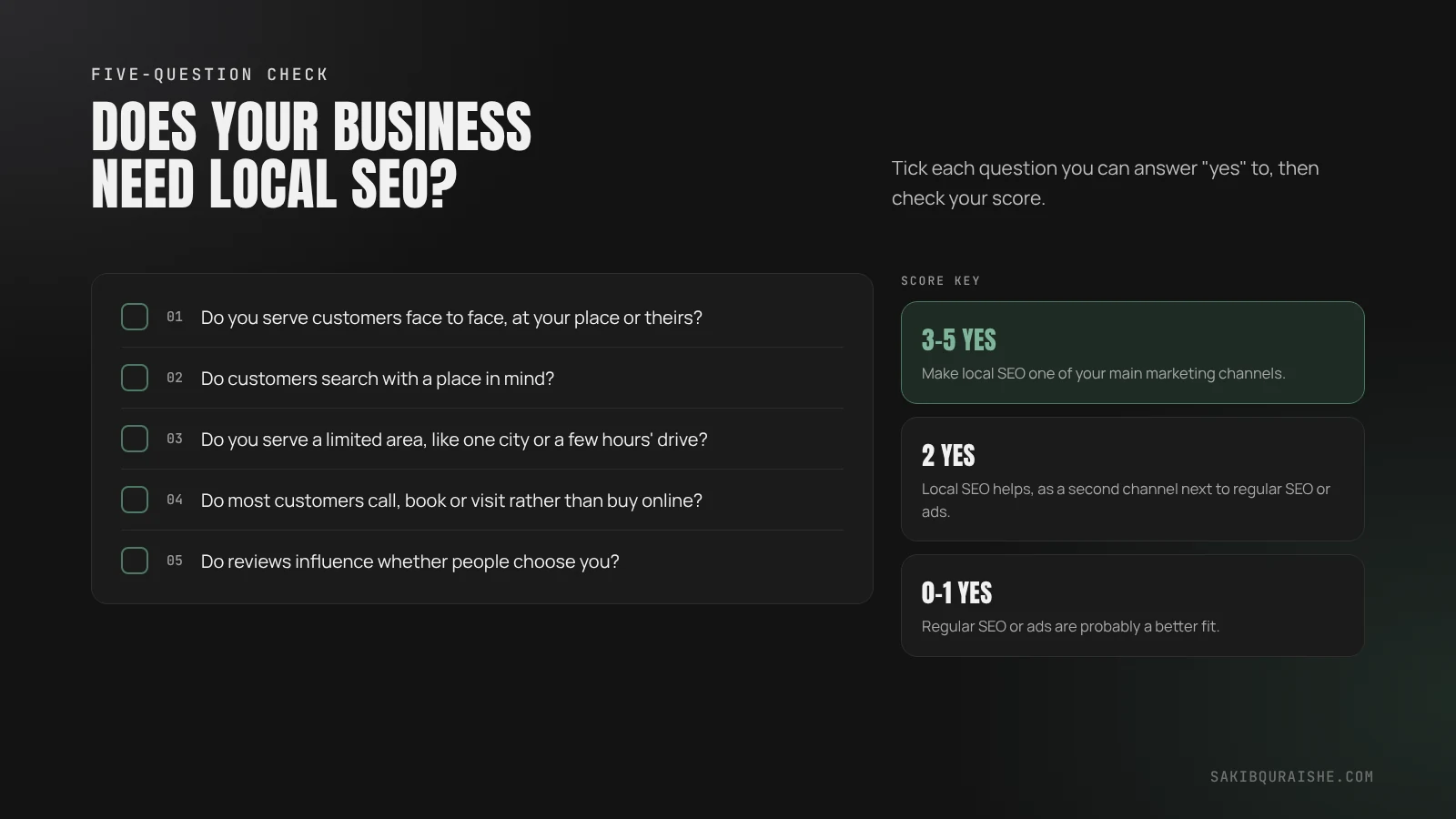
You know your business needs local SEO by answering five simple questions:
- Do you serve customers face to face, at your place or theirs?
- Do customers search with a place in mind? Try searching your main service in your city. If a map with three businesses appears, that search is local.
- Do you serve a limited area, like one city or a radius of a few hours' drive?
- Do most customers call, book or visit rather than buy online?
- Do reviews influence whether people choose you?
- Three or more "yes" answers: local SEO should be one of your main marketing channels.
- Two: local SEO helps, but as a second channel next to regular SEO or ads.
- One or none: regular SEO or ads are probably a better fit. See local SEO vs regular SEO.
How can you check if your customers search locally?
You can check if your customers search locally with a few free tests, before you spend anything:
- Search your main service the way a customer would, on your phone, from where your customers are. If a map pack appears, Google treats that search as local.
- Type your service into Google and look at the suggestions. Suggestions with city names or "near me" show local demand.
- Check Google Search Console, if you have a website. Look for search terms that include your city, nearby towns or "near me".
- Check your Business Profile's Performance report, if you have one. It shows the searches people used to find you and how many called or asked for directions.
- Ask new customers how they found you. If many say "Google Maps" or "I searched for a [service] near me", local SEO is already working for you, even by accident.
Results change with the searcher's location, so a search from your office only shows one spot. See what is a GeoGrid scan to check a whole area.
Can your business get a Google Business Profile?
Your business can get a Google Business Profile if it has a place customers can visit or it travels to customers. That matters, because the map pack is built from Business Profiles. Google'sBusiness Profile guidelines say an eligible business "either has a physical location that customers can visit, or travels to customers where they are."
The rules that catch people out:
- Virtual offices aren't eligible. Google says a virtual office "isn't eligible for a Business Profile" unless it's staffed during business hours.
- P.O. boxes don't count. "P.O. boxes or mailboxes located at remote locations aren't acceptable."
- Co-working spaces only qualify if the office has clear signage, receives customers during business hours and is staffed by your own team.
- Service-area businesses must hide their address, and their service area "shouldn't extend farther than about 2 hours of driving time" from their base.
- Age-restricted businesses (alcohol, cannabis, weapons) aren't allowed as service-area businesses without a storefront.
- Lead-generation agents for big companies aren't eligible as individual practitioners.
If you can't get a profile, you can still use local SEO on your website (local pages, schema, local links), but you won't appear in the map pack. Having trouble with verification? See GBP verification problems and how to fix them.
Which types of businesses benefit most from local SEO?
The businesses that benefit most are those where one new local customer is worth a lot, or where people pick from the first few results they see. What each type should focus on first:
| Business type | Why local SEO pays off | Focus on first |
|---|---|---|
| Home services (plumbers, roofers, HVAC, electricians) | Urgent, high-value jobs; people call the first businesses they see | Primary category, service pages, reviews, service area |
| Clinics and dentists | Patients choose on location, reviews and trust | Practitioner listings, privacy-safe review replies, service pages |
| Law firms and accountants | One client can be worth thousands | Category, practice-area pages, reviews, local links |
| Restaurants and cafes | Decisions made on the spot, often on a phone | Hours, photos, menu, reviews |
| Salons, spas and gyms | Repeat customers from nearby | Booking link, photos, reviews, posts |
| Real estate agents | Buyers and sellers search by area | Area pages, reviews, local content |
| Auto repair shops | Urgent, nearby, trust-heavy | Reviews, services list, hours |
| Retail stores | Shoppers check stock, hours and directions | Hours, products, photos, directions |
From my own work: a cash home buyer in Oak Creek, Wisconsin went from an average map rank of 20.23 to 1.53 in four months (case study), a roofer in Scottsdale, Arizona went from 0% to 49% top-of-map coverage in four months (case study), and a brand-new electrician in La Puente, California went from 2 to 28 calls a month in six months (case study).
More in local SEO by industry.
Do service-area businesses need local SEO?
Service-area businesses need local SEO as much as storefronts do, and often more, because emergency searches like "plumber near me" go straight to the map pack. You hide your address, set the areas you serve, and rank around your verified base.
The challenge is ranking beyond your base. Google's local results still weigh distance, so you rank most easily near your verified address. To reach further, you need strong service pages, reviews that mention the places you work, and links from local sites in those areas. See service-area business vs storefront and ranking in multiple cities without thin pages.
Home-based businesses work the same way. If customers don't come to your home, set up as a service-area business and hide the address.
Do clinics, lawyers and other professionals need local SEO?
Clinics, lawyers and other professionals need local SEO, because people choose them by location and reputation. Google also allows individual practitioners (doctors, dentists, lawyers) to have their own profiles if they deal with the public directly at the verified location.
A few rules from Google's guidelines:
- Support staff "should not create their own Business Profiles."
- One profile per practitioner, not one for each specialty.
- A solo practitioner in a branded practice shares one profile named "[brand]: [practitioner name]".
- Departments that work as separate entities can have their own profile with a different name.
Reviews matter a lot here, but replies must protect patient privacy. See how clinics should get and respond to Google reviews, and dental SEO.
Do multi-location businesses and franchises need local SEO?
Multi-location businesses and franchises need local SEO for every location, not just the brand. Each branch has its own Business Profile, reviews and rankings, and each needs its own location page with its own address and phone.
The common mistakes are one profile for the whole brand, shared phone numbers, and near-identical city pages. See multi-location SEO or myNational & Enterprise SEO service.
Do new businesses need local SEO?
New businesses need local SEO early, because it's one of the cheapest ways to get the first calls. Google Business Profile is free, and Google says a complete profile makes customers70% more likely to visit and 50% more likely to consider buying.
Expect it to take longer than for an established business, because you start with no reviews, no links and no history. Start with:
- Claiming and verifying your profile, with the right primary category.
- A simple website with one page per main service.
- A review request for every early customer.
- Consistent name, address and phone on the main directories.
The electrician example above was a brand-new business. Start with my Google Business Profile checklist, or have the setup done by myGoogle Business Profile optimization service.
Which businesses don't need local SEO?
The businesses that don't need local SEO are those with no local customers to reach:
- Online-only shops that ship anywhere and have no showroom. Regular SEO and product-page SEO fit better. See myE-commerce SEO service.
- Software and online services sold nationally or globally.
- National B2B companies whose buyers don't search by location.
- Publishers and affiliate sites.
- Businesses without an eligible location, like a virtual-office-only company. Local pages on your website can still help, but you won't get a map pack listing.
Even these businesses can benefit from a little local SEO if they have a real office that clients visit, or want to hire locally. In that case, a basic, accurate Business Profile is enough.
What about hybrid businesses?
Hybrid businesses need local SEO for the physical part of the business and regular SEO for the rest:
| Hybrid business | Local SEO for | Regular SEO for |
|---|---|---|
| Online shop with a showroom | The showroom: hours, directions, reviews | Product and category pages |
| Restaurant with nationwide delivery or shipping | The restaurant | The online shop |
| Consultant who works remotely and in person | Local clients and meetings | National content and services |
| Clinic with telehealth | The clinic and its practitioners | Telehealth pages and content |
Keep the two clear on your website: a location page for the physical side, and normal service or product pages for the rest. See local SEO vs regular SEO.
Does local SEO still matter with AI search?
Local SEO still matters with AI search, and it now covers more than Google.BrightLocal's 2026 consumer survey found 45% of consumers use ChatGPT or other AI tools to find local recommendations, up from 6% a year earlier. Its2026 search behavior research found 52% of consumers start a local search on Google, and 75% use more than one channel.
But for clear "near me" searches, the map pack still leads.Whitespark's 2025 study found the map pack on 93% of local-intent searches, and AI Overviews on only 15%.
AI tools build their answers from the same signals local SEO works on: your Business Profile, reviews, website and what other sites say about you. More in GEO explained and myAI Search Optimization service.
FAQ
Do I need local SEO if I don't have a storefront?
You need local SEO if you travel to customers, even without a storefront. Set up as a service-area business and hide your address.
Does a home-based business need local SEO?
A home-based business needs local SEO if it serves local customers. If customers don't visit your home, list it as a service-area business with the address hidden.
Does an online store need local SEO?
An online store doesn't need local SEO unless it has a showroom, pickup point or local customers it serves in person.
Can I get a Google Business Profile with a virtual office?
You can't get a Google Business Profile with a virtual office unless it's staffed during business hours. Google's guidelines say virtual offices aren't eligible.
Do B2B companies need local SEO?
B2B companies need local SEO only if their clients are nearby and search by location, like a commercial cleaner or an IT support firm serving one city. National B2B companies usually don't.
Is local SEO worth it for a small business?
Local SEO is usually worth it for small businesses that serve a local area, because the Business Profile is free and nearby searchers are ready to buy. See is local SEO worth it and how much local SEO costs.
How long does local SEO take?
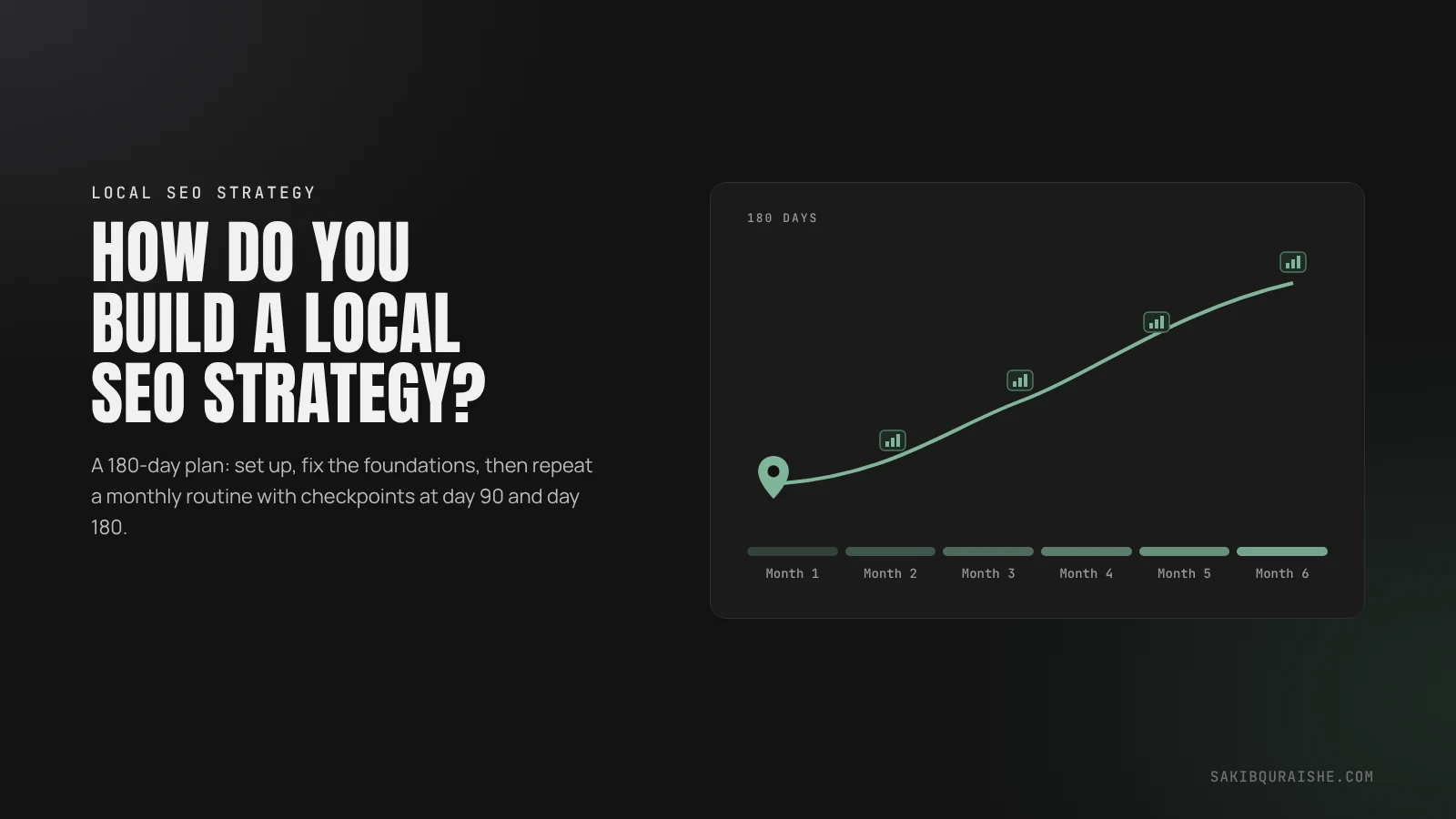
Most local businesses see clear map movement within 8 to 12 weeks. Crowded cities and brand-new profiles can take three to six months.
Not sure if local SEO is right for you?
I'll look at how your business shows up in the map pack today and tell you honestly whether local SEO is worth it for you.Request a free local map audit, or see myLocal SEO service.
Sources
- Google Business Profile guidelines
- Google: complete profile benefits
- BrightLocal local SEO statistics
- BrightLocal Local Consumer Review Survey 2026
- Whitespark AI Overviews study (2025)
- Your case studies and Local SEO service page (8–12 weeks for clear map movement; 3–6 months in crowded markets).