This guide is general information, not legal advice. Check your own privacy and advertising rules with your compliance lead or professional body.
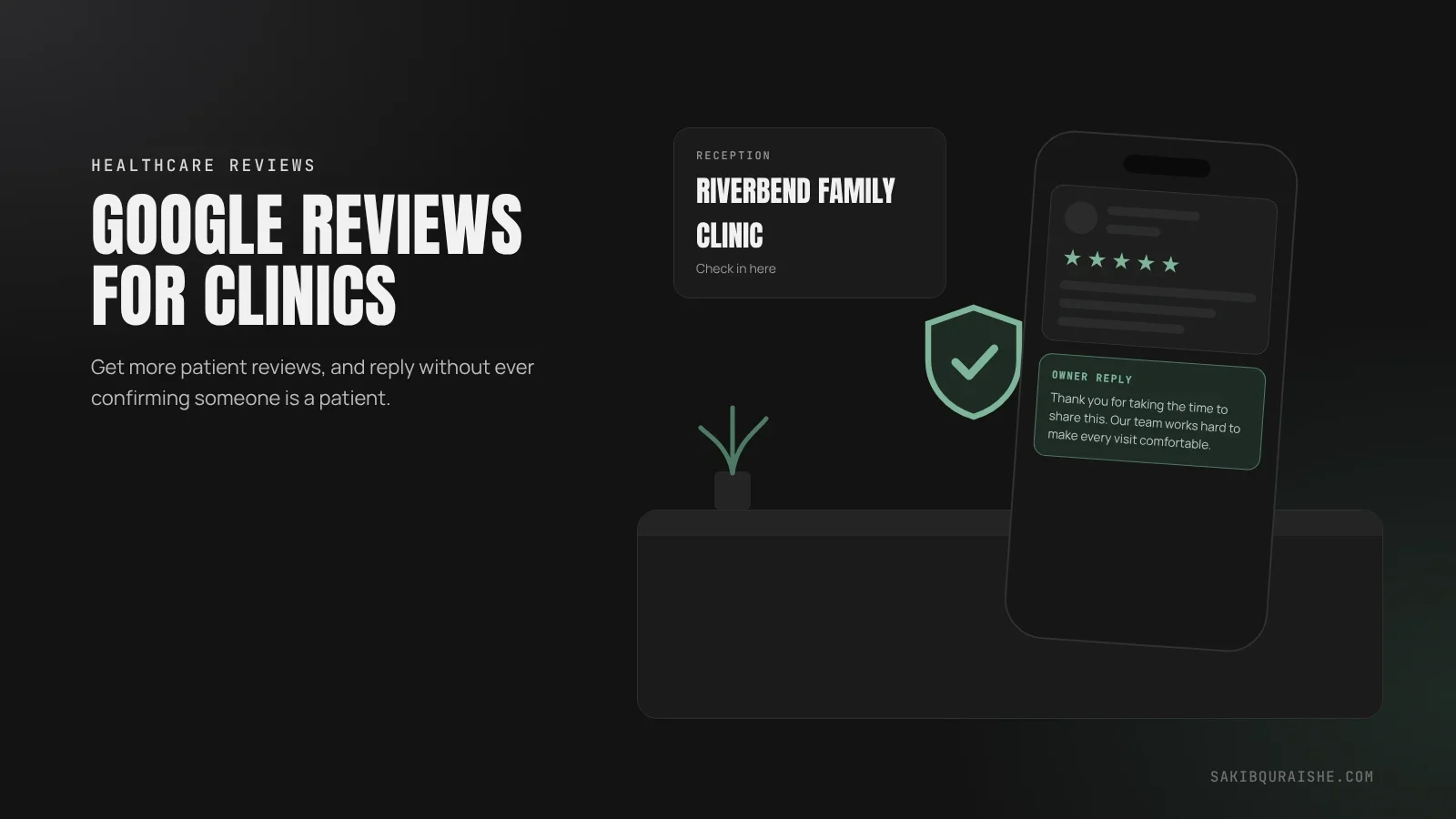
Clinics should ask every patient for a Google review in the same way, soon after their visit, usually by email or text, and send those reviews to the profile patients actually search for. When replying, never confirm that the reviewer is a patient or mention anything about their care. Keep replies general, polite and short, and take complaints offline.
- 84% of patients check online reviews before choosing a new provider, but 57% rarely or never leave one. Most will if you ask.
- Ask everyone, the same way, within a day of the visit. Email works best for most patients.
- Decide whether reviews go to the clinic profile, the doctor's profile, or both.
- Never confirm someone was a patient in a reply. Clinics have been fined for it.
- Rules differ by country. In Australia, for example, you can't use clinical reviews in your advertising.
Clinics are some of the most rewarding businesses to do local SEO for, and some of the trickiest when it comes to reviews. Below is the approach I'd recommend, built on Google's own rules, patient survey data and published privacy enforcement cases, for to any clinic, dental practice or medical office.
Why do Google reviews matter so much for clinics?
Google reviews matter so much for clinics because patients rely on them to choose a provider, often more than on personal recommendations. A rater8 survey of more than 1,000 US patients, reported by Medical Economics in 2025, found:
- 84% check online reviews before choosing a new provider.
- 61% put online reviews ahead of recommendations from friends and family.
- 40% have cancelled or avoided an appointment because of negative reviews.
Reviews also affect where you appear on Google Maps. In Whitespark's 2026 Local Search Ranking Factors survey, a high star rating ranked #6, the number of reviews with text #9, and how recent they are #11 out of 187 local pack factors.
Clinics are among the businesses that gain most from local SEO. See which businesses need local SEO.
Can clinics ask patients for Google reviews?
Clinics can ask patients for Google reviews. Google allows businesses to ask customers for honest reviews and only prohibits offering anything in return, or asking only patients you expect to be happy (review gating). What clinics must be careful about is what they say when they reply, and how they use reviews in their own marketing. Check your professional body's rules, since some countries add restrictions.
How should a clinic ask patients for reviews?
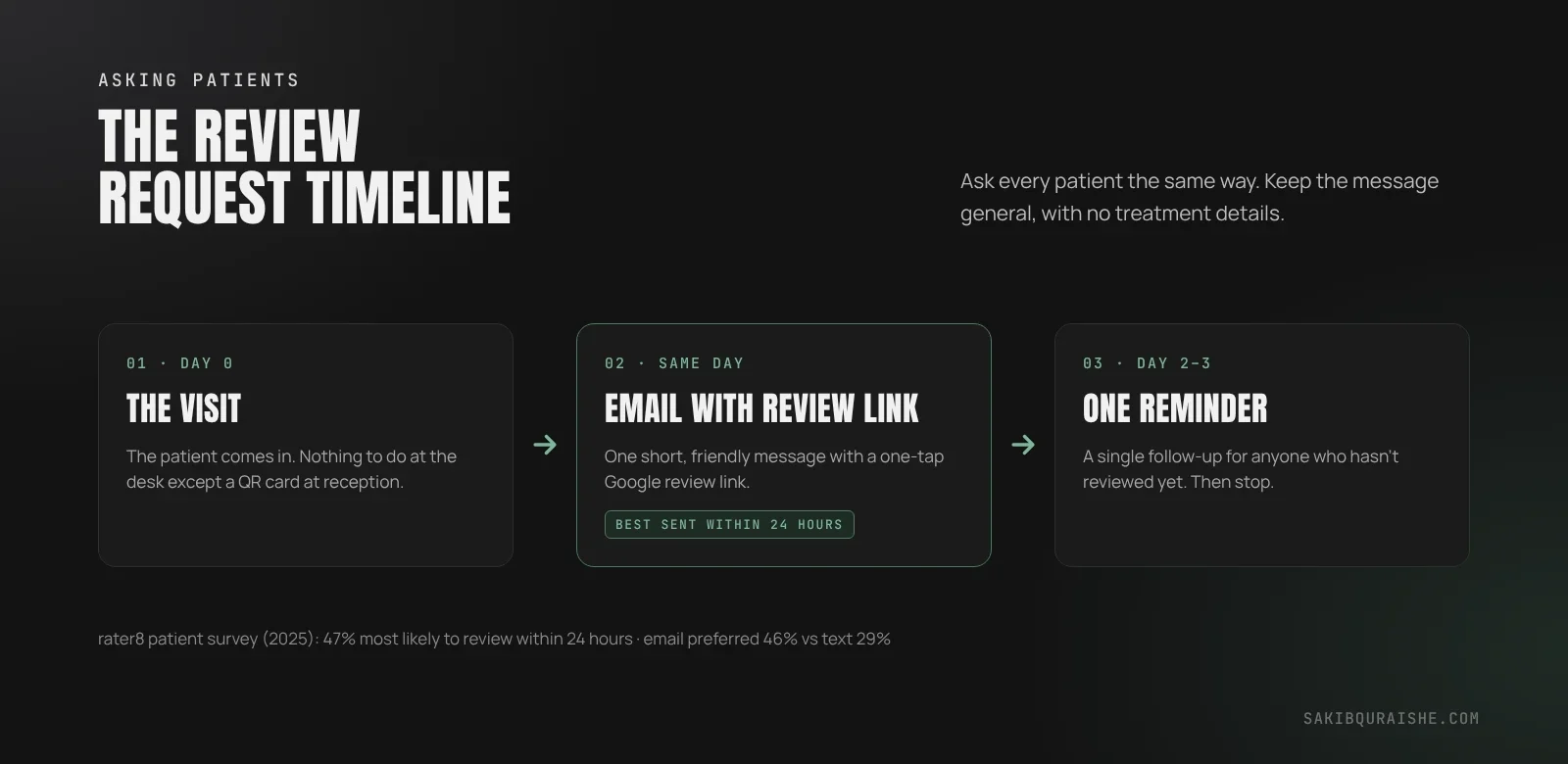
A clinic should ask patients for reviews soon after the visit, through a channel they already use, with a one-tap link. The rater8 survey reported by Medical Economics found 74% of patients would be more likely to leave a review if their provider asked, 47% are most likely to do it within 24 hours of the appointment, and email (46%) is preferred over text (29%).
A simple process:
- Send one request after every visit, the same day or next day, by email (or text where patients have agreed to receive texts).
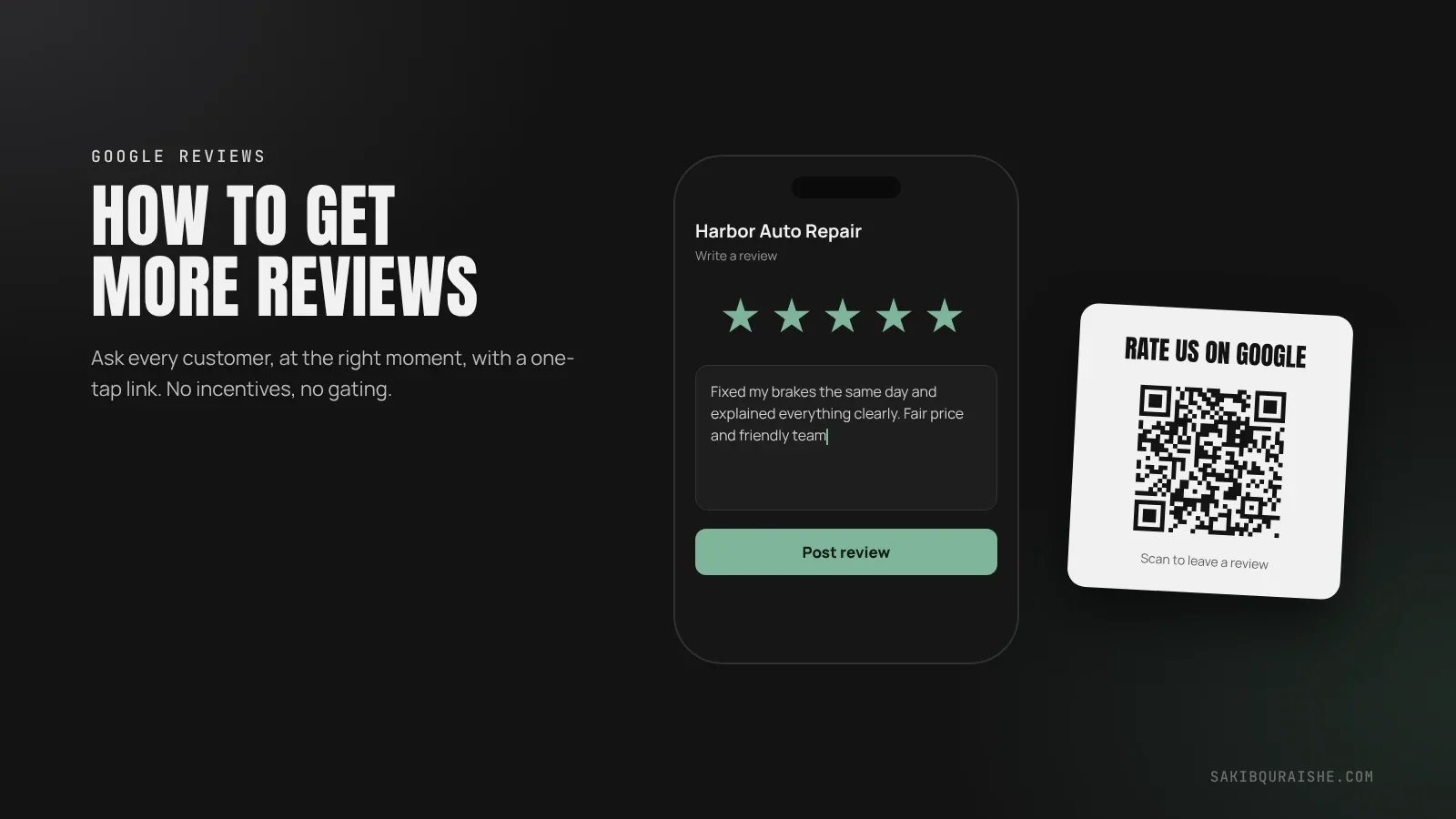
- Use your direct Google review link, so it's one tap.
- Ask every patient the same way. Don't filter to only happy patients.
- Keep the message general. Don't mention the treatment or condition in the request.
- Send one reminder, then stop.
Email or text template:
Hi [first name], thank you for visiting [clinic name]. If you have a moment, we'd be grateful for an honest review on Google: [link]. It helps other people in [city] find the right care. Thank you, the team at [clinic name].
A QR code at reception or on the aftercare sheet also helps. Avoid asking patients to post the review on a clinic tablet or in the clinic itself, since reviews posted in bulk from one place can look suspicious, and some patients won't want to post where staff can see.
More channels and scripts are in how to get more Google reviews.
Should reviews go to the clinic's profile or the doctor's profile?
Reviews should go to whichever profile patients actually search for, and that depends on how your practice is set up. Google allows individual doctors and other public-facing practitioners to have their own Business Profiles, separate from the clinic's. As Sterling Sky explains in its practitioner listings guide, each profile then needs its own reviews.
| Your setup | Where to send reviews |
|---|---|
| Solo practitioner | One combined profile (practice name and practitioner) |
| Group clinic, patients choose the clinic | The clinic profile |
| Group clinic, patients choose a named specialist | The specialist's profile, plus the clinic profile for general visits |
| Several locations | Each location's own profile |
Whatever you choose, keep primary ownership of every profile with the clinic, so a departing doctor doesn't take a profile and its reviews with them. More in the multi-location section of my National & Enterprise SEO service.
How many Google reviews does a clinic need?
A clinic needs at least 20 Google reviews to pass the bar many patients set: BrightLocal's 2026 consumer survey found 47% of people won't use a business with fewer. To compete in the map pack, look at the three clinics that rank for your main search ("dentist near me", "eye clinic [city]") and aim to match their review count over time, with a steadier flow of new ones each month.
How do you respond to patient reviews without breaking privacy rules?
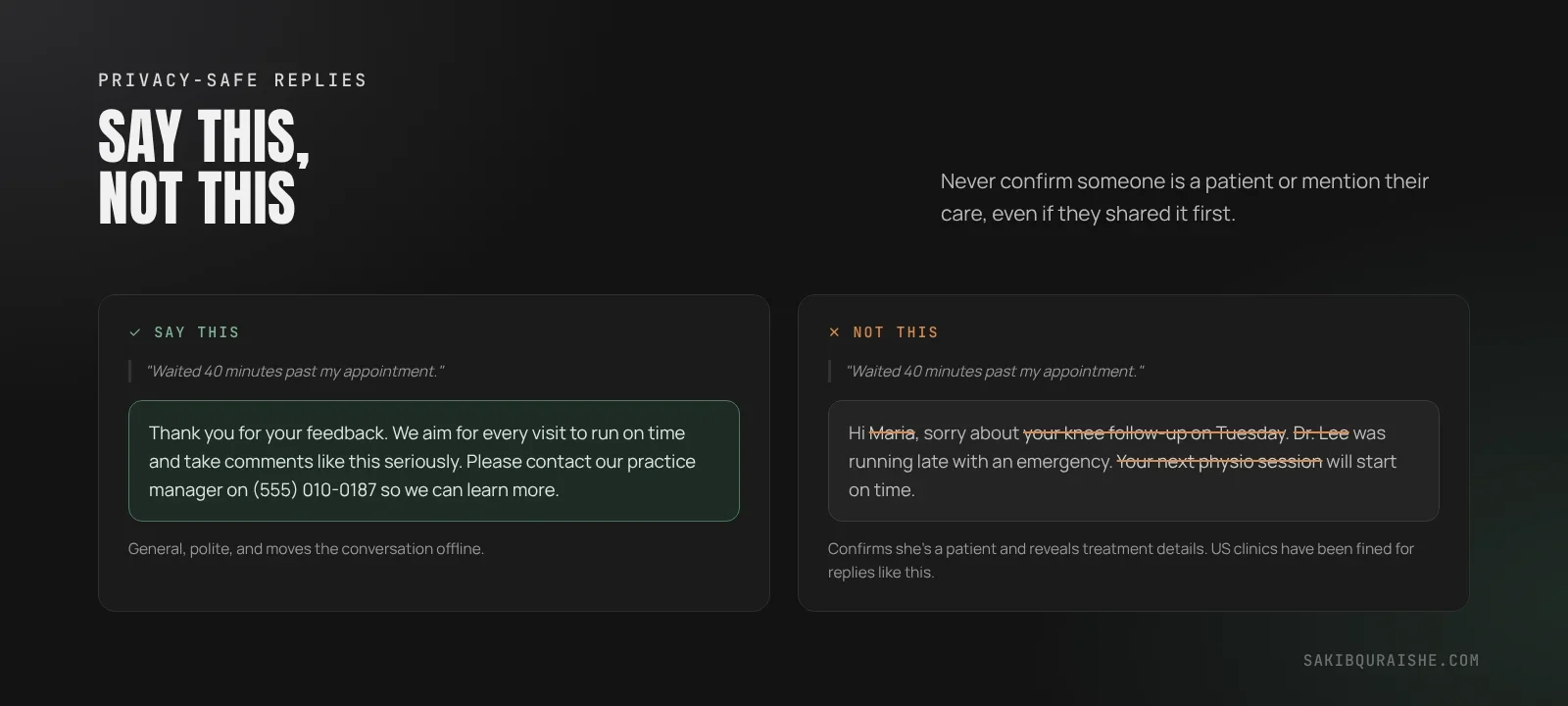
You respond to patient reviews without breaking privacy rules by never confirming the reviewer is a patient and never mentioning anything about their care, even if they've shared it themselves. In the US, the HHS Office for Civil Rights has fined providers for exactly this:
| Practice | Year | Penalty | What they revealed in replies |
|---|---|---|---|
| New Vision Dental, California | 2022 | $23,000 | Patients' full names, treatment and insurance details |
| Manasa Health Center, New Jersey | 2023 | $30,000 | A patient's mental health diagnosis and treatment |
The rules for every reply:
- Don't use the reviewer's name if it would confirm they're a patient.
- Don't mention appointments, dates, treatments, results, insurance or bills.
- Don't say "when you visited" or "your treatment".
- Speak about your clinic's general standards instead.
- Invite them to contact the clinic directly.
What do privacy-safe review replies look like?
Privacy-safe review replies sound warm and professional but stay general. Some templates:
Positive review:
Thank you for taking the time to share this. Our team works hard to make every visit as comfortable as possible, and feedback like this means a lot to us.
Negative review about waiting or service:
Thank you for your feedback. We aim for every visit to run on time and feel welcoming, and we take comments like this seriously. Please contact our practice manager, [name], on [number] so we can learn more.
Negative review that mentions clinical care:
Thank you for sharing your concerns. Privacy rules mean we can't discuss individual care online, but we'd genuinely like to talk. Please call [name] on [number].
Suspected fake review:
We take all feedback seriously. Because of privacy rules we can't discuss any individual online, but we'd welcome a conversation. Please contact [name] on [number].
For every review type, see how to respond to Google reviews.
Should clinics reply to every review?
Clinics don't need to reply to every review. Replying to positive reviews is low-risk with privacy-safe wording, but negative reviews need a judgement call, especially ones about clinical care. Australia's RACGP, for example, advises clinics to avoid replying to reviews that discuss clinical issues, and says most negative comments aren't worth a reply, since a response rarely changes a venting reviewer's mind. The exception is a review that raises a fair service or admin point, where a short, general reply helps. If a review is fake, offensive or breaks Google's policies, report it rather than debating it. See how to handle negative and fake Google reviews.
What are the review rules outside the US?
The review rules outside the US vary, but the privacy principle is the same everywhere: never reveal a patient's details in public. Some countries also limit how you can use reviews:
- Australia: Ahpra's testimonial guidance bans using clinical testimonials (comments about symptoms, treatment or outcomes) to advertise a regulated health service. You're not responsible for reviews on sites you don't control, but reposting clinical reviews on your website or social media counts as using a testimonial, and Ahpra warns that engaging with reviews on third-party sites can be treated the same way. Keep replies short and non-clinical.
- Everywhere else: check your medical council, dental board or professional body, and your medical defence organisation, before featuring reviews in marketing.
Can you use patient reviews on your clinic website?
You can use patient reviews on your clinic website only where your local rules allow it, and safest with the patient's written permission. In the US, get written authorization before featuring a patient's review as a testimonial. In Australia, only non-clinical reviews (about service or friendliness, for example) can be used, published in full and unedited. A widget that shows your full Google review feed, unfiltered, is usually lower-risk than hand-picking quotes, but check with your compliance lead first.
How should sensitive specialties handle reviews?
Sensitive specialties such as mental health, addiction, sexual health and fertility should be gentler with review requests. Many patients won't want their name linked to the clinic publicly, so:
- Make the request optional and low-key, never repeated.
- Mention that patients can use initials or a nickname on their Google account if they prefer.
- Expect fewer reviews than other specialties, and focus on profile completeness, accurate categories and a strong website.
- Be extra careful with replies. The Manasa Health Center fine involved a mental health practice.
How do reviews affect a clinic's Google Maps rankings?
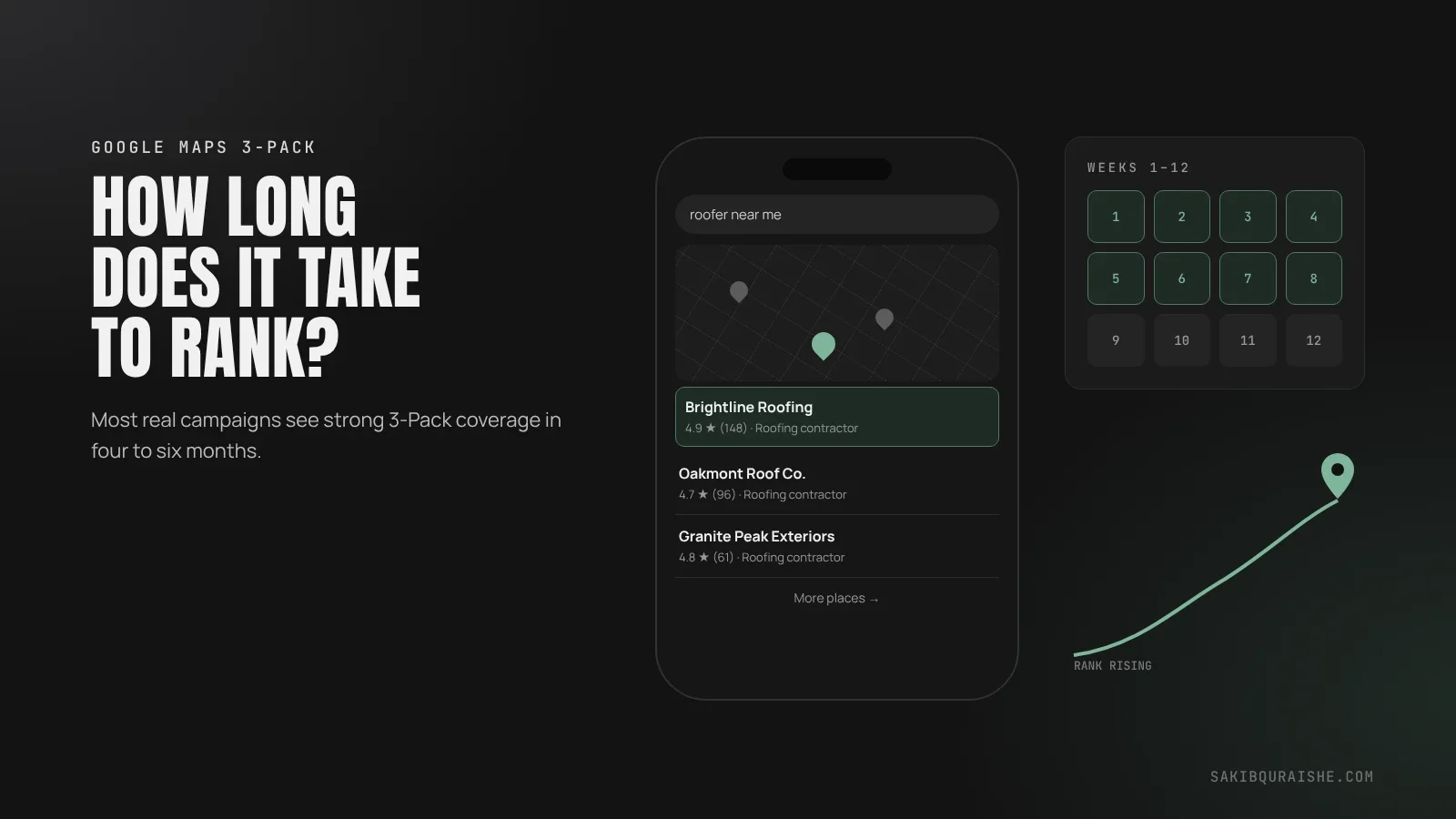
Reviews affect a clinic's Google Maps rankings through their number, rating, recency and steady flow, which together make up four of the top 15 local pack factors in Whitespark's 2026 survey. Reviews work best alongside the right primary category, complete services and a strong website. For one eye clinic I worked with in Ikeja, Lagos, the average Google Maps grid rank moved from 9.26 to 1.15. See my case studies.
More in eye clinic and LASIK SEO, dental SEO and medical practice SEO.
Reviews work alongside the other parts of local SEO. See what is local SEO and how it works.
FAQ
Is it legal for a clinic to ask patients for Google reviews?
It's generally legal for a clinic to ask patients for Google reviews, as long as you ask everyone the same way, offer nothing in return, and don't reveal any health details in the request.
Can I thank a patient by name in a review reply?
You shouldn't thank a patient by name in a review reply if it confirms they were treated at your clinic. Keep replies general, even when the reviewer uses their real name.
What if a patient posts false details about their treatment?
If a patient posts false details about their treatment, don't correct them publicly. Reply with a general, privacy-safe message, invite them to call, and report the review to Google if it breaks its policies.
Should each doctor have their own Google Business Profile?
Each doctor can have their own Google Business Profile if patients search for them by name. Solo practitioners are usually better with one combined profile.
Can I offer a discount for a patient review?
You can't offer a discount, gift or any other incentive for a patient review. Google treats incentivized reviews as fake content.
Want help growing your clinic's reviews?
Clinics are a core part of my work, from LASIK and eye clinics to dental and medical practices. Request a free local map audit, or see my Local SEO service. For the full profile picture, read my Google Business Profile checklist.
Review requests and privacy-safe replies are part of my Google Business Profile optimization service.
Sources
- Medical Economics: rater8 patient survey, Feb 2025: 84%, 57%, 61%, 40%, 74%, 47%, email 46% vs text 29%, 45%, 41%
- HHS OCR: Manasa Health Center settlement, June 2023: $30,000
- HIPAA Journal: New Vision Dental, Dec 2022: $23,000
- RACGP: Responding to online reviews
- Ahpra: Testimonials guidance
- Sterling Sky: Practitioner listings
- Google: Tips to get more reviews (incentives and gating)
- BrightLocal Local Consumer Review Survey 2026: 47% won't use a business with under 20 reviews
- Whitespark 2026 Local Search Ranking Factors: review factors #6, #9, #11, #14
- Eye clinic case data (Ikeja, Lagos): 9.26 → 1.15 average grid rank, from your own records